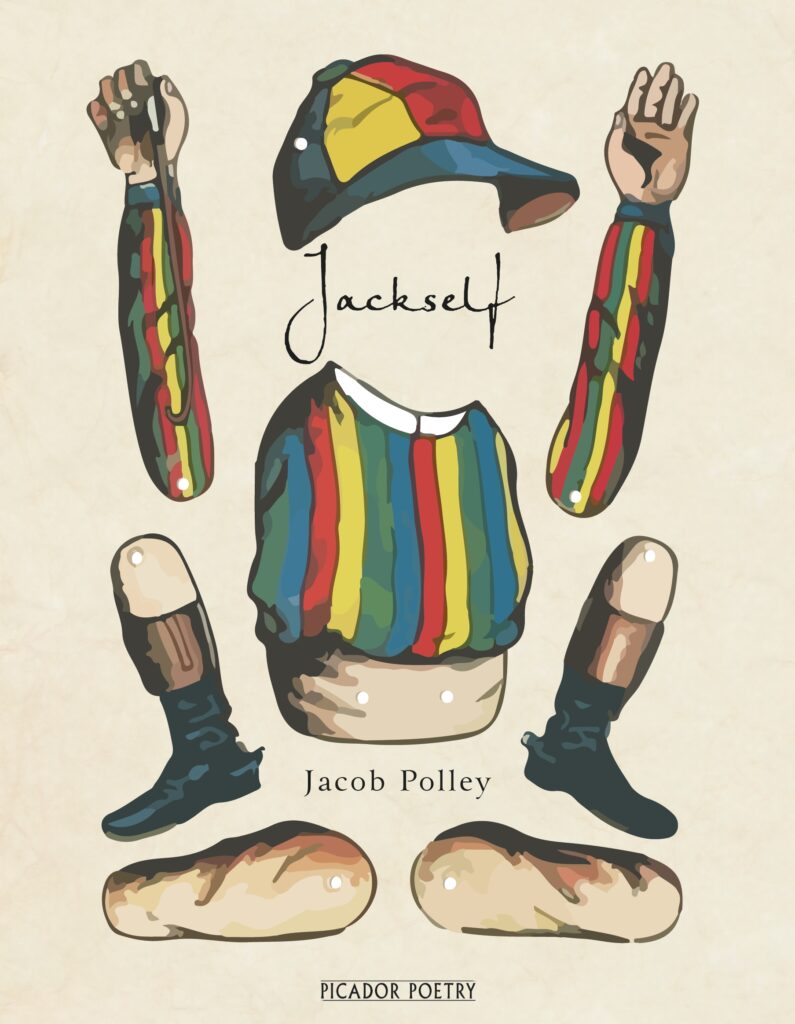
In Jacob Polley's Jackself, 'the persistence of character presents a narrative of sorts: a childhood, an education, friendship and loss. However, the quasi-mythic character of Jackself presents this as a darkly magical experience [...] of a childhood lived outdoors, dancing in Bedlam wildness', writes John Field
Be among the first to receive updates on the latest T. S. Eliot Prize news by subscribing now!
‘The persistence of character presents a narrative of sorts: a childhood, an education, friendship and loss. However, the quasi-mythic character of Jackself presents this as a darkly magical experience […]Jackself offers the reader an intense experience of a childhood lived outdoors, dancing in Bedlam wildness’, writes John Field
Jacob Polley’s Jackself opens with two epigraphs – one from the anonymous ‘Tom o’Bedlam’ and the other from Gerard Manley Hopkins’s ‘My Own Heart’, one of his ‘terrible sonnets’. The despairing Hopkins seeks joy and tries to pull himself – to pull body and soul – together and, in the word ‘Jackself’, presents himself as an everyday, hard-working fellow: “Soul, self; come, poor Jackself”. ‘Tom o’Bedlam’ gives voice to a mad vagrant, dependent upon the charity of the Bethlehem (Bedlam) psychiatric hospital. Its speaker is a deluded wanderer and “By a knight of ghosts and shadows / I summoned am to tourney”. These epigraphs set the tone: Jackself promises a deep engagement with nursery rhyme and folktale and wanders in a midnight world.
The collection presents a dreamlike, shifting vision. Sometimes folklore and the modern world collide in surprising and beautiful ways. In ‘Jack Frost’, “Jackself is tapping / fractals of ice, ice / ferns and berries of ice, onto windowpanes”. Polley’s natural imagery is reassuringly familiar, but ‘fractals’ presents something mathematical: a kaleidoscopic iterating algorithm of the infinite. This collision helps to underscore the persistence of folklore and its difference from the modern world.
However, Jack Frost’s work is as dispiriting as production line drudgery and as infinite as the fractal “and 3am finds Jackself / with his silvery head / in his hands, slumped on the unspun roundabout / among the gallows-poles of the moonlit playground, / the stars grinding on above him”. The loaded “unspun” suggests his total exhaustion, unable to work, unable to play, as the location metamorphoses into one of desolation and despair. The terrestrial roundabout may remain unspun but the grinding revolution of the heavens perhaps carries echoes of another Jack – Jack in the Beanstalk – and the grinding of bones. The collection presents other arresting images of the passing of time. Take ‘The Misery’, where “the year wheels / round and the days pass like light between the spokes”. Like Hopkins’ terrible sonnets, many of these poems convey an existential despair.
The collection is also rooted to a place and its poems wheel around a farm, Lamanby, whose name ties it to Polley’s native Cumbria. ‘An Age’ presents a different kind of time as “Jackself is staying in / today, like a tool in a toolbox, to try to just be / high in the lovely lofts / of Lamanby”. Assonance, alliteration and rhyme let this poem luxuriate in language and, in contrast with the nihilistic chill of ‘Jack Frost’, we are presented with warmth, heartwood floors and a time when “bees / browsed the workshops / of wildflowers for powder of light”. It’s intoxicating stuff and Polley’s heady assonance channels Keatsian excess.
The persistence of character presents a narrative of sorts: a childhood, an education, friendship and loss. However, the quasi-mythic character of ‘Jackself’ presents this as a darkly magical experience. The intoxicating rhyming couplets which run through the collection make it feel a little like Shakeapeare’s Puck – or witches – and Polley mythologises place like Dylan Thomas’s Under Milk Wood. Jackself offers the reader an intense experience of a childhood lived outdoors, dancing in Bedlam wildness.
Jacob Polley’s Jackself (Picador Poetry) is shortlisted for the T. S. Eliot Prize 2016. John Field blogs at Poor Rude Lines.
Be among the first to receive updates on the latest T. S. Eliot Prize news by subscribing now!