Ailbhe Darcy's collection Insistence is a troubling response to the spirit of the age, but it is not devoid of optimism, writes John Field
Be among the first to receive updates on the latest T. S. Eliot Prize news by subscribing now!
Ailbhe Darcy’s collection Insistence is a troubling response to the spirit of the age, but it is not devoid of optimism, writes John Field
Ailbhe Darcy’s Insistence responds to troubled times: this summer, children took refuge from the searing sunshine, and drought laid Queensland to waste. The glacier on Sweden’s Kebnekaise mountain, formerly the country’s highest point, was its highest no longer. The planet’s political instability crystallises in the image of Alan Kurdi, drowned on a Turkish beach. Insistence is a troubling response to the spirit of the age but is not devoid of optimism.
The collection’s epigraphs, taken from Kate McGarrigle’s song, ‘Prosperpina’, and John Jerimiah Sullivan’s essay, ‘Violence of the Lambs’, frame our response to Darcy’s poems. In the Prosperpina myth, Ceres’ daughter, Proserpina, is abducted by Hades and Ceres’ anger manifests as crop failure. The myth reminds us that we have always been aware of the fragility of the ecosystem. Sullivan’s essay, ostensibly a solid piece of research into animals’ violent responses to humans in a changing world, is a fiction worthy of Borges and warns us against our credulous responses to fake news.
Read against these touchstones, the opening poem, ‘Ansel Adams’ Aspens’, reminds us that perception is subjective and the landscape is a composition. We see Adams ‘kneeling on granite, choosing one filter over another’ (Adams shot ‘Aspens’ with a yellow filter to darken the sky). The poem adopts the form of the modern documentary, ‘says the voiceover’, as the reader sees Adams in a dramatic recreation of his childhood, ‘Helpless in his Biltrite pram’. In his essay, Sullivan uses improbable facts, double bluffing by inviting us ‘to verify these things as well, through Google’ and alerts us to our unwillingness to check facts. Darcy’s ‘Biltrite’ pram, a credible detail, problematises the media: as mind’s eye sees an image, it becomes true – but we cannot check it and usually lack the inclination to do so anyway.
If ‘Ansel Adams’ Aspens’ explores the small screen, ‘Jellyfish’ presents the big screen and starts with a close-up: ‘At first you only noticed one– / a translucent crisp nestling in the sand’ but the next stanza zooms out for the wide shot: ‘death’s full murmuration on the sand’. Yes, this suggests a sea of bodies on an epic scale, but also suggests low, barely audible sounds: the suffering of the dying. The catastrophe here is a natural one as, later, we read that jellyfish spawn ‘Where plastics – far away but you can’t help / knowing about it– / make an island’. However, that initial lone jellyfish was ‘nestling’ (such a gentle word) in the sand and reads as a metaphor for the tragedy we witnessed on the Greek and Turkish coasts: ‘Once you saw a photograph / of a child – / lifeless – / on a beach – / so did everybody’. As parents, we shift awkwardly under the guilty weight of our inactivity, omission and indifference.
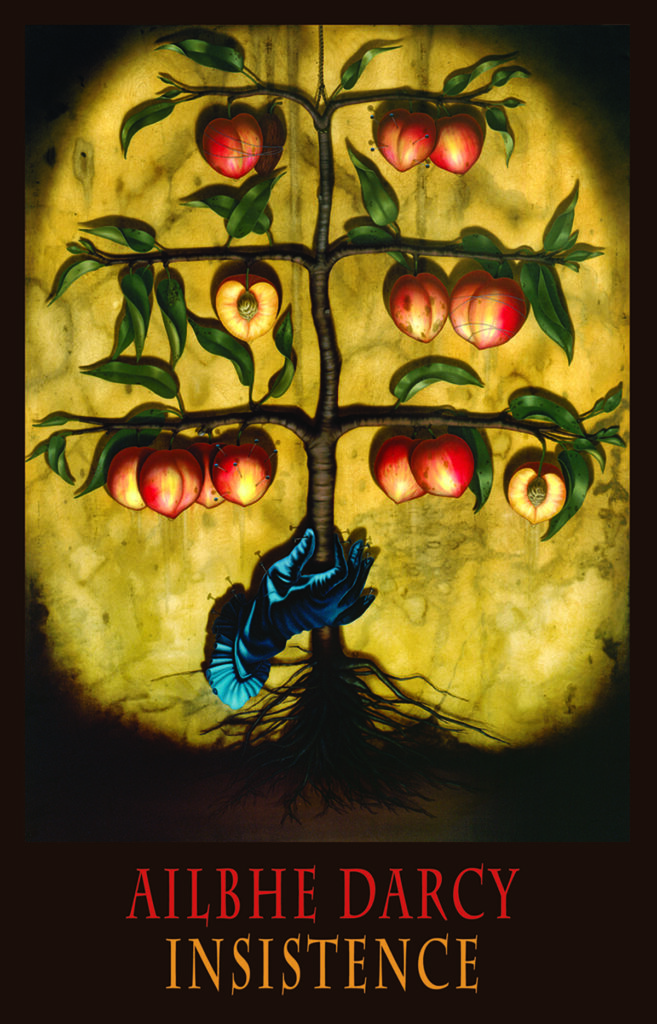
Insistence is not without hope. The stanzas of the final poem, ‘Alphabet’, grow organically from the Fibonacci sequence, nature’s own numbers, suggesting that beauty and growth are independent of human affairs. We start with an image from Inger Christensen’s alphabet: ‘apricot trees insist; apricot trees insist’ but this natural insistence is immediately threatened: ‘but brand names insist, and battlefields, battlefields, / bombs still insist.’ However, political turmoil and rampant capitalism are not permitted free rein and the tenth section digs deep, stripping itself back to short lines and simple statements as it declares that ‘we are not doomed yet’. The poem leaves us in a rich landscape with ‘huckleberries, the skylark / waking and thinking, the sunshine hiding / and thinking, the rain ticking and thinking’. That word, ‘ticking’, crops up a few times. There’s hope – but for how long?
Ailbhe Darcy’s Insistence (Bloodaxe Books) is shortlisted for the T. S. Eliot Prize 2018. John Field blogs at Poor Rude Lines.
Be among the first to receive updates on the latest T. S. Eliot Prize news by subscribing now!