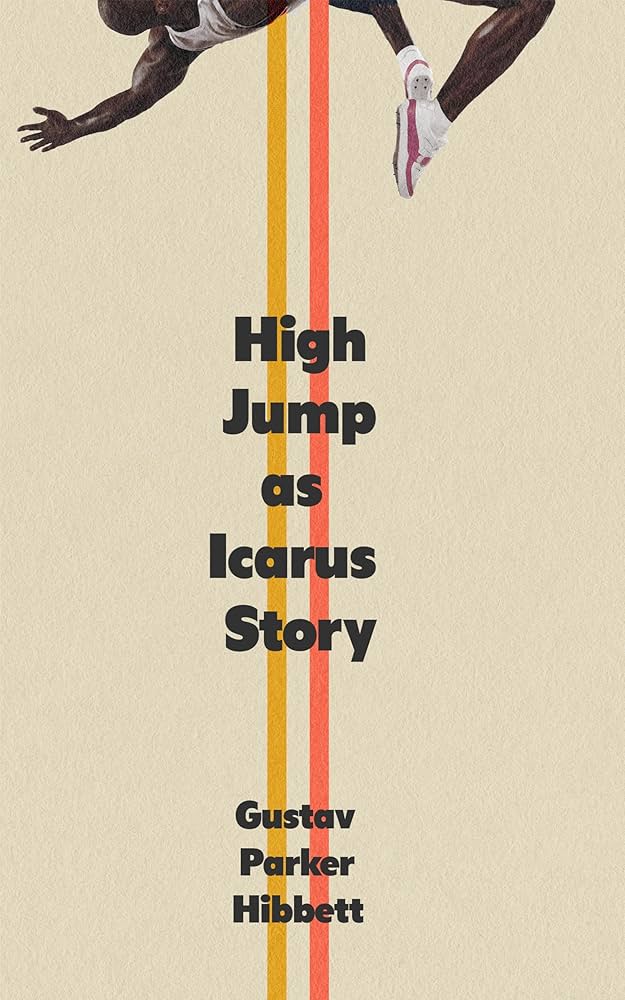

Gustav Parker Hibbett’s High Jump as Icarus Story is both a dazzling and sobering exploration of freedom and injustice
Be among the first to receive updates on the latest T. S. Eliot Prize news by subscribing now!
Gustav Parker Hibbett’s High Jump as Icarus Story is both a dazzling and sobering exploration of freedom and injustice
In High Jump as Icarus Story, Gustav Parker Hibbett’s debut collection, the high jump becomes a dazzling conceit, used to explore the Blackness, the queerness and the maddening contrariness of life. After all, Icarus revels in the freedom and possibility afforded by the wings fashioned by his father. However, those wings have their downside…
In ‘High Jump as a Flow State’, we experience this tension. The speaker opens ‘By some accounts’, signposting the fact that other interpretations of their career as a high jumper are available. However, they choose to present themselves to the reader first as ‘an artist’, implying a certain disregard for success as they pursue a higher calling. No sooner has this thought been shared, than it is complicated by market forces, as ‘Coaches from other places would / approach my dad at State, tell him / with that form they’d have me jumping / six, eight inches higher within months’. With a deal brokered between two adults, the young athlete looks more like a Victorian child apprentice, sold into a form of servitude, than anything resembling the artist they had dreamed of becoming. Yet, look at the enjambment running through the stanza and across the stanza break – this is a person who thinks and feels that they are free. That flow state is presented as a ‘diamond / needle in a record’s groove’ – it might sound cool, effortless, musical, artistic but, if the needle is the jumper, then it’s running on a fixed track. It’s in captivity. We revisit this territory in ‘Colouring Book’. The speaker ‘saw colouring as a test, dexterity / predicting concentration’. They ‘didn’t know you could ignore / the lines’. Discipline and dedication now look like a lack of imagination, the mind stuck in a rut, rather than locked into a jazzy groove.
‘grendel’ draws our attention away from those heroic aerialists: Daedalus and Icarus. Instead, we’re considering the monster, Grendel, here unworthy even of a capital letter. The speaker tells us that, when studying Beowulf in class, all ‘i think about is grendel / armless slinking back across the / the moors to tell his mother golden / hero beowulf came all this way to send him / to whatever heaven monsters go to’. Perhaps we catch an echo of ‘harmless’ in the speaker’s ‘armless’ and, given how the poem pivots to consider the victims of America’s gun-toting vigilantes, meting out their extrajudicial ‘justice’, then perhaps we’re also reminded of Gaige Grosskreutz, one of the men who chased Kyle Rittenhouse after he had shot and killed Joseph Rosenbaum in Kenosha, Wisconsin, 2020. Grosskreutz lost ninety per cent of his bicep for his trouble. ‘golden’ reimagines Beowulf as an entitled member of the Aryan Herrenvolk. Grendel is ‘made to bear the fears / of other people’ – the word ‘monster’ is profoundly troubling…. perhaps its etymology is rooted in the Latin monstrare, ‘to demonstrate’. In this sense, every time someone is made an example of, we might think of them as having become a monster.
And now we come to ‘In which I attend my own lynching’. Many of the poems leading to this point have revelled in the high jump (In ‘High Jump as Life lessons’, ‘you are building something that will take you stratospheric’). However, ‘the dangling, empty rope all frayed and prickled’ reimagines the high jump in sickening fashion. ‘I see myself appear / over the hill, I am bloody, carried by a crowd’ – a warning to others, an expression of dominance, a grotesque exhibition – a monster.
In High Jump as Icarus Story, Hibbett achieves a work of extraordinary breadth and power. It’s celebratory poetry which pulses with life and wears its scholarship lightly. Yet, at the same time, Hibbett pulls no punches as they hold their mirror to our world.
Gustav Parker Hibbett’s High Jump as Icarus Story (Banshee Press) is shortlisted for the T. S. Eliot Prize 2024. John Field blogs at Poor Rude Lines.
Be among the first to receive updates on the latest T. S. Eliot Prize news by subscribing now!