
Catherine-Esther Cowie’s Heirloom rejects easy answers and explores the legacies of colonialism through time, writes John Field
Be among the first to receive updates on the latest T. S. Eliot Prize news by subscribing now!
Catherine-Esther Cowie’s Heirloom rejects easy answers and explores the legacies of colonialism through time, writes John Field
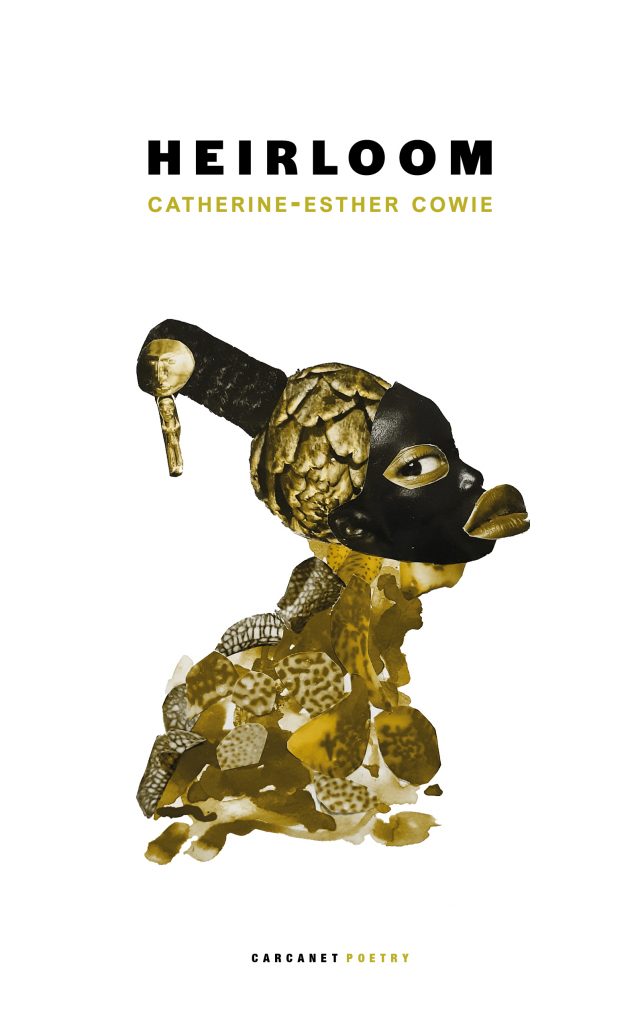
Heirloom, Catherine-Esther Cowie’s debut collection, encompasses a sweep of St Lucian history, from the 1840s to the present day, exploring the impact of colonialism on successive generations of women from the same family.
The title of the collection itself is an acknowledgement of the difficulties faced in negotiating history. An heirloom is anything inherited from one’s ancestors and we have no choice about what we inherit but, at a material level, at least we can choose whether to retain the heirloom, or to destroy it. At a genetic level, we have no choices. The gifts given to us by our ancestors insist on being retained, seen and passed on.
The collection opens with ‘Manman: Tifi’ – ‘Mother: Daughter’ in Kwéyòl (St Lucian Creole). It opens ‘Image of my own making, / more paper and ink than flesh’. As a print, the daughter carries the precise impression of the mother (another heirloom) but the printmaking process does not produce an exact copy: the impression is the inverse of the printing plate, one where black becomes white, and white becomes black. Cowie explores this elsewhere in the collection. In ‘Blessed Be My Unwed Head’, a monologue voiced by Leda, a St Lucian woman (nominally the poet’s great-grandmother), we witness her rape by a white British colonist – her brother-in-law. The newborn child ‘has put on his power: her pale skin / blessing her bastardness clean’. It’s a complex hierarchy as, although marriage and legitimacy are valued, they are set against skin colour. It makes for difficult reading as the speaker describes her rapist as an ‘angel’, and the rape as a version of Gabriel’s annunciation to the Virgin Mary. ‘Let it be as you decree’, the speaker says, in a grotesque echo of Luke 1:38 (‘But it unto me according to thy word’). The Bible’s ‘word’ is changed to ‘decree’, adding civil authority to the biblical reference’s ecclesiastical authority. It’s a troubling marriage of church and state, seen again in ‘Colour Flood’, a poem presenting the mixed congregation at a Sunday service in 1841 where we see ‘The women pressed / into the pews like bodies / corralled in plantation cabins’.
By exploring the legacy of colonialism through time, rather than focusing on a single moment, the collection corrects the British historical amnesia. For example, when people think of U-boats, they think of the Battle of the Atlantic. ‘My Englishman’ bears the subheading ‘St Lucia, 1942’ and, according to the US Naval Institute, between February and November 1942, German U-boats sank 263 ships in the Caribbean – losses which outstripped those inflicted in the Atlantic at the same time. In the popular imagination, the Caribbean has been written out of this history, and Cowie’s corrective reminds us to guard against its simplifications and selectiveness. Cowie’s Kwéyòl monologue offers an oblique glimpse of the conflict through its socio-sexual impact. It opens: ‘He here for di war, / he a captain of a ship’. ‘He’ is the subject of the stanza. Defined by seniority and authority, we might presume that he will prey upon the local woman but the second stanza seems to flips the focus, and Leda’s the one calling the shots: ‘I meet him in di rum shop, / jut my hips so-and-so’. She chooses the battleground and the terms of the engagement. Over the page, in a poem entitled ‘The War’, the relationship is less clear-cut, ‘the sky loud / with the memory of assault’ – it’s a loaded word in this collection and, even if the sky reverberates with the echoes of shellfire, sexual assault echoes in our minds too. The speaker tells us that ‘we go on with our lovemaking’ – and while the first person plural and the choice of vocabulary are reassuring, the memory of earlier sexual assaults reverberates: ‘the body as machine— / dead heart, dead pubis’; his ejaculate ‘like the flies / swarming the torpedoed ships / in the harbour’.
Heirloom rejects the easy answer. In the final poem, ‘Aftermath’, subtitled ‘To Great-Grandpa’, the speaker says ‘I call you monster. / I call you father’. It’s blunt. It’s stark. Despite the passing of time, revulsion is felt, but love endures.
Catherine-Esther Cowie’s Heirloom (Carcanet Press) is shortlisted for the T. S. Eliot Prize 2025. John Field blogs at Poor Rude Lines.
Be among the first to receive updates on the latest T. S. Eliot Prize news by subscribing now!