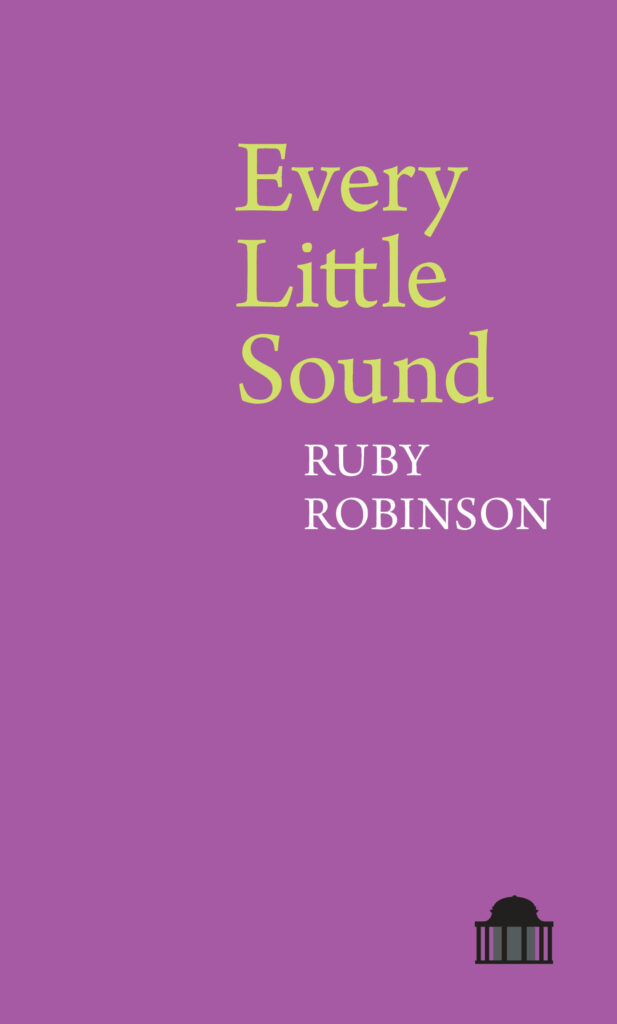

Every Little Sound

Pavilion Poetry (Liverpool University Press)
9.-Ruby-Robinson-portrait-1
Ruby Robinson was born in Manchester in 1985, grew up in Sheffield and Doncaster and now lives in Sheffield. She studied English Literature at the University of East Anglia and has an MA from Sheffield Hallam University where she also won the Ictus Prize for poetry. She says she draws inspiration from writing which takes her ‘somewhere unexpected’. Her poems...

Review

Review

'In Every Little Sound, the imperceptibly fragile achieves audibility and presence, and casts some hope into an unravelling universe', writes John Field

Videos

Ruby Robinson reads from Every Little Sound at the T. S. Eliot Prize Shortlist Readings
Ruby Robinson reads from Every Little Sound

Related News Stories

Jacob Polley’s disturbing tale of lost innocence wins world’s most prestigious poetry prize The T. S. Eliot Foundation is delighted to announce that the winner of the T. S. Eliot Prize 2016 is Jacob Polley for his remarkable new collection Jackself. After months of reading and deliberation, judges Ruth Padel...
To help readers engage fully with the T. S. Eliot Prize 2016 Shortlist, we asked poetry blogger and regular Eliot Prize reviewer John Field to explore the shortlisted titles. In his review of Rachael Boast’s Void Studies, John Field writes, ‘Reading Void Sudies is a sensual, sensory joy. Like music,...
The T. S. Eliot Prize is delighted to announce the thrilling 2016 Shortlist, featuring exciting newcomers and established names. Judges Ruth Padel (Chair), Julia Copus and Alan Gillis have chosen the Shortlist from 138 books submitted by publishers: Rachael Boast – Void Studies (Picador Poetry) Vahni Capildeo – Measures of...

Review of Every Little Sound

In Every Little Sound, the imperceptibly fragile achieves audibility and presence, and casts some hope into an unravelling universe, writes John Field

The teenage electric guitarist in me would have started the journey into effects pedals with something flashy – with a slice of heavy metal distortion, perhaps. However, the 40-something with the disposable income for this hobby started with something quite different: compression. Loud sounds are quietened and quiet sounds are amplified. The instrument feels more present, louder, in an odd sort of way and the essential details – the rhythmic click of funk, or the hammered notes of country – become possible. Robinson’s Every Little Sound opens with a summary of the concept of ‘internal gain’: ‘an internal volume control which helps us amplify and focus upon quiet sounds in times of threat, danger or intense concentration’. The result is a set of hyperreal observations which transcend the everyday, unlocking its latent Gothic menace.

The collection opens with ‘Reader, listener’, a staged invitation to enter a home, a home with all the authenticity of a MTV crib: ‘come in. I’m opening my door to you – the trap / door of a modern barn conversion with lots of little rooms, vast paintings on the bare brick walls, a daring colour scheme, / sofas and awkward plastic chairs for interrogating guests’. The first delicious line break acknowledges the calculation behind the home visit – the barn’s humble rusticity repurposed behind seemingly honest, seemingly transparent ‘bare brick’, which may amount to a double bluff, to another posture. The sofas too, are to interrogate guests and the poem’s incessant imperatives: ‘come in’, ‘take off’, ‘take some’ start to sound less avuncular: ‘I know your deepest thread, like a baked-in hair’. The quality of Robinson’s figurative writing is sensational. Everyday similes pulse with insight: ‘thread’ suggests life’s precious fragility but that hair in the food transforms it into something intolerably revolting.

With its ‘porthole in your bedroom door’, ‘Locked Doors’ reimagines the care home as prison-cum-boat, voyaging we can but wonder where, ‘cigarettes in a locked drawer’, evoking the torture of Tantalus: food and drink eternally just beyond reach while, with sickening irony, beyond the locked doors, someone’s ‘noticing the warmth of a star, 93 million miles away’. Robinson’s use of the second person makes it clear where we’re all heading.

The ‘burnt eyeballs’ and ‘the collapse // of the food-chain’ in ‘Watching TV’ present other inevitabilities. ‘Collapse’, teeters on the edge of the stanza and it’s all too easy for the reader to fill in the blank with any number of catastrophes in the time it takes to flick an eye to the next line. The sofa, usually sat on, becomes something sat ‘inside’, as we insulate ourselves from the pain of digital images, self-medicating with whiskey and chocs – and then Robinson returns to the image of threads, as ‘The threads at the edge // of your rug were falling apart’. This quietest of unravellings is amplified to destruction on a massive scale.

The couplets comprising ‘Tuning Fork’, one of the collection’s final poems, evoke the fork’s twin poles. Although its vibrations are virtually imperceptible to the ear, the speaker remembers that ‘our voices, raised // against each other, amplified // by the walls of this house, recall // the function of a resonator, // as simple as a table top, to which // the handle of the fork is pressed, // or a hollow wooden box’ and, in Every Little Sound, the imperceptibly fragile achieves audibility and presence, and casts some hope into an unravelling universe.

Ruby Robinson’s Every Little Sound (Pavilion Poetry / Liverpool University Press) is shortlisted for the T. S. Eliot Prize 2016. John Field blogs at Poor Rude Lines.

Every Little Sound
Pavilion Poetry (Liverpool University Press)

Newsletter

Be among the first to receive updates on the latest T. S. Eliot Prize news by subscribing now!


The T. S. Eliot Prize on Social Media

Part of tseliot.com

Designed by thinking

Interview of Every Little Sound

Every Little Sound
Pavilion Poetry (Liverpool University Press)

Newsletter

Be among the first to receive updates on the latest T. S. Eliot Prize news by subscribing now!


The T. S. Eliot Prize on Social Media

Part of tseliot.com

Designed by thinking