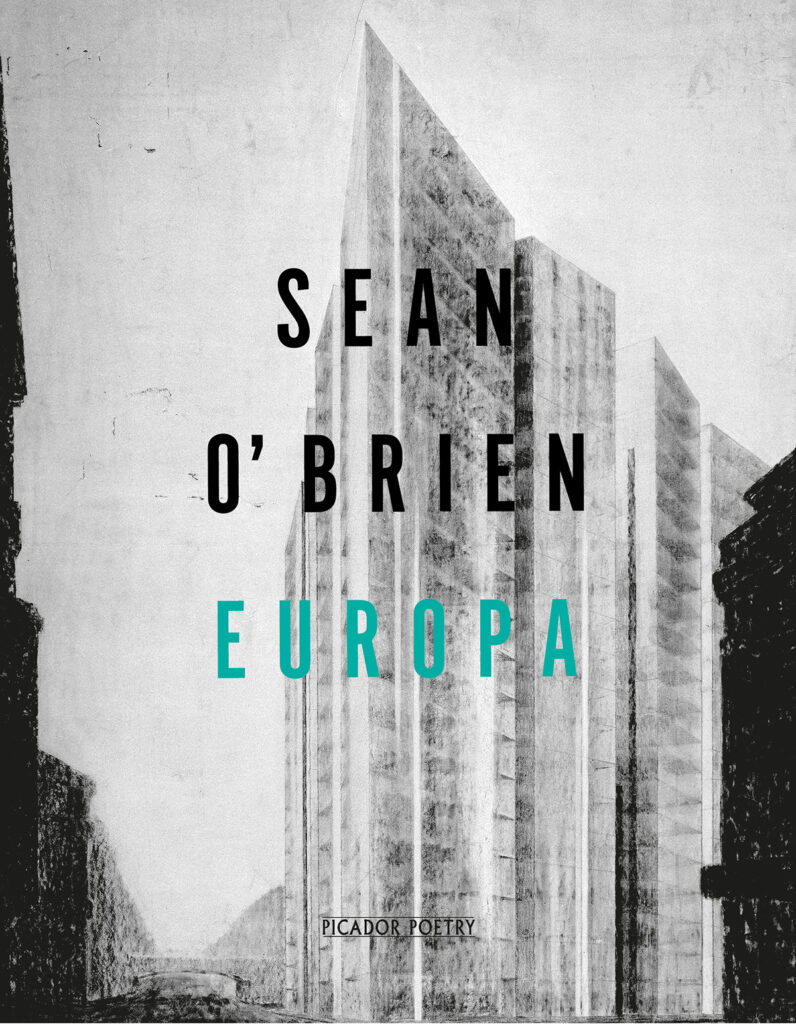
Europa

Picador Poetry
WINNER Sean O'Brien 1200 x 1530 © Caroline Forbes
Sean O’Brien is a poet, critic, novelist and short-fiction writer. Born in London in 1952, he grew up in Hull and now lives in Newcastle. His poetry collections include The Indoor Park, The Frighteners (both Bloodaxe Books) and HMS Glasshouse and Ghost Train (both Oxford University Press). His collection, Downriver (2001), shortlisted for the T. S. Eliot Prize, was published...

Review

Review

In Sean O’Brien’s Europa, a stylised, noir vision, skeined in smoke, is combined with a crisp thematic focus and an economy of form and language, writes John Field

Read the
Reader's Notes

Videos

Sean O’Brien reads from Europa at the T. S. Eliot Prize Shortlist Readings
Sean O’Brien talks about his work
Sean O’Brien reads ‘You Are Now Entering Europa’
Sean O’Brien reads ‘One Way or Another’
Sean O’Brien reads ‘The Calm’

Related News Stories

Fresh from reading a record 176 submissions, T. S. Eliot Prize 2018 judge Clare Pollard celebrates the boom in poetry By most measures, this is a good year for poetry. As life moves increasingly online, poetry suits the internet – it fits in a tweet, a blogpost, an Instagram snap,...
Judges Sinéad Morrissey (Chair), Daljit Nagra and Clare Pollard have chosen the T. S. Eliot Prize 2018 Shortlist from a record 176 poetry collections submitted by, as Sinéad Morrissey says, ‘a plethora of poetry publishers’. The Shortlist comprises five debut collections, one small press, five men, five women, and two...
Review of Europa

In Sean O’Brien’s Europa, a stylised, noir vision, skeined in smoke, is combined with a crisp thematic focus and an economy of form and language, writes John Field

Sean O’Brien’s Europa presents an infernal dream vision of decadence and decay. It can be a stylised, noir vision, skeined in smoke and clad in stockings. However, its crisp thematic focus, and economy of form and language balance this with urgency. O’Brien’s language of borders, fences and walls gains power and resonance as it speaks of – and to – the geopolitical challenges of the present.

The scars of conflict mark the collection. It opens with ‘You Are Now Entering Europa’. Perhaps the title echoes the 1969 mural, painted on a gable wall in Londonderry, ‘You are now entering free Derry’, or perhaps the reader will catch an echo of the iconic sign on Berlin’s Friedrichstraße: ‘You are now entering the American Sector’. (The ghostly image on the cover is of Mies van der Rohe’s 1921 Friedrichstraße Skyscraper: a beautiful, bold look towards a better Berlin, impossible in a city subsequently bisected by ideology along that very street.) The poem opens ‘The grass moves on the mass graves’, creating an unresting, unresolved atmosphere as the reader is reminded that Europe is built on bones.

O’Brien returns to this idea towards the end of the collection, in ‘The Sunken Lane’, ‘Where the dead are once more / Trying to assemble in the dark’. Again, there is a sense of unfinished business, as if the ghosts have not accepted that the conflict has been resolved and ‘the ancient ordnance / Sweats and waits implacably // For Zero Hour beneath the ridge’. ‘Ancient ordnance’ suggests every war, not just the Great War, reminding us that the challenges we face extend far beyond the twentieth century. In the spectacular ‘From the Cherry Hills’, set in Bosnia and Herzegovina, ‘there lies / More history than any place can be / Imagined to accommodate’. ‘Lies’ suggests that this history is now buried, but the poem is uneasy about this, as its sheer volume defies containment and the dynamited mosque is rebuilt, suggesting the futile cyclic nature of history.

Time, that perennial subject, is given fresh urgency as the breakneck speed of social change is presented. In ‘The Chase’, we see a mock-Tudor Midland roadhouse, ‘Thirties-built to meet the passing trade / Long since diverted down the bypass’. It reads like an ironic twist on the country house poem, the poetic form in which Ben Jonson and Aemilia Lanyer praise their patrons’ pads. Instead, O’Brien gives us the collapse of middle England with his Midland hotel as we are joined outside by someone’s husband and his ‘shy-smiling bigotry about “Our friends from the subcontinent”’.

Weariness abounds. ‘Hence, Loathèd Melancholy’ is a rebuttal of Milton’s ‘L’Allegro’. Milton concludes ‘Mirth, with thee I mean to live’, but O’Brien gives us instead the utter vacuity of enforced social banality: ‘This will all be a lie’. In ‘Sabbatical’, the tyranny of the Research Excellence Framework (REF) compels ‘the lunatics who stick it out / In mortal terror’ to work without holidays in an intellectually bankrupt society: as ‘the West declines and does not read’.

Although these are serious poems for serious times, there is a human warmth to the Larkineque quality of the speaker’s world-weariness and isolation. There are also moments of comic satire. In ‘Mecklenburgh Square’ the speaker ‘roamed the streets of London town’ in a nod to William Blake’s ‘London’, where the speaker wanders ‘thro’ each charter’d street’. However, O’Brien’s tale of booze and abandonment reads like a twenty-first century ‘La Belle Dame Sans Merci’ as the girl vanishes, leaving the speaker ‘to wander / Back through Mecklenburgh a while’.

O’Brien’s Europa proves that unsettling times produce excellent poetry.

Sean O’Brien’s Europa (Picador Poetry) is shortlisted for the T. S. Eliot Prize 2018. John Field blogs at Poor Rude Lines.

Europa
Picador Poetry

Newsletter

Be among the first to receive updates on the latest T. S. Eliot Prize news by subscribing now!


The T. S. Eliot Prize on Social Media

Part of tseliot.com

Designed by thinking

Interview of Europa

Europa
Picador Poetry

Newsletter

Be among the first to receive updates on the latest T. S. Eliot Prize news by subscribing now!


The T. S. Eliot Prize on Social Media

Part of tseliot.com

Designed by thinking