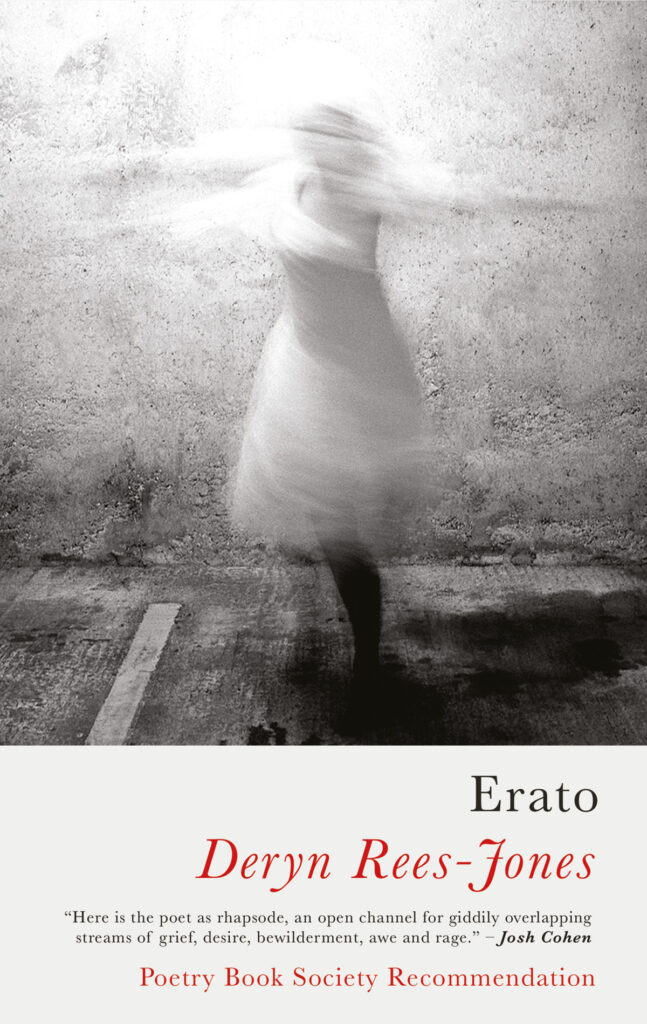
The shapeshifting quality of Deryn Rees-Jones's Erato, its exploration of mistakes, distortions, the destructive and the fantastical, make it a virtuosic and devastating collection, writes John Field
Be among the first to receive updates on the latest T. S. Eliot Prize news by subscribing now!
The shapeshifting quality of Deryn Rees-Jones’s Erato, its exploration of mistakes, distortions, the destructive and the fantastical, make it a virtuosic and devastating collection, writes John Field
Erato revels in the sheer joy of language and holds a mirror to society’s seamier, darker side. The collection comprises a series of prose poems, interspersed with formal lyrics. The poems work well in isolation, but Erato works best in conversation with itself.
Rees-Jones’s epigraphs offer a useful steer: the first, taken from Book VII of Virgil’s Aeneid, invokes Erato, the muse of love, as Juno sows discord between the Trojans and the Latins, causing them to scrap over the possession of Rome. She also references Elizabeth Bishop’s ‘The Man-Moth’, Bishop’s response to a newspaper typo which transformed a mammoth into something superhuman.
Initially, we’re likely to guess at the meaning of ‘Erato’ and our knowledge of language points us to ‘error’ and ‘erratum’, and Rees-Jones’s reference to ‘The Man-Moth’ permits these fanciful associations. ‘The Owl Husband’ doffs its cap to Bishop as it cocks a snook at the Owl Bible’s misprinting of ‘own’ as ‘owl’, lending 1 Peter 3:5 an unexpected dash of the fantastical. Rees-Jones opens ominously in the woods, in the isolated, fairy tale locale associated in our minds with the wolf – with sexual predation. Here ‘You pulled me down: mud, leaf-mulch, / feather moving shade and shadow. Did I tremble in the face of beak / and wings?’ The shapeshifting quality of the Owl Husband evokes Zeus, and especially his assault of Leda as a swan. The encounter haunts the collection and, in ‘Erratum’, Rees-Jones riffs on the theme, linking it to the Welsh myth of Blodeuwedd – transformed into an owl for unfaithfulness – and this, in turn, adds a sinister subtext to the collection’s final poem, the sonnet ‘Nightjar’, whose ‘sound electrifies the heath’.
‘Eyes to the Right, Nose to the Left’ wrongfoots the reader as the title suggests a playful distortion of the division of parliament. Instead, we’re offered a childhood memory of Sindy’s ‘long, nylon locks’ and the ‘rough blonde head’ of Action Man, ‘who had a little serrated switch at the back of his head’ to move the ‘Eyes to the Right’. It’s an innocent age in which the children understand that the dolls are best kept apart. However, Rees-Jones returns to Westminster, to the divided nation originally proposed by the title and politicians ‘unreal in their dissimulation’, concluding that, in this toxic environment, ‘Poetry / stood very still’. Here, she’s shaking it up again.
In contrast, the prose poem, ‘Siren’, explores a different sort of shapeshifting. It first presents the reader with the ‘wail of an ambulance’s siren’. The doppler effect means that a siren appears to change pitch as it moves and, as the speaker ‘thought instead about the word siren and the strange bird-women who sang between treacherous rocks’ the siren changes from sound to mythical bird woman (with echoes of Blodeuwedd). The hospital becomes an unsettling environment: ‘You had to run a mental algorithm to distinguish what was a sign and what was a picture. There were posters of smiling nurses and chief executives and patients being advised on how to have their say. No one looked real’. What wizard, we wonder, has spirited away the NHS we knew and loved?
The shapeshifting quality of the collection, its exploration of mistakes, darkens further in ‘Drone’ where a drone operator is interviewed and asked ‘Do you ever think about the people you’ve killed?’ and the answer, an emphatic ‘No, no, never’ rings hollow in Rees-Jones’s structure of error, the epigraph from the Aeneid reminding us of the enduring relationship between arms and the man.
Erato is a riot of associations and ideas, but Rees-Jones marshals her material to devastating, virtuosic effect.
Deryn Rees-Jones’sErato(Seren) is shortlisted for the T. S. Eliot Prize 2019. John Field blogs at Poor Rude Lines.
Be among the first to receive updates on the latest T. S. Eliot Prize news by subscribing now!