
Robert Minhinnick's Diary of the Last Man 'presents an unsentimental, indifferent world, filled with cruelty and atrocity but, while there may be no Jesus in Minhinnick’s geology, there is no shortage of beauty', writes John Field
Be among the first to receive updates on the latest T. S. Eliot Prize news by subscribing now!
Robert Minhinnick’s Diary of the Last Man ‘presents an unsentimental, indifferent world, filled with cruelty and atrocity but, while there may be no Jesus in Minhinnick’s geology, there is no shortage of beauty’, writes John Field
In Diary of the Last Man, Robert Minhinnick meditates on environmental apocalypse before training his eye on Anglo-American atrocities in Iraq. Finally, he offers translations from Welsh, Arabic and Turkish. Minhinnick’s poems are a virtuoso display: reminiscent of Gerard Manley Hopkins or Dylan Thomas, bringing the sounds of Welsh poetry to English. He also writes with the force and indignation of Shelley’s ‘The Mask of Anarchy’ as he attacks the obscenities of war.
‘The Diary of the Last Man’ is a sequence of 23 poems, perhaps indicating that, for humanity, time is running out and will be cut short. Loneliness and uncertainty dominate as the speaker muses ‘Perhaps / I am the last man’, with the line break highlighting his doubt as he hums his ‘hymn of sand’. Minhinnick suggests the deadness of the world as the sands of time run fast through humanity’s emptying glass. ‘Hum my hymn of sand’ repeats consonants in the same order, akin to Welsh cynghanedd, resulting in an arresting formality and beauty. The collection enjoys a Protean musicality as sounds morph and shift as they sift through Minhinnick’s hourglass: ‘Slack? / Slake? / Lake? / Meres and mosses and mirrors and mortuaries’. Some might see environmental catastrophe as an unmitigated disaster but Minhinnick’s second poem, ‘Snipe’ presents ‘Two of them, two lines of barbed wire / across the sky, two voices’ and, for once, humanity is outnumbered as nature begins to reclaim the planet.
Another sequence, ‘Mouth to Mouth: A Recitation Between Two Rivers’ alternates between prose and poetry and is reminiscent of William Dyce’s painting ‘Pegwell Bay, Kent – a Recollection of October 5th 1858’. Dyce’s figures scuttle, dwarfed by the geological strata in the cliffs and, above, Donati’s comet, with an orbital period of roughly 1,739 years, crosses the sky. Sand, ‘formal as fossils’, drifts through Minhinnick’s poem and its shifting landscape renders it an ‘unchronicled country’. The landscape is indifferent and insatiable as the dunes swallow human history and Minhinnick’s deer echo Ted Hughes’ ‘Roe Deer’: ‘two shamen praying to the lightning god, / or so they might well be in this unearthly light’.
The ‘Amiriya Suite’ memorialises the bombing of an Iraqi public air raid shelter by the United States Air Force in 1991, killing hundreds of civilians. In the first part, end-stopped lines accent the poem’s cutting bitterness: ‘One body with four hundred souls / is exposed in a photographic flash. / They pick the wedding rings and wisdom teeth / from crematorium ash’ and the facts of the event are re-read as obscene ironies: ‘Think of a smart bomb. / Not so smart’. In the rest of the sequence, Minhinnick gives us unrhymed couplets, suggesting that nothing hangs together in a world of lies and sexed-up dossiers, where ‘a farmer had written nuclear formulae / on the skin of a watermelon’.
Towards the end of the collection, his translations of Erozcelick Seyhan invite us to reconsider the temporal sands running through ‘Mouth to Mouth’ and the ‘Amiriya Suite’. Here, ‘we rise like incense through the sky, / people who become a plume of smoke’. The translation echoes Psalm 141, ‘May my prayer be set before you like incense’ but, for Minhinnick, ‘there is no Jesus in geology’ and nature will just have to make do.
Diary of the Last Man presents an unsentimental, indifferent world, filled with cruelty and atrocity but, while there may be no Jesus in Minhinnick’s geology, there is no shortage of beauty and, filtered through the sands of his language, this beauty is arresting and memorable.
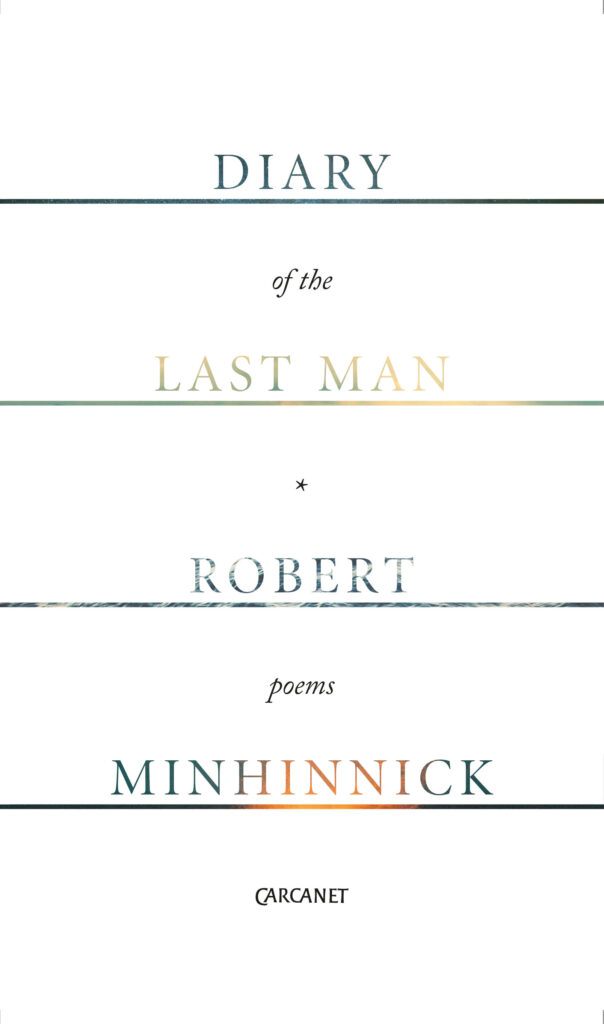
Robert Minhinnick’s Diary of the Last Man(Carcanet Press) is shortlisted for the T. S. Eliot Prize 2017. John Field blogs at Poor Rude Lines.
Be among the first to receive updates on the latest T. S. Eliot Prize news by subscribing now!