
Self-aggrandisement and pride deform and pervert love. With its spare, muscular language, Sasha Dugdale's Deformations views our distorting predilection for myth-making with no-nonsense clarity, writes John Field
Be among the first to receive updates on the latest T. S. Eliot Prize news by subscribing now!
Self-aggrandisement and pride deform and pervert love. With its spare, muscular language, Sasha Dugdale’s Deformations views our distorting predilection for myth-making with no-nonsense clarity, writes John Field
Sasha Dugdale’s large-scale poems ‘Welfare Handbook’ and ‘Pitysad’ meditate on myth. The second of these works, ’Pitysad’ is an explicit engagement with myth as the reader encounters characters and scenes from Homer’s Odyssey. ‘Welfare Handbook’, working with fragments from Eric Gill’s letters, diaries, notes and essays, shines an unsettling spotlight on the artist. The poem casts a shadow across the collection and, in its shade, the pristine alabaster biceps and six packs of meticulously crafted fiction, masculinity, crack and crumble like cheap plaster.
‘Welfare Handbook’ echoes the series of ‘Welfare Handbooks’ Gill worked on in the 1920s for the Guild of St Joseph and St Dominic. The Roman Catholic guild espoused agrarian ideals and their handbooks adopt a catechetical tone, making the contrast between Dugdale’s form and the speaker’s transgressive mind a stark one. Gill sexually abused his daughters and Dugdale’s poems get beneath Gill’s clean, austere Classicism. One poem in the series opens ‘sex with children upsets us / more than it used to’. Where our terms for this, ‘abuse’, or ‘rape’, are pejorative, ‘sex with’ offers no judgement and, although we are disturbed by the spectacular understatement of ‘upsets’, we are consoled by the line break, which creates a statement of disapproval. (Note the speaker’s manipulative use of the first person plural ‘us’, drawing us into the poem’s murky world). However, the second line’s ‘more than it used to’ shakes the ground beneath our feet and we wonder whether the speaker is celebrating better child protection, or looking nostalgically to a time when the abuse of children was easier to get away with. At the heart of the poem lies an epic simile: ‘The prohibition / is like a seawall in the adult mind, but back then / the waters slopped in and out the harbour’. The force of the speaker’s desire is implacable – elemental. The destructive, eternal ebb and flow of the tide ‘in and out’ is horrific when read in sexual terms.
‘Welfare Handbook’ views the world through the prism of perversion. Another poem opens with an Imagist beauty: the changing colour of leaves in the breeze is like ‘tiny white flags’. The poem turns on another epic simile – up the skirt of a doll where ‘a different face, a different girl’ is revealed. Nothing natural and wholesome is safe from the speaker’s mind. Nowhere is this felt more powerfully than in ‘One X for Mary and XX for May’. The x, the symbol of love and affection, is a thing of beauty, ordered in ranks like a doodle in Dugdale’s concrete poem. Then we see the arrangement on the page: ‘— xx x xx x xx x’ and a record of abuse, not paternal kisses. We fear too the state of the mind that needs to keep this record.
In ‘Pitysad’, the Classical Athenian collides with the present day. As soon as Odysseus’s Boy’s Own heroism is recast in a contemporary setting, it darkens. ‘R & R’ evokes the American military, and the poem’s dust and IED locate it in the Middle East. A girl has caught Odysseus’s eye. He ’kept his book open on his knee / his body lolled, his eyes looked sleepy / but inside he’d never felt so alive’. It’s a studied deceit. The book might as well be a sculptor’s prop – the fig leaf of culture but, beneath it, there’s a reptilian menace stirring. The girl seems to want him but their ‘malnourished little bodies’ remind us that these girls are desperate. It is her poverty, not her will, that consents.
‘Pitysad’ concludes with a rapturous skit on Molly Bloom’s soliloquy. Dugdale’s Penelope would ‘brush away all the hero / all the myth’. What is so awful about humdrum insignificance? Self-aggrandisement and pride deform and pervert love. With its spare, muscular language, Deformations views our distorting predilection for myth-making with no-nonsense clarity.
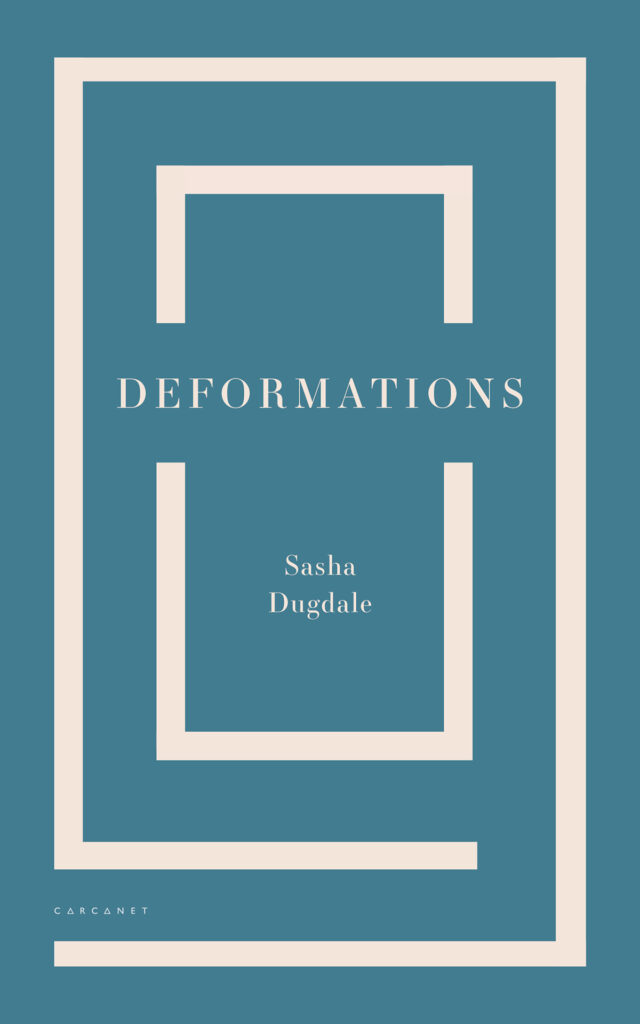
Sasha Dugdale’s Deformations (Carcanet Press) is shortlisted for the T. S. Eliot Prize 2020. John Field blogs at Poor Rude Lines.
Be among the first to receive updates on the latest T. S. Eliot Prize news by subscribing now!