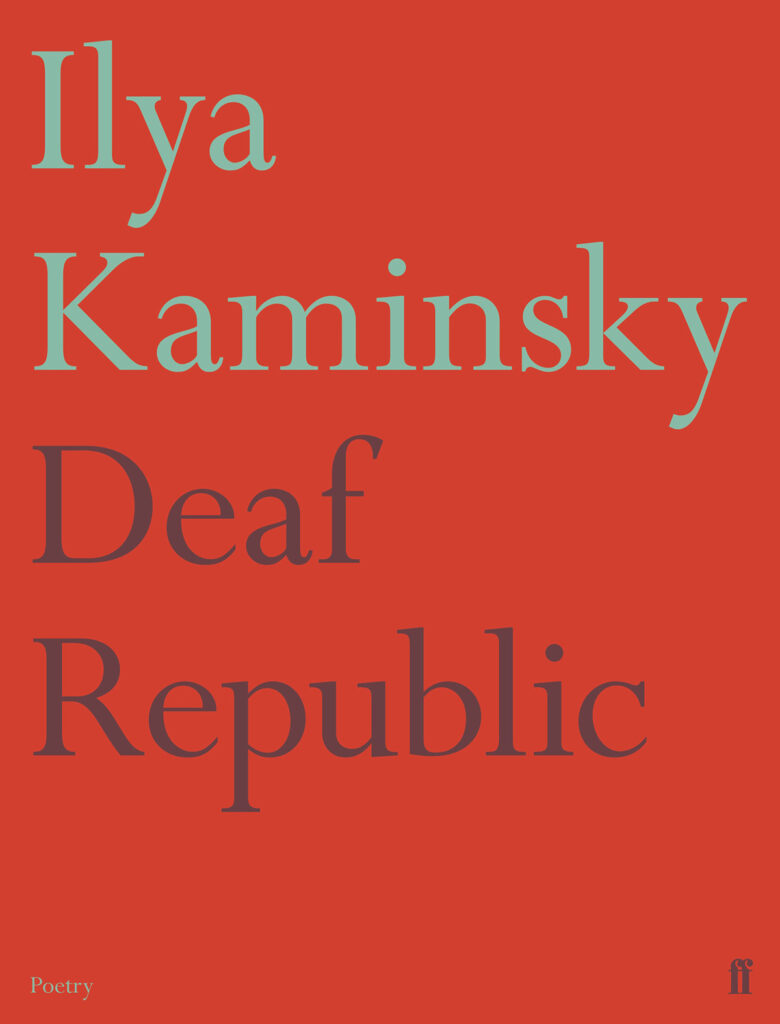

Ilya Kaminsky's Deaf Republic cries out the miserable truth of every military occupation in an arresting, vivid, timeless exploration of resistance – and complicity
Be among the first to receive updates on the latest T. S. Eliot Prize news by subscribing now!
Ilya Kaminsky’s Deaf Republic cries out the miserable truth of every military occupation in an arresting, vivid, timeless exploration of resistance – and complicity
A sequence of free verse poems comprising a two Act play, Deaf Republic ostensibly documents events in the fictional town of Vasenka, garrisoned by the army and under martial law. The poems explore the townspeople’s resistance and the soldiers’ attempts to impose authority. The notional Eastern European setting grounds the poems. However, Deaf Republic cries out the miserable truth of every military occupation in an arresting, vivid, timeless exploration of resistance – and complicity.
Kaminsky opens with ‘Gunshot’, spoken by the chorus, the townspeople of Vasenka. The chorus, a feature of Classical Greek theatre, points to a conflict on a par with Euripides’ Antigone: an irresistible force meets an immovable object, lending the poems a timelessness and truthfulness. Winston Churchill is credited with the earliest recorded use of ‘theatre of war’, in a letter from 1914 discussing the Western Front, and the Chorus declaims that ‘Our country is the stage.’ At one level, this invites us to imagine the stage as a warzone, but it also acknowledges the world’s willingness to watch a tragedy unfold from the comfort and safety of a plush, upholstered seat.
Kaminsky’s language is arresting and elemental. As Sonya kneels by the body of her cousin, Petya, shot to death by soldiers on the street, she ‘kisses his forehead – her shout a hole // torn in the sky’. Kaminsky works the stanza break: first we see the black O of her mouth, and then our perspective spirals outwards to see the rent torn in the universe. Metaphor is almost unbearably painful as ‘She stretches out / beside the little snowman napping in the middle of the street’. In ‘That Map of Bone and Opened Valves’, Gora’s wife is torn from her bed ‘like the door off a bus’ but, despite the savage power of Kaminsky’s figurative language, his eye maintains its focus on the human tragedy: ‘The body of the boy lies on the asphalt like a paperclip. / The body of the boy lies on the asphalt / like the body of a boy’.
Kaminsky’s play is framed by a pair of poems: ‘We Lived Happily during the War’ and ‘In a Time of Peace’. They provide his theatre with its audience. In ‘We lived happily during the war’, as atrocity unfolds, we // protested / but not enough’. The first person plural implicates us in a collective indifference before the speaker comments more explicitly on his own splendid, American, isolation: ‘I was / in my bed’ and in ‘our great country of money we (forgive us) // lived happily during the war’. ‘In a Time of Peace’ asserts that we are in ‘a peaceful country’ – the presence of cops puts us back in America again. There’s a repeated refrain: ‘It is a peaceful country’. It’s a statement, but the repetition undermines this – it’s an act of self-delusion, a dream. The poem’s reality is watching ‘neighbors open // their phones to watch / a cop demanding a man’s driver’s license. When the man reaches for his wallet, the cop / shoots. Into the car window. Shoots.’ Again, the line break creates a freeze-frame and we’re given the space to hope that those neighbors are opening their doors. However, no-one gets off the hook here as the speaker too is complicit, watching people watching on their phones.
Deaf Republic exists beyond time and place. It’s a book we need and is certainly one we deserve. Come and see.
Ilya Kaminsky’s Deaf Republic (Faber & Faber) is shortlisted for the T. S. Eliot Prize 2019. John Field blogs at Poor Rude Lines.
Be among the first to receive updates on the latest T. S. Eliot Prize news by subscribing now!