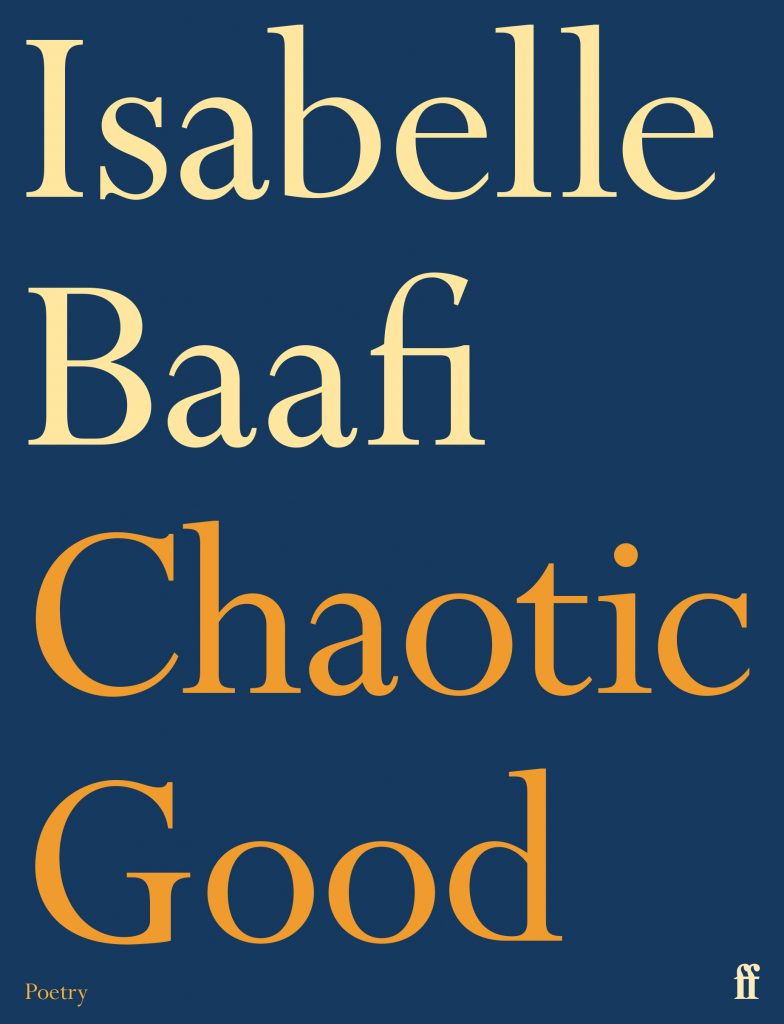

Isabelle Baafi’s Chaotic Good is a bravura display of artistic mastery, but it also has heart, writes John Field
Be among the first to receive updates on the latest T. S. Eliot Prize news by subscribing now!
Isabelle Baafi’s Chaotic Good is a bravura display of artistic mastery, but it also has heart, writes John Field
The formal pleasures of substitution and symmetry abound in Chaotic Good. It’s a counterpoint to Baafi’s difficult subject matter: bailiffs at the front door and bruises behind it.
The opening poem, ‘The Mpemba Effect’ is specular, a mirror form where the lines of the first stanza are repeated in reverse in the second. The Mpemba Effect is the assertion that it’s quicker to freeze hot water than it is to freeze cold – a comment, perhaps, on the speed with which the relationship between the speaker and her husband cools. Straddling the poem’s line of reflection is the statement that ‘By our seventh year we ate around the rot.’ The kitchen is the heart of the home but here the core is rotten. One might imagine soup as warming and wholesome but this wife was ‘sweating over a pot for days’, a fevered, unsavoury image and a perfect seasoning for a soup of ‘gizzard’ and ‘liver’.
In ‘Everything is going according to plane’ Baafi plays with orthographic neighbours (one word becomes another when a single letter is changed). The speaker tells us that ‘I was rot the daughter she wanted’ implying that she might view herself as the rot at the core of her mother’s marriage. This points the reader to a deeper rot at the heart of the family – other, older cycles are playing – and replaying – through that marriage. Nowhere do we see this more than in ‘Your Mother’s Daughter (a GIF)’. Graphics Interchange Format is a file type which endlessly repeats a tiny fragment of film, such as you might see on a social media post. Here, instead of working with reflection, Baafi works with repetition. Stanza one opens with ‘you will be nothing / like your mother who hoarded / scabs on her knees praying daily’; in stanza two the file appears to have been corrupted. The slashes have shifted to give us ‘you will be nothing like your mother’. When dealing with digital files we view corruption as negative but here, perhaps, the rot ought to be viewed positively – this GIF is not going to repeat ad nauseam and into infinity. Things will change – and they will change for the better.
The collection is divided into five sections: ‘Separation’, ‘Childhood’, ‘Adolescence’, ‘Marriage’ and ‘Rebirth’, and this in itself is an uplifting movement. Although much of the collection is characterised by instability, as one word morphs into another, meaning becomes fixed as we reach ‘Rebirth’. In ‘Alicante’ we hear the overused language of the tourist but, far from being worn thin through overuse, it gains solidity: ‘The city is perfect: I don’t know a single person. / For days, the only words I say are perdón and gracias. // To waving palm trees and leafy plazas: gracias. / To Alhambra tiles and coloured steps: gracias.’
This is followed by ‘The Lost Sheep’. In the Gospel of Luke, Jesus tells the parable of the shepherd who leaves the flock to find the lost sheep – a metaphor for the redemption of the sinner. Baafi’s poem subverts the poem’s biblical language as, wandering in the psychic wilderness like the lost sheep, ‘it was forty days and nights before I realised that the voice / was mine’. That voice is the mistress of its own destiny. It may have been lost, but it has discovered the power to save itself.
Chaotic Good is a bravura display of artistic mastery. On its pages one feels Baafi’s affinity with her forebears (Carolyn Forché is name-checked in the notes for ‘Dear Eve (a letter to his second wife)’) – and George Herbert’s early modern poetry blazes the trail for the specular poem. All of this would amount to little if the collection lacked heart – but there’s nothing rotten at the core of Chaotic Good. It pulses with life.
Isabelle Baafi’s Chaotic Good (Faber & Faber) is shortlisted for the T. S. Eliot Prize 2025. John Field blogs at Poor Rude Lines.
Be among the first to receive updates on the latest T. S. Eliot Prize news by subscribing now!