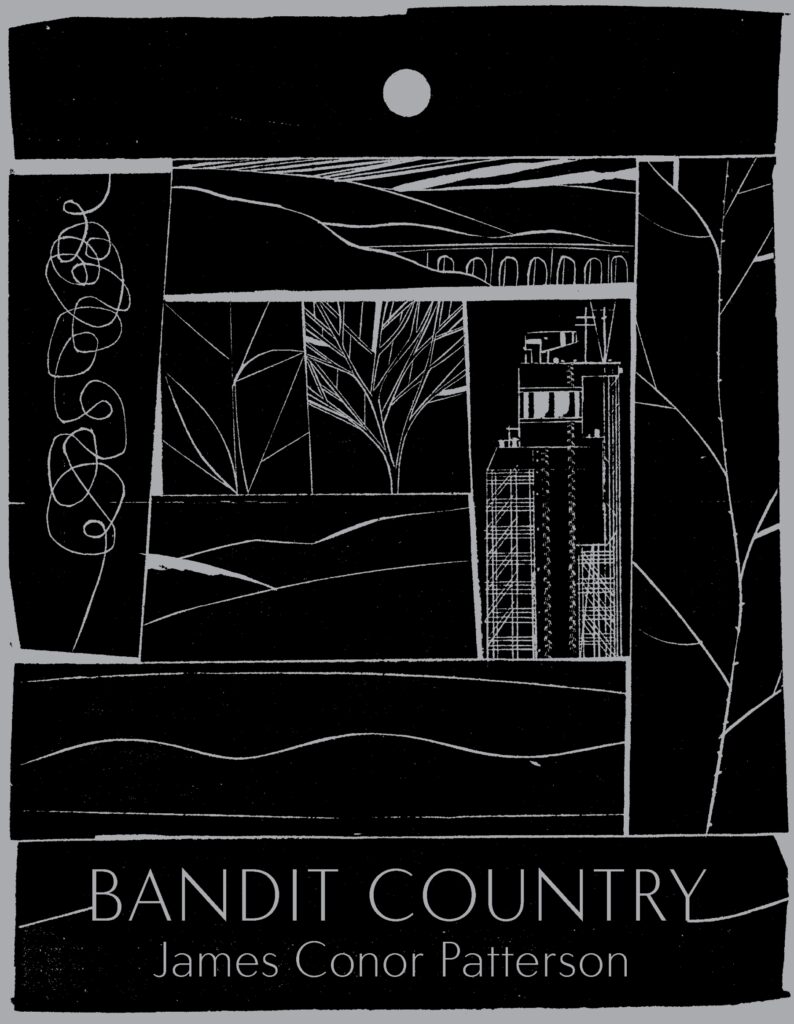

bandit country

Picador Poetry
Conor-Patterson-James-by-Aimee-Walsh
James Conor Patterson is from Newry in the north of Ireland and currently lives in London. He won an Eric Gregory Award for bandit country in 2019 and fragments and versions of the poems appeared in publications including Magma, The Moth, New Statesman, Poetry Ireland Review, The Poetry Review, The Stinging Fly, Poetry London and The Tangerine. A selection of...

Review

Interview

Review

In bandit country, James Conor Patterson writes of Newry as a place of the future while acknowledging the power of the past and its ability to menace the present, writes John Field

Interview

James Conor Patterson is shortlisted for the T. S. Eliot Prize 2022 for his debut collection, bandit country (Picador Poetry, 2022). We asked him about dialect and sense of place, politics, humour and liberation

Read the
Reader's Notes

Videos

James Conor Patterson reads from bandit country at the T. S. Eliot Prize Shortlist Readings
Lily McDermott reviews James Conor Patterson’s bandit country
James Conor Patterson reads ‘london mixtape’
James Conor Patterson reads ‘yew’
James Conor Patterson talks about his work
James Conor Patterson reads ‘the drowning’

Related News Stories

The T. S. Eliot Foundation is delighted to announce that the winner of the T. S. Eliot Prize 2022 is Anthony Joseph for his collection Sonnets for Albert published by Bloomsbury Poetry.
Judges Jean Sprackland (Chair), Hannah Lowe and Roger Robinson have chosen the 2022 T. S. Eliot Prize shortlist from a record 201 poetry collections submitted by British and Irish publishers. The eclectic list comprises seasoned poets, including one previous winner, and five debut collections. Victoria Adukwei Bulley – Quiet (Faber &...
Review of bandit country

In bandit country, James Conor Patterson writes of Newry as a place of the future while acknowledging the power of the past and its ability to menace the present, writes John Field

Merlyn Rees, Secretary of State for Northern Ireland, 1974-6, coined the term ‘bandit country’ to describe the area of South Armagh, South Down and North Louth. The task, he said in 1975, of enforcing a ceasefire was ‘made difficult by the terrain, the proximity of the border and the limited assistance given by local people’. James Conor Patterson’s debut collection, bandit country, explores the gravitational pull of Newry and the borderlands of Armagh and County Down. In doing so, he offers a response to Rees through a collection scintillating with local dialect. While Patterson’s ‘bandit country’ may be disturbed by dreams of the past, as a place it looks to the future.

The title of the opening poem, ‘bambooland’, invites the reader to imagine a jungle, then immediately undermines such an exotic idea as a drunken adolescent is hauled ‘intae the back of a parent’s car’. Yes, the world can at times be anarchic, but parental love and care demonstrate that society is functioning just fine. Jumping into the bamboo void, teenage boys may regard themselves as ‘like orpheus’ but the effect here is bathetic. Boys will be boys the wide world over.

Over the page in ‘may queens’ Patterson balances this laddish portrait with a group portrait of some girls dressed ‘like a cuppla vaudeville performers / in our ma’s old barbara stanwyck shurtwaists & revlon red lipsticks’. The girls’ vaudevillian look suggest they dream of somewhere more glamorous than Newry. Later in the collection, in a poem entitled ‘the depression’, we get to visit Hollywood. It’s 1932 and up close and personal the Hollywood sign, the epitome of star-studded dreams and glamour, is wild and sordid, surrounded by ‘hosiery & scrub’. We’re addressed in the second person as someone prepared to jump from the iconic sign. Newry comes off the best from this comparison and the girls mix cultures as they ‘morris dance freely’ until ‘called for tea’ in a charming mix of the folksy and the glamorous.

The Troubles appear in ‘about suffering’, a poem that both nods to Auden’s ‘Musée des Beaux Arts’ and offers a reflection on the Brexit vote in which, according to the LSE’s Roch Dunin-Wasowicz, ‘85% of Catholics voted Remain compared to only 40% of Protestants’. We see Newry from ‘the moutha the crimean war cannon’, a projection both of British military power and the city’s tourist itinerary. We observe ‘memorial arcs of of strongbow down the arts centre steps’ as a drunken parody of a civic water feature and perhaps another slant nod to English invasion (Strongbow was also the moniker of Richard de Clare, a leading actor in the Anglo-Norman invasion of Ireland). Suddenly, from ‘outta nowhere, a saracen comes squealin / through the barricades’, a hated symbol of the British military oppression. However, across the stanza break, the speaker reveals that this is ‘the sorta thing i imagine there mighta bin / had i lived through the eighties’. The Troubles have receded into the imagination and instead we’re shown people committed to the democratic process, booking their flights and returning home to vote on Brexit in an image of optimism that flies in the face of the past. We see much the same thing in ‘INTERNMENT’. The poem’s title evokes dark memories of places like the Maze prison. Delivered in terse stabs across the page, it recreates intense memories of brokenness and division, but the recall of these days is dying with their generation.

Nevertheless, bandit country acknowledges the power of the past and its ability to menace the present. The poem ‘currents’ shows us ‘two young rapscyallions launchin their newspaper boat—as / fragile as a may butterfly—down a flagstone culvert with a rusted / grille…’ Patterson’s pop-culture reference to Stephen King’s It perhaps reminds us that Pennywise lies dormant for 27 years. The ellipsis readies us for a jump scare but instead of darkness, there’s light reflected from ‘the glare from a starbucks / takeaway cup’. A gulf of time separates the Troubles from these more affluent times. Still we’re unsettled, alternative histories lurking like King’s killer in the culvert of the reader’s imagination, whether they manifest or not.

bandit country is a rollicking read. Its pages sing as it celebrates the borderlands and puts Newry on the personal, cultural and psycho-geographical map.

James Conor Patterson’s bandit country (Picador Poetry, 2022) is shortlisted for the T. S. Eliot Prize 2022. John Field blogs at Poor Rude Lines.

bandit country
Picador Poetry

Newsletter

Be among the first to receive updates on the latest T. S. Eliot Prize news by subscribing now!


The T. S. Eliot Prize on Social Media

Part of tseliot.com

Designed by thinking

Interview of bandit country

James Conor Patterson is shortlisted for the T. S. Eliot Prize 2022 for his debut collection, bandit country (Picador Poetry, 2022). We asked him about dialect and sense of place, politics, humour and liberation

T. S. Eliot Prize: Would you say something about Newry as a place and why it’s important to your book – as your home/the home you’ve left, its dialect, as an idea? ‘Bandit country’ is an old term, isn’t it?

James Conor Patterson: The impulse to write about Newry initially came from a desire to correct some of the more glaring misconceptions around my home, particularly in the wake of the Brexit vote in 2016. Settlements along the Irish Border suddenly found themselves in the unusual position of fulfilling tortured metaphors about the overall failure of the Brexit project, and newscasters were despatched on a near-weekly basis to warn their audiences about a potential ‘return to violence’ in a worst-case-scenario of border controls being implemented.

The Newry hinterland has a long history in this regard. In 1974, Labour-appointed Northern Ireland Secretary of State Merlyn Rees coined the term ‘Bandit Country’ to describe the South Armagh/South Down/North Louth border triangle, with the intention to stigmatise (and ultimately dehumanise) the local population. The British military had already committed atrocities in other Catholic areas of Northern Ireland – Derry’s Bogside, West Belfast’s Ballymurphy – and a certain level of plausible deniability was needed should something similar happen again. Civilians were therefore implicated in their own demise. Normal people became recalibrated as ‘bandits’, ‘rebels’, or to employ the less romantic terminology of Margaret Thatcher ‘criminals’, ‘terrorists’.

It was important, therefore, that bandit country reclaim the narrative of the area; not just by shifting focus away from the Troubles material readers have come to expect, but by rendering it in language that felt true to its inhabitants. A language as far removed from the received pronunciation and BBC English of the British State as it was feasible to use.

TSEP: In your Eliot Prize film interview, you talked about Joyce’s suggestion that if Dublin were suddenly to disappear it could be reconstructed out of Ulysses. Ciaran Carson – who was an important influence on you – had an interest in Belfast similar to Joyce’s in Dublin, but his idea was that a place could never be fixed. Have you couched the founding of Newry in ‘yew’ to signal that we are talking about an idea of a place, a phantasmagoria or myth as much as anyone’s reality?

JCP: The tension between Joyce’s idea and Carson’s idea is where bandit country ultimately lies, especially if we regard Joyce’s interest in Dublin as more personal than phenomenological and Carson’s interest in Belfast as somewhat more objective. In a sense, bandit country aims to convey both points of view, wherein my (the speaker’s) perception of Newry is necessarily shaped by lived experience.

In how this relates to ‘yew’, you’re right to suggest that when origin stories move beyond the control of their originator, they are often imbued with the personality of each new storyteller. In fact, much of Ireland’s folklore was passed along this way – through the oral tradition – and storytellers were often judged on how well they adapted or embellished a certain tale to suit the needs of their audience, or indeed, themselves.

TSEP: And yet… one of the big delights of bandit country is the powerful sense of place, its stories (some tall!), real incidents. Your use of dialect (as well as your punchy way with words and ideas) does some of that job. I’d love to hear you talk about northern Irish or Newry dialect. Had you an idea of it as a counterweight to the classical allusions in the collection, to Orpheus, the many descents?

JCP: I’m interested in Patrick Kavanagh’s notion that ‘Gods make their own importance’. That Newry – or anywhere for that matter – is as ripe for classical allusion as Thebes or Carthage or Alexandria. In ‘Epic’, the poem from which this line is taken, Kavanagh recounts a series of local squabbles in his native Monaghan, confesses that he is unsure of their significance (and thus the significance of his own life’s work), before ultimately concluding that literature and any richness of place ascribed it by its readers is only as strong as the poet making it: ‘Homer’s ghost came whispering to my mind. / He said: I made the Iliad from such / A local row.’

By rendering bandit country in language which is ‘local’, therefore, the book attempts to grasp at the universal, for what appeals to readers about stories like the Iliad is the idea that it could happen anywhere. One needn’t be adept in Hiberno-English to recognise that many of the scenarios in bandit country could play out just as easily in other environs. All it takes are some different street names, a new cast of characters, and some different inflections in how those characters speak.

TSEP: Can we ask about the tall stories? There are many dark, unsettling episodes but some are treated comically. Are they part of the cityscape or the landscape or in your head?

JCP: The tall tales in the book are inextricably linked to the landscape, and in many cases perform the action of landmarks more effectively than the physical characteristics of, say, buildings or streets, flora or fauna. In order to provide a sense of fixity when it comes to place – which, as we’ve seen in Ciaran Carson’s work, is difficult to achieve through physical description alone – it is necessary to populate it with the folklore, apocrypha, urban legend, and surreal gallows humour that makes it distinctive.

In Joan Didion’s 1979 essay collection The White Album, she writes that ‘we tell ourselves stories in order to live’ and in a certain sense this is true of what takes place in the book. The opposite is also true, with stories providing a kind of escapism from the psychological and physical damage wrought by long periods of conflict. The speakers in bandit country tell stories to one another in order to forget the drudgery of living; preferring instead to make sense of the world through ghost stories, tall tales, and tales of the macabre.

TSEP: ‘[P]hotographs, too, fulfilled this need / to anthologize and make tangible the fleeting…’ Would you talk about the photos in the book? What do they do (for you) as additions to the poems? Should poetry collections only include poems?

JCP: The photographs initially came from an impulse to set down visual cues (or prompts) for myself, which I could then write about. Later, I had the idea of using those photographs as companion pieces to the poems themselves, perhaps in an attempt to harken back to an earlier idea of what Irish writing looked like, where neither the text nor the image around it vied for supremacy, but would be taken together to form a cohesive whole, for example the glosses in The Book of Kells, the Cathach, The Book of the Dun Cow.

I was also inspired by the multimedia approach taken by modern writers like Caleb Femi and, in particular, Claudia Rankine who uses a combination of lyric, memoir and ‘found’ photographs to devastating effect in texts like Citizen, Don’t Let Me Be Lonely, and Just Us. Her work demonstrated to me that it was possible to write about multiple subjects within a given theme, whilst at the same time subtly employing the image to signal to the reader that a consistency underlies everything.

TSEP: There are many cycles that are difficult to escape in the book but it seems to me to steadily progress towards a sense of liberation. Is that right?

JCP: I think a book has to strive toward something in order to fulfil its promise. Whether ‘liberation’ is what bandit country strives toward I don’t know, though certainly ‘redemption’ plays its part. For me, the ultimate endpoint is ‘love’ in all its guises; whether that’s familial love, fraternal love, love for one’s community and culture, or simply the love and understanding of another like-minded individual – reader, partner, spouse – who shares in that redemptive journey.

James Conor Patterson’s bandit country is published by Picador Poetry. Watch the T. S. Eliot Prize filmed readings and interview, and read the reviews and Readers’ Notes online to find out more.

bandit country
Picador Poetry

Newsletter

Be among the first to receive updates on the latest T. S. Eliot Prize news by subscribing now!


The T. S. Eliot Prize on Social Media

Part of tseliot.com

Designed by thinking