
Into the crucible of American Sonnets for My Past and Future Assassin Terrance Hayes casts the dreams and nightmares, love and hate of a nation, writes John Field
Be among the first to receive updates on the latest T. S. Eliot Prize news by subscribing now!
Into the crucible of American Sonnets for My Past and Future Assassin Terrance Hayes casts the dreams and nightmares, love and hate of a nation, writes John Field
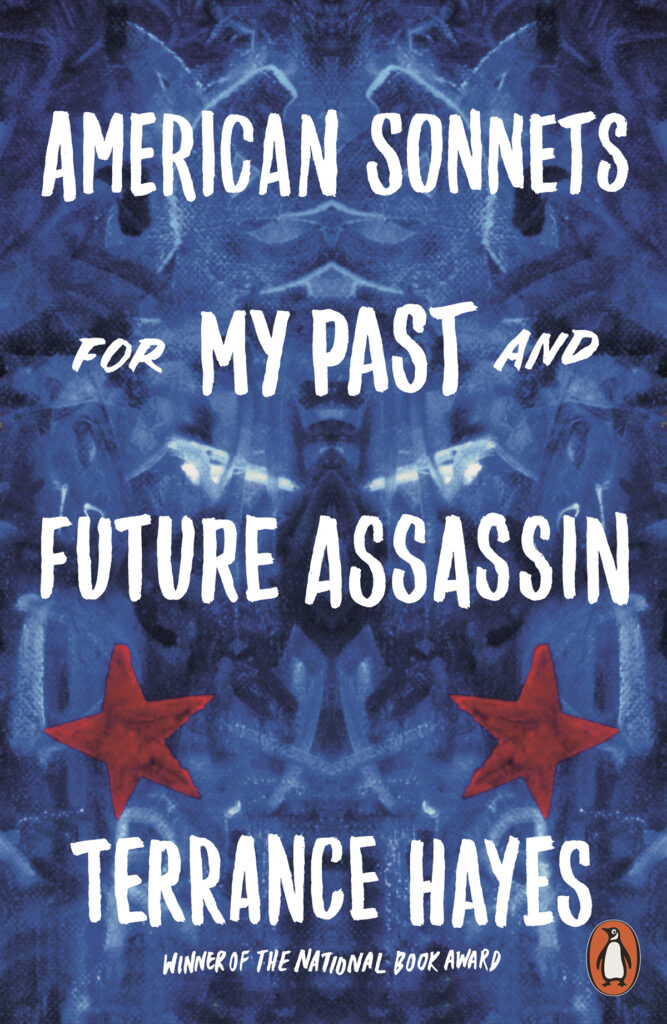
Terrance Hayes’s collection, American Sonnets for My Past and Future Assassin, comprises a sequence of seventy sonnets and, into this crucible, Hayes casts the dreams and nightmares, love and hate of a nation. The result is fast-paced and disarmingly intimate, yet it declaims its politics of protest from the rostrum.
In a regular love sonnet, the conceit is that the speaker cannot capture the beauty of the beloved in language. Hayes’s sequence starts here too. The lover is Poetry and s/he is impotent: ‘In a second I’ll tell you how little / Writing rescues.’ Perhaps this is just a poetic conceit, as the sequence unloads its onslaught against the world’s most despised idiolect, against sonnet 40’s ‘honk of hollow thunder. / The umpteenth Believe me’. Hayes’s language testifies to a truth, to the belittling of a nation by ‘bumble bureaucracy / With teeny tiny wings too small for its rumpled / Dumpling of a body. Humpty-Dumpty. Frumpy / Suit. Instead of power, Hayes presents portliness and paradox as Trump is at once both corpulent and pathetically small. Presenting Trump as a bumblebee, and not as something dangerous and rapacious is supremely belittling. Trump is unnamed explicitly but 18 unique rhyming words – ‘thump’, ‘rump’, badunkadunk’ hit him like the jabs of a boxer, or perhaps he figures instead as J.K. Rowling’s He-Who-Must-Not-Be-Named – the embodiment of evil.
Hayes has his sights trained on more than Trump. At the time of writing, 11 were shot dead in an attack on a synagogue on Pittsburgh. Once again, it was suggested that more guns: guns on the door and inside the synagogue would, as Trump put it ‘have been far better […] maybe it would have been a much different situation’. In sonnet 58, Hayes places the gun in a domestic space. Verbs twist and pervert as the ‘you have’ of ownership becomes an act of coercion: ‘You have a gun but to use the poison / You have your son dip a rose in venom / So strong the smell alone will kill someone, But the first to die smelling it is your son’. The poem reads like a disgusting literalization of William Blake’s ‘The Sick Rose’. A sacrosanct space, perhaps the family, perhaps America herself, has been perverted. This becomes even more uncomfortable as, in sonnet 22, the speaker observes that ‘Christianity is a religion built around a father / Who does not rescue his son’.
Race too is read with sensitivity and nuance. In Sonnet 62, ‘the Robert E. Lee statue was painted white / So often over the years it looked like someone / Covered in a sheet of glue’. There’s a touch of comedy to the image as a version of a confederate past is destroyed in the crude attempt to preserve it but there are disturbing undertones here too as imperceptibly, through time, Lee dons the clansman’s robes.
Hayes’s conclusions are uncertain and the penultimate poem reads as a litany of recent flashpoints and killings: ‘I remember my sister’s last hoorah. / She joined all the black people I’m tired of losing, / All the dead from parts of Florida, Ferguson, / Brooklyn, Charleston, Cleveland, Chicago, / Baltimore’. There’s a weariness and pessimism here. Yes, there’s a bright side of sorts too ‘Because we are all dust’ in the end, although there is small comfort in this communion.
If the American novel is a fine wine, American Sonnets for My Past and Future Assassin is its grappa: the distilled, heady liquor of a nation. Yes, it burns, but thrillingly so.
Terrance Hayes’s American Sonnets for My Past and Future Assassin (Penguin Poetry) is shortlisted for the T. S. Eliot Prize 2018. John Field blogs at Poor Rude Lines.
Be among the first to receive updates on the latest T. S. Eliot Prize news by subscribing now!