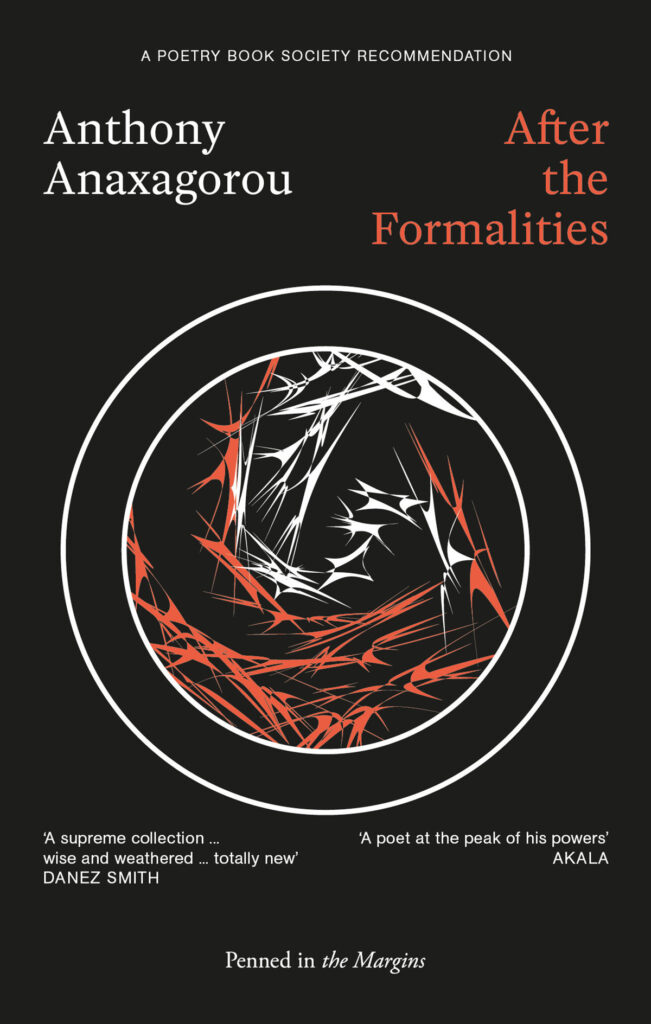

These urgent, honest poems in Anthony Anaxagorou's After the Formalities are born of our times and walk a tightrope of extremes. Anaxagorou looks bravely into the abyss but love marks the path, writes John Field
Be among the first to receive updates on the latest T. S. Eliot Prize news by subscribing now!
These urgent, honest poems in Anthony Anaxagorou’s After the Formalities are born of our times and walk a tightrope of extremes. Anaxagorou looks bravely into the abyss but love marks the path, writes John Field
After the Formalities is a spectacular collision of the public and the private, of little lives and the breaking of nations. Anaxagorou writes against the context of the comments made by David Starkey on national television following the riots that shook the nation in the summer of 2011. Starkey said that ‘A substantial section of the chavs have become black’ and, referencing Enoch Powell’s 1968 ‘Rivers of Blood’ speech, commented that Powell ‘was absolutely right in one sense. The Tiber didn’t foam with blood but flames lambent.’ Anaxagorou takes these trite remarks to task.
‘Cause’ starts, like Virgil’s Aeneid, in the middle of things, amidst the smouldering ashes of a civilization: ‘& to the burning I say / my worry is a whole country.’ The speaker travels with a ‘heavy trunk of silverware / museum glass polish / portraiture / of bent flags’. This nod to the razing of Troy destabilises Starkey’s notion of Romans and Vandals as Aeneas, Virgil’s legendary founder of Rome, is just a refugee pushing his chattels – the wreckage of a prized culture – towards a brighter future.
The stunning ‘Uber’ also enjoys an epic quality. Exploring ideas of home and homecoming, it’s a modern multi-national Odyssey, delivered in exhilarating form, terse as a fragmented start-stop conversation in a cab. Odysseus was a loner but in ‘Uber’, the displaced are everywhere, even out the window as ‘a car / makes an / emergency stop / a homeless / man / moves / like a saw / into traffic’, reminding us that ‘home’ and ‘belonging’ resist smug nationalistic notions of ethnicity. Love and work link us and the Uber driver keeps the photo of his nine-year-old daughter close as he earns the money to see her again.
Fatherhood too teeters on the brink. In ‘Things Already Lost’, stanzas walk the tightrope across the void between left and right of the page. The flattened pigeon on the driveway teaches the son a hard lesson as ‘Each morning for a week / he’d run to the window waving / at its disintegrating wings’ and through these means, ‘he learnt the perils / of grapes, to grip bannisters / & stand still for sun block’. These daily cares and rituals speak eloquently of our hopes and cares for our children. However, Anaxagorou digs deeper with fearless honesty. In the prose poem ‘A Boy Stood Still’, we revisit these hackneyed, timeless images of paternal tenderness: ‘With the top of my elbow dipped in, I float the yellow duck to be sure. 37o flashed a solid green’. The exactness of that digital thermometer flashes a convincingly geeky, manly green. On such familiar ground, nothing can prepare us for what follows: ‘my uncle made his son sit in a bathtub of ice water for half an hour.’ We are presented with two baths and two fathers and understand that life resists convenient generalisations – stereotypes – prejudices.
The final poem, ‘From Here the Camera Crew’ returns to unsettling images of apocalypse: ‘They’re sipping Old Fashioned / in their gardens tonight / deckchairs facing the sun’ echoes Nero, fiddling as Rome burned – a stern rebuke to Starkey’s ‘flames lambent’ suggesting that decadent torpor accounts for the state of a nation content to treat ‘the body of a boy in Dalston’ and Grenfell Tower as one and the same detached ‘brightness of a screen’. Anaxagorou concludes with a sickening yet optimistic image: ‘our nation a slow animal / unable to digest any more meat’.
These urgent, honest poems are born of our times and walk a tightrope of extremes. Anaxagorou looks bravely into the abyss but love marks the path.
Anthony Anaxagorou’s After the Formalities (Penned in the Margins) is shortlisted for the T. S. Eliot Prize 2019. John Field blogs at Poor Rude Lines.
Be among the first to receive updates on the latest T. S. Eliot Prize news by subscribing now!