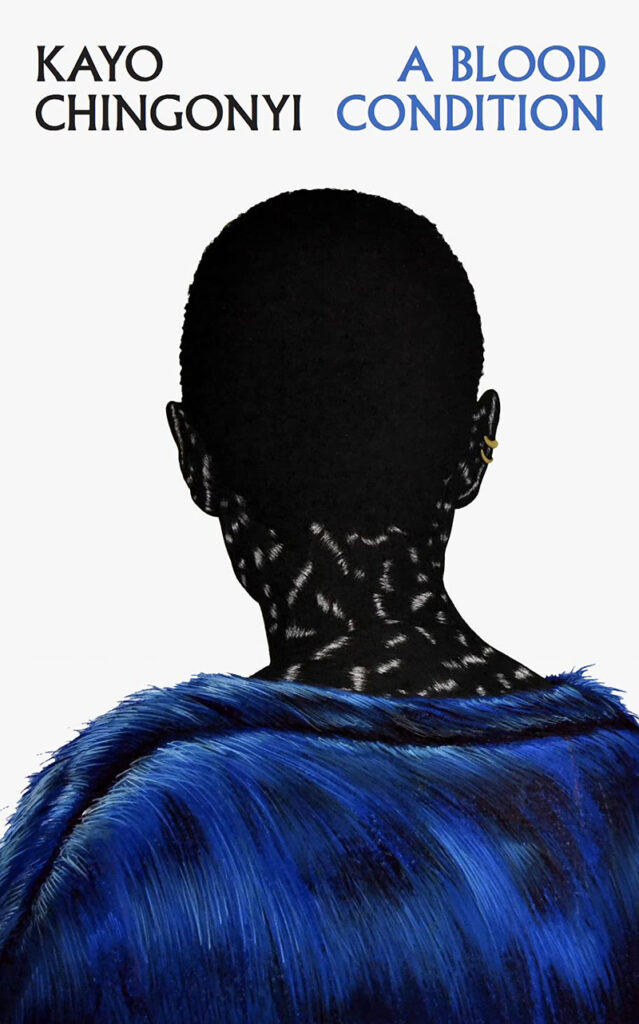

A Blood Condition

Chatto & Windus
Kayo-Chingonyi-c-Smart-Banda_bw
Kayo Chingonyi was born in Zambia in 1987 and moved to the UK at the age of six. He is the author of two pamphlets and a fellow of the Complete Works programme. In 2012 he was awarded a Geoffrey Dearmer Prize and was Associate Poet at the ICA in 2015. His first full-length collection, Kumukanda (Chatto & Windus, 2017)...

Review

Review

In Kayo Chingonyi’s meticulously crafted A Blood Condition, echoes and reflections bounce and shimmer between poems, layering meaning and lending the collection a gentle hauntedness, writes John Field


Read the
Reader's Notes

Videos

Kayo Chingonyi reads from A Blood Condition at the T. S. Eliot Prize Shortlist Readings
Kayo Chingonyi talks about his work
Kayo Chingonyi reads ‘Guy’s and St Thomas’s’
Kayo Chingonyi reads ‘Postcard from the Sholebrokes’
Kayo Chingonyi reads ‘Language Signs’
Kayo Chingonyi reads ‘Ginnel’

Related News Stories

The T. S. Eliot Foundation is delighted to announce that the winner of the T. S. Eliot Prize 2021 is Joelle Taylor for C+nto & Othered Poems, published by The Westbourne Press. Chair Glyn Maxwell said: Every book on the Shortlist had a strong claim on the award. We found...
Parisa Ebrahimi on a celebrated imprint, now run entirely by women Chatto & Windus has a long and illustrious history of publishing poetry. Founded in 1855, it is one of the UK’s oldest literary imprints, and the oldest continuous imprint at Penguin Random House. Poetry has formed the backbone of...
  Judges Glyn Maxwell (Chair), Caroline Bird and Zaffar Kunial have chosen the T. S. Eliot Prize 2021 Shortlist from a record 177 poetry collections submitted by British and Irish publishers. The Shortlist consists of an eclectic mixture of established poets, none of whom has previously won the Prize, and...
The T. S. Eliot Foundation is delighted to announce the judges for the 2021 Prize. The panel will be chaired by Glyn Maxwell, alongside Caroline Bird and Zaffar Kunial. The 2021 judging panel will be looking for the best new poetry collection written in English and published in 2021. The...
Review of A Blood Condition

In Kayo Chingonyi’s meticulously crafted A Blood Condition, echoes and reflections bounce and shimmer between poems, layering meaning and lending the collection a gentle hauntedness, writes John Field

As well as being shortlisted for this year’s T.S. Eliot Prize, Kayo Chingonyi’s A Blood Condition – his second collection – was also shortlisted for the Forward Prize for Best Collection. It explores absence and loss with a spirit of generosity and thankfulness. The collection is meticulously crafted: both at the level of the individual poem and as a whole. Echoes and reflections bounce and shimmer between its poems, layering meaning and lending it a gentle hauntedness.

Chingonyi opens with ‘Nyaminyami’, an exploration of Nyami Nyami, the river god of the Zambezi. The prose poem flows like a torrent, broad and wide as, on the page, the margins – the poem’s banks – are reduced to thinnest of strips by Chingonyi’s expansive lines, for ‘the river is wide and the flow gives life’. However, this Zambezi flows through memory, not through the present, as the repeated preposition ‘before’ circumscribes its flow: ‘before the valley was connected by the orderly topography of macadam and the valley’s footworn pathways, taught to the valley’s young by experience, were paved’. ‘Nyaminyami: …the river god’ follows next. Prose is swept aside and Chingonyi offers gnomic truth as the river’s snake god bites back at the Kariba dam and the collection’s first haunting is an environmental one as ‘we often make mistakes / make beds   in which our descendants sleep badly’.

Chingonyi follows this with ‘Origin Myth’, a sonnet corona meditating on the genesis and legacy of HIV where ‘a ghost note in simian blood / is loosed by a novice butcher’s unsteady knife work’. We’re reminded, perhaps, of the Wuhan South China Seafood Wholesale Market, and Chingonyi’s use of the sonnet corona feels like an oblique reference to coronavirus. In the sonnet corona, the final sonnet’s last line becomes the first line of the first and Chingonyi’s concatenations lends ‘Origin Myth’ a cyclic quality, inviting us to consider when humanity will release contagion’s next ‘ghost note’.

The collection’s engagement with the poetry of Tony Harrison makes itself felt long before we reach ‘Postcard from the Sholebrokes’, written for Tony Harrison. In ’16 Bars for the Bits’, we encounter the collection’s first Meredithian sonnet, a form Harrison made his own in ‘The School of Eloquence’. The OED records ‘bits’ as Northern English and Scottish slang for ‘poor little children’ and Chingonyi’s 16 bars are both the 16 lines of his Meredithian sonnet where ‘the Youngers get bladdered and stagger’ and an epic pub crawl. It’s a relentless, intoxicated tour de force where 11 of the poem’s 16 lines use the same rhyme, and its presentation of the underbelly of the city reads as Chingonyi’s nod to Harrison’s ‘Durham’.

‘Ginnel’ explores a dialect word for a channel, or a long narrow passage between houses, and initially presents as a dictionary entry: its numbered stanzas akin to the numbering of definitions. The poem starts safely enough with ‘an interstice’ – perhaps a playful acknowledgement of the dictionary’s tendency to send its reader on a spiralling quest across its pages, as the words used in a definition create more problems than they solve. Chingonyi’s second line starts with an indent, a ginnel’: ‘     a quarter-tone’ and, somehow, his poem embodies this void, this ‘last known / whereabouts / of missing persons, this ‘gap in the teeth / of a terraced street’, and the void of absence becomes palpable, worried away at by the troubled tongue. In ‘landscape w/ motorway’ the reader’s mind returns to ‘Ginnel’ as we see ‘the spot a car abandoned its original / trajectory’ and, in a nod to Paul Muldoon, the ‘wayside shrine   a warning sign’ by the roadside speaking of another absence.

Despite his meditation on loss, the collection returns to its beginning, suggesting that the ebbing river will once again flow and ‘to this day pilgrims / sometimes see a momentary swell / in the course of the river’. Chingonyi’s beautiful, austere poetry leaves us on the brink of renewal.

Kayo Chingonyi’s A Blood Condition (Chatto & Windus) is shortlisted for the T. S. Eliot Prize 2021. John Field blogs at Poor Rude Lines.

A Blood Condition
Chatto & Windus

Newsletter

Be among the first to receive updates on the latest T. S. Eliot Prize news by subscribing now!


The T. S. Eliot Prize on Social Media

Part of tseliot.com

Designed by thinking

Interview of A Blood Condition

A Blood Condition
Chatto & Windus

Newsletter

Be among the first to receive updates on the latest T. S. Eliot Prize news by subscribing now!


The T. S. Eliot Prize on Social Media

Part of tseliot.com

Designed by thinking