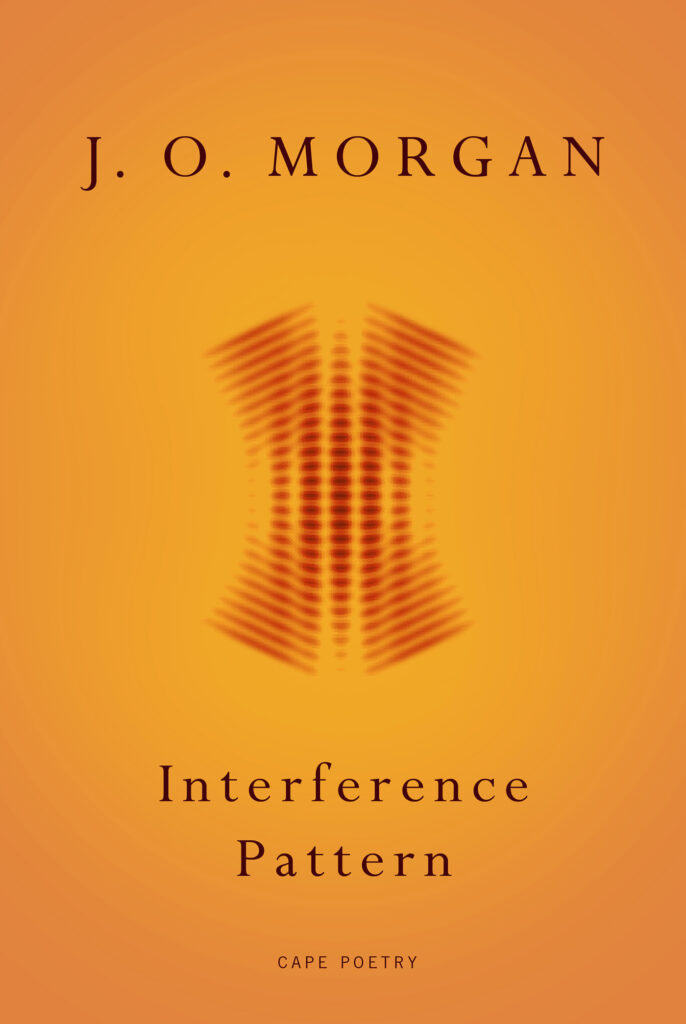

J. O. Morgan's Interference Pattern 'is an exquisite read and, although it is greater than the sum of its parts, its parts are, nevertheless, quite something', writes John Field
Be among the first to receive updates on the latest T. S. Eliot Prize news by subscribing now!
J. O. Morgan’s Interference Pattern ‘is an exquisite read and, although it is greater than the sum of its parts, its parts are, nevertheless, quite something’, writes John Field
Interference Pattern offers vivid, physical experience, offset by oblique, figurative responses. Although the book comprises a collection of individual poems, many of which stand alone sensationally well, this is no collection. Morgan’s poems work together to create a powerful, provoking metaphysical experience.
‘The first duty…’ voiced by someone responsible for unlocking a public swimming pool, presents the memory of – or perhaps the myth of – the tragedy of two girls drowned during an illicit midnight swim. One of the speaker’s duties is to ‘uncover the pool where, I’m told, / two girls were drowned, though long before my time’. The qualifying phrase, ‘I’m told’, suggests even the speaker’s dubiousness but, regardless, the event casts its blood shadow. Yet, despite the continuing uncertainty of the speaker’s ‘This we may presume’, s/he is powerless to do anything other than to conjure the two drowned girls: ‘and I can’t help but wonder what may bob into existence / as I slowly turn the wheel to roll the dripping plastic back’. ‘Turning the wheel’ re-casts the humble pool attendant as a minister of fate and humanity dwarfs into flotsam bouncing either upon a divinely ordained tide, or upon one of nihilistic chance.
I first encountered this poem as a Guardian Saturday poem back in March and, make no mistake, Morgan’s work is arresting, haunting and utterly memorable but, in book form, he achieves much more. ‘The first duty…’ segues into ‘it’s like the lights…’ a timeless, quasi-Homeric simile, the type of thing which one might expect to memorialize a fallen hero in the Iliad, an interference pattern running across the grain of ‘The first duty[‘s]…’ sense of time and place. The collection regiments its poems along these lines, as opposing sets of waves of interference, as the collision between the physical and the transcendental. Morgan also alternates between Roman and Italic typefaces to help to stage this opposition visually. It’s an incredible achievement – each poem gains mass and gravitas from the others. Furthermore, the Roman poems are aligned left but the similes often comprise two stanzas: one aligned left, and one aligned right – perhaps a signal of their equilibrium: ‘it’s like the lights that flash across the face / of a fruit-machine so many colours that flare up / and go out so fast it’s as if they are all lit at once’ – and we’re back at that wheel, rolling back the dripping plastic, chance and fate playing the brutal odds of the house – the flame of our brief candle has rarely felt so fleeting.
There’s a shocking calmness in the way in which some of Morgan’s characters deal with the universe’s chaotic cause and effect. One of the later poems, ‘I used to be…’ is voiced by ‘the teacher known / for dishing corporal punishment’. The line break here stages its own little drama as we mentally rehearse what teachers might be known for. ‘Dishing’, in this case pejorative, a meting out, ought really to be the provision of nutrition and represents the perversion of a vocation. Then there’s the chilly darkness in the teacher’s musing upon his cane and ‘those many lives it touched’. Ordinarily, one might hope that teachers touch lives to positive effect but then Morgan offers a maritime simile: ‘it’s like two boats whose courses bump and / after for a time run parallel and when / the vessels connect their timbers mesh / in part and are joined’.
J. O. Morgan’s Interference Pattern is an exquisite read and, although it is greater than the sum of its parts, its parts are, nevertheless, quite something.
J. O. Morgan’s Interference Pattern (Cape Poetry) is shortlisted for the T. S. Eliot Prize 2016. John Field blogs at Poor Rude Lines.
Be among the first to receive updates on the latest T. S. Eliot Prize news by subscribing now!