This article on the T. S. Eliot Prize was first published in the Poetry Book Society’s PBS Bulletin in 1993.
I’m not sure when the closing date for the first T. S. Eliot Prize was, but I do know that by the time it came more than a hundred new collections of new verse had been submitted for consideration. Out of these the judges had to choose ten to form a shortlist. Correction. We had to choose six. The PBS selectors’ four quarterly choices were already guaranteed their place. Six out of a hundred. What chance of agreement there? The odds against seemed sky high. I spent much of last summer reading through this hundred, some in book form, others still at proof stage, a few no more than the corrected typescripts, and although it didn’t take much more than a glance to realise that some could simply be binned, a sizeable number of volumes deserved second and then third readings. After a few weeks of reading and note-taking I had got down to a list of twenty titles. I’ve no idea whether the other judges worked this way, nor did I think it right to enquire. But I now had to choose six from twenty. I checked my notes, re-read once more and made up my short list. (Though not without misgivings. Was that volume I’d discarded right at the beginning really as naff as I’d thought it, did it perhaps glint with a genius I was blind to?). Then I posted my list to Peter Porter, our chairman, and left for a two-months’ residency in Tasmania.
A month later he telephoned me from the PBS headquarters where the rest of the judges had met to draw up the agreed shortlist. To my surprise only two of my choices didn’t find favour elsewhere and one of these was, I knew ‘rogue’. (I had made a case for Roy Fuller’s posthumous collection but Peter rightly ruled it out on the grounds that the prize had to go a living poet. Still, in that case, why was it submitted – only asking). So now the even more difficult task began. Further re-readings, a desperate attempt not to look at reviews of the shortlisted volumes, a wariness about literary chat that might turn into ear-bending sessions on the relative merits of X or Y and the reasons for their being over/under valued. By the time the five of us came together on 13th of January, with Gillian Beer representing the interests of the PBS members, I was quite certain which I thought was the best collection, but I was far less certain of a ranking order, always supposing one was thought necessary.
Peter opened proceedings by suggesting that we abandon any idea of setting down our preferences in order to make grand totals for each name. That was, as he pointed out, because it was entirely possible for the winner to be someone none of us had put at the top of our lists. No compromise winner, in other words; number three by popular choice couldn’t be allowed to carry off the prize. That out of the way, we heard about the PBS members’ votes. Only one separated Carol Ann Duffy from Patricia Beer and the same margin distanced Beer from James Fenton. ‘Well,’ as Philip Larkin remarked in a rather different context, “useful to get that learnt.’ We settled down to a discussion about which titles each of us was ready to discard. There was general agreement that two could go. But there we stuck. How about collections on which we’d changed our initial views, Peter enquired? Did any look better in the light of re-readings, had any dropped down? The question generated a good deal of discussion, as they say in Management guides. Next question: were there any collections we felt rock solid about? Yes, there were. They weren’t the same, by any means, but a kind of pattern was beginning to emerge. The same four or five poets kept cropping up. We were getting close to a decision.
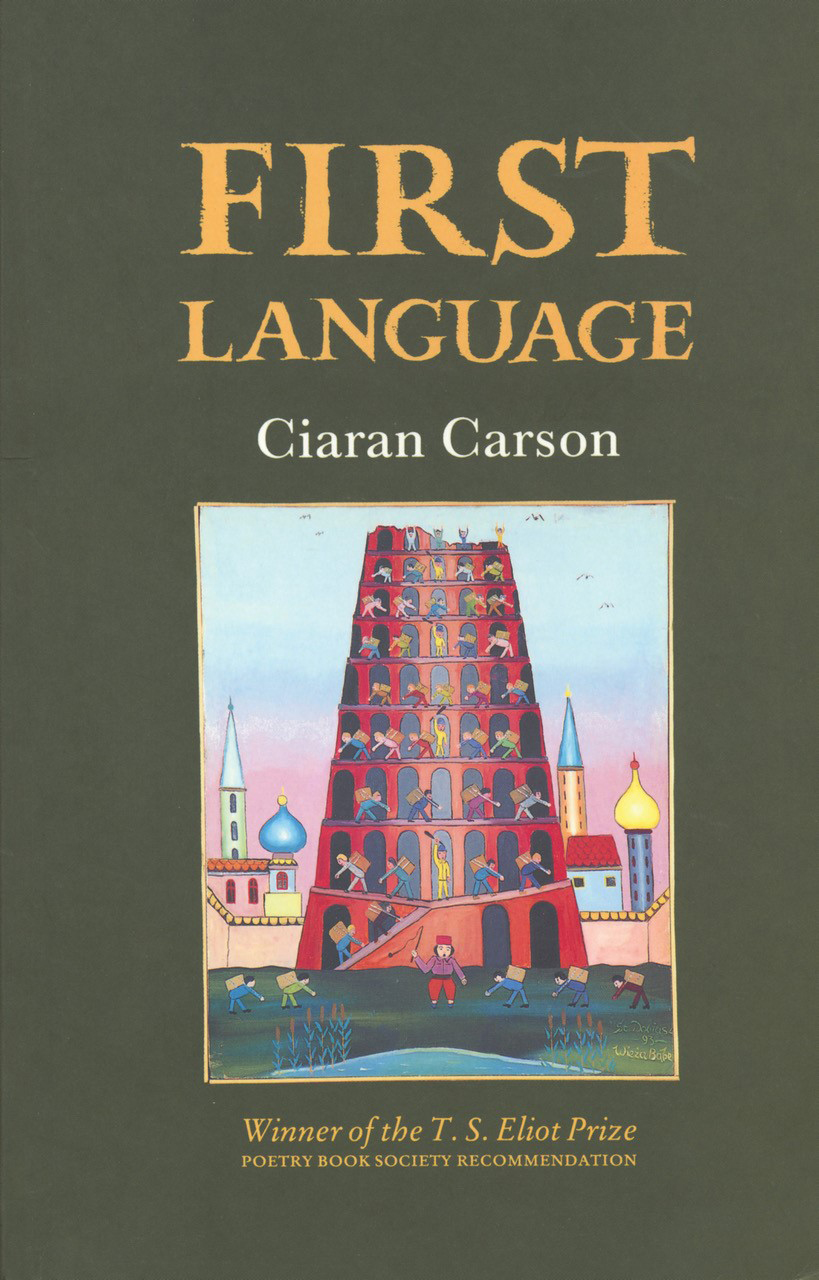
Or were we? A number of strongly-urged claims for different collections suggested that agreement might still be some way off. One judge’s first turned out to be another’s third, or fourth; a third judge agreed with neither as to which should be at the top. We were in broad agreement about the best five collections, but could we agree about which was the best of the best? Perhaps we ought to name our top three choices, Peter suggested, and list them in descending order. We went round the table and suddenly it was all over. Three out of five judges had First Language at the top of their lists. Ciaran Carson was the winner of the T. S. Eliot annual prize for 1994.
The T. S. Eliot Prize 1993, the first to be awarded, was presented to Ciaran Carson for First Language (Gallery Press) at the Chelsea Arts Club, London, on 20 January 1994. The judging panel comprised Peter Porter (Chair), Edna Longley, John Lucas and PBS selectors Fleur Adcock and Robert Crawford.
This article, published here to provide a fuller picture of the T. S. Eliot Prize history, first appeared in the PBS Bulletin spring 1994, number 160, the members’ magazine of the Poetry Book Society, © John Lucas, is reproduced by kind permission of the Poetry Book Society, www.poetrybooks.co.uk
The T. S. Eliot Prize was inaugurated by the Poetry Book Society in 1993 to mark the Poetry Book Society’s fortieth birthday, and to honour its founding poet. The T. S. Eliot estate has provided the prize money since the Prize’s inception, and the T. S. Eliot Foundation took over the running of the Prize in 2016, following Inpress Books’ acquisition of the PBS.