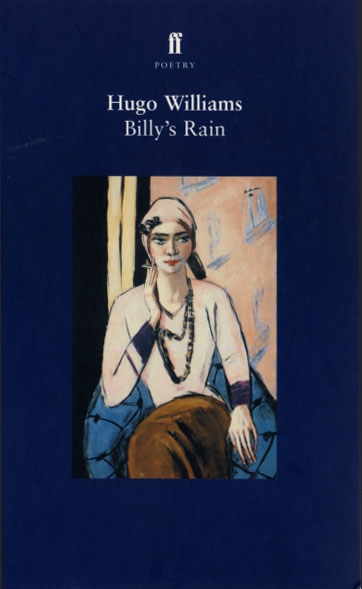
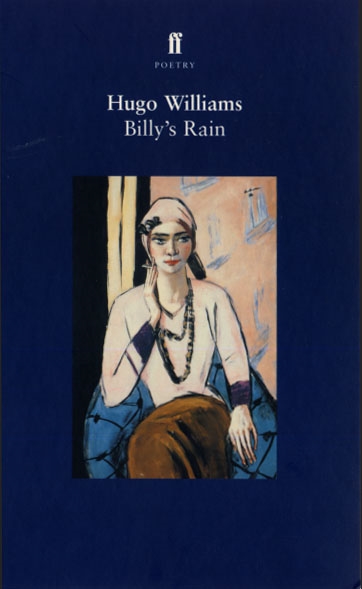
Judges Blake Morrison (Chair), Selima Hill and Jamie McKendrick chose Hugo Williams’s Billy’s Rain (Faber & Faber) as the winner of the T. S. Eliot Prize 1999. ‘What [Hugo] was trying to do was incredibly ambitious,’ commented Selima Hill. ‘It was cool… It was very brave.’
We asked Hugo to reflect on his experience as an Eliot Prize winner. He wrote:
I can’t be the first Eliot Prize winner to look in the mirror with renewed self-approval, as if he has just been knighted or got a gold star in God’s Good Conduct Book. Hard to credit my luck, considering Michael Hofmann was on the shortlist. It must have been a default verdict, or perhaps a kind of mad nepotism because my daughter had married a remnant of the Eliot family who grew up in a house called Port Eliot on the River Tamar. Harder still to credit the prize when you remember that the modernist style of the Prize’s namesake was conceived a hundred years ago last year and died out a few years later under the influence of Auden and co, and then Philip Larkin.
As Eliot himself once said, modern poetry must be ‘difficult’ – although the same quality has to be called ‘resistance’ in academic circles. I was once asked the question: ‘Is it difficult what you do?’ and suddenly couldn’t remember Fred Astaire’s famous answer: ‘If it looks difficult you aren’t working hard enough’. Difficulty sounds like a kind of ingredient or flavour like saffron or curry powder. Did one put it in before or after writing the poem? I put six nonsense poems in my last book and everyone said they were no different from my ordinary ones. Oh well.
Modern poetry started to be taught at Oxbridge the same year The Waste Land came out, hence Eliot’s jokey notes for the professors. The sort of minimalist icebergs of my generation hardly compare with the great cultural commentaries of TSE (luckily for me).
English Literature courses began
In nineteen twenty-two
(Which was just in time for you) –
Between the end of paper and pen
And the reign of scissors and glue.
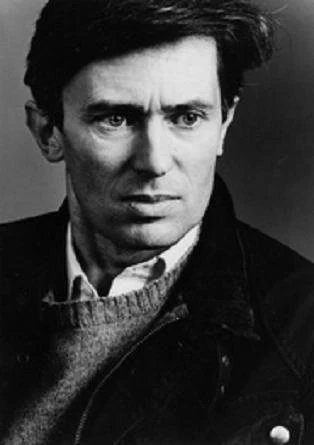
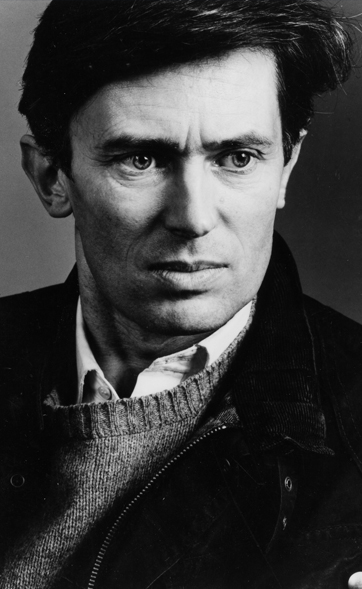
Hugo Williams was born in 1942 and grew up in Sussex. He worked on the London Magazine from 1961 to 1970, since when he has earned his living as a journalist and travel writer. As well as winning for Billy’s Rain, he was also shortlisted for the T. S. Eliot Prize four further times: in 1994 (Dock Leaves); 2006 (Dear Room); 2009 (West End Final); and 2014 (I Knew the Bride). He was a judge in 1997. His Collected Poems was published in 2002 and his latest collection, Lines Off, was published by Faber & Faber in 2019. In 2004 he received the Queen’s Gold Medal for Poetry.
About the T. S. Eliot Prize
The T. S. Eliot Prize celebrated its 30th anniversary in 2023. Awarded annually to the best new poetry collection published in the UK and Ireland, the Prize was founded by the Poetry Book Society in 1993 to celebrate the PBS’s 40th birthday and to honour its founding poet. The T. S. Eliot Estate has provided the prize money since the Prize’s inception in 1993, and the T. S. Eliot Foundation took over the running of the Prize following the acquisition of the PBS by InPress Books in 2016. For more on the history of the Prize, visit tseliot.com/prize