WINNER
2022

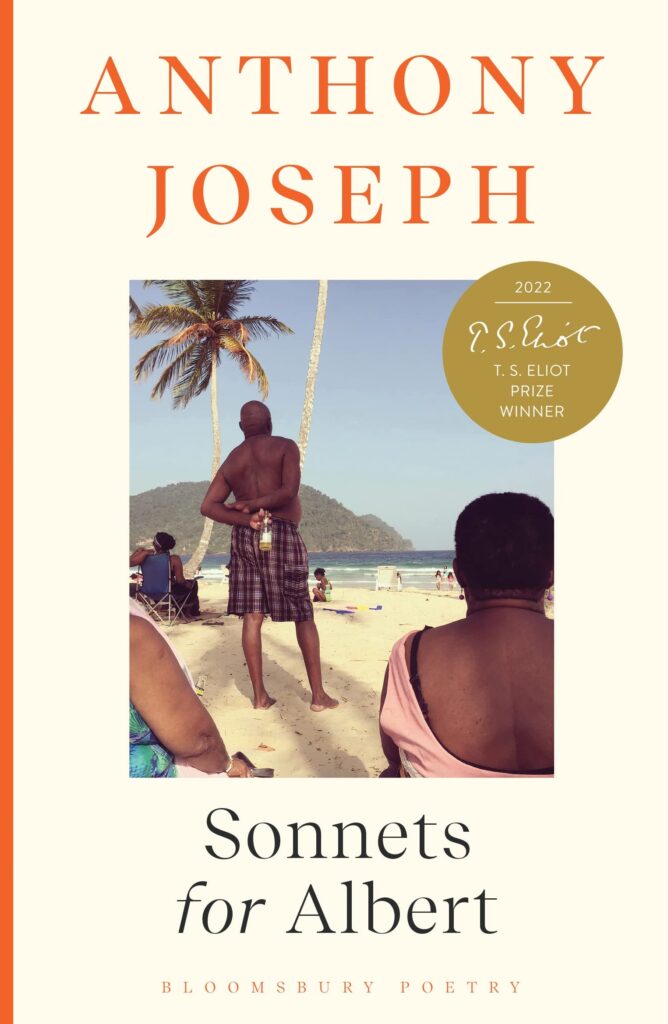
Sonnets for Albert

Bloomsbury Poetry
T S Eliot Prize 2022 presented Jan 16th 2023Anthony Joseph Winner
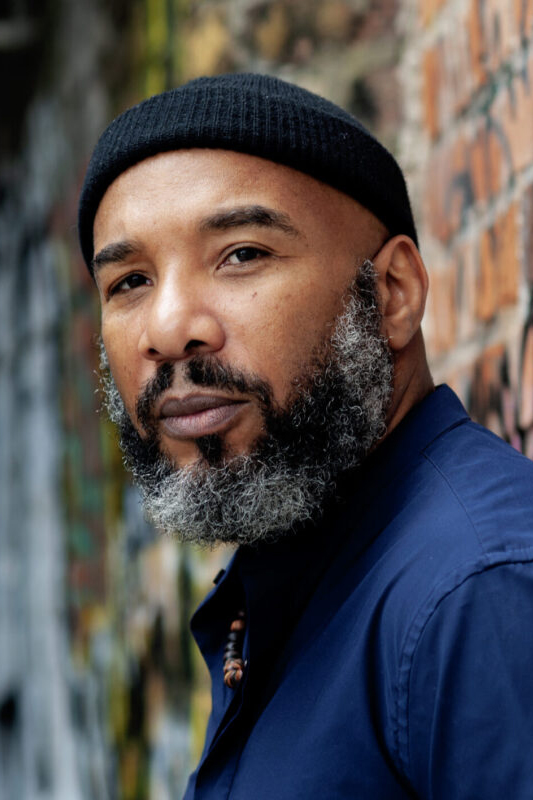
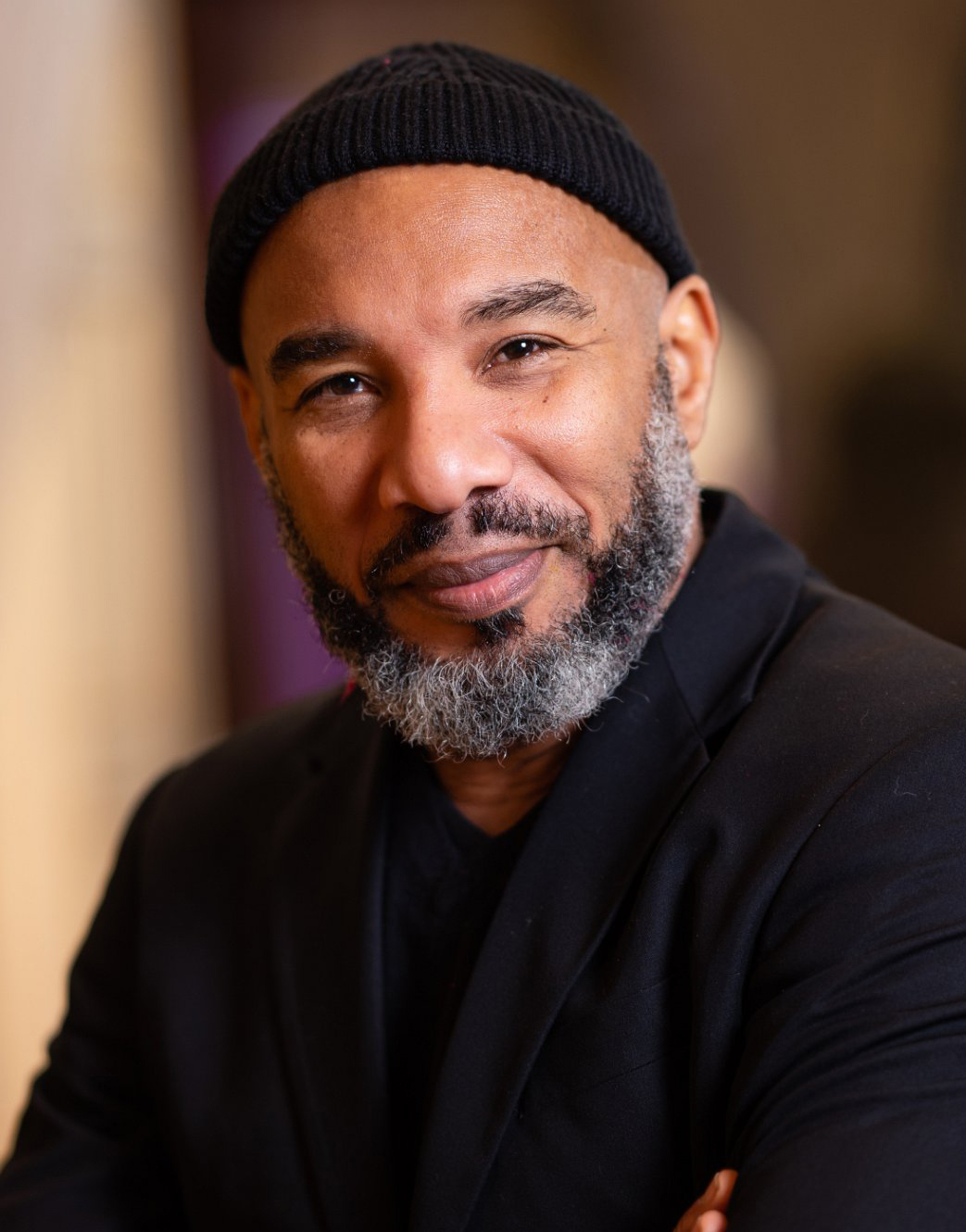
Anthony Joseph was born in Trinidad. He is a poet, novelist, academic and musician. He holds a PhD in Creative Writing from Goldsmiths University and is a Lecturer in Creative Writing at King’s College London. He was the Colm Tóibín Fellow in Creative Writing at the University of Liverpool in 2018 and was awarded a Jerwood Compton Poetry Fellowship 2019/20....

Review

Interview

Review

Anthony Joseph’s Sonnets for Albert explores how we cling to precious moments in time and, when necessary, construct absent loved ones from scant coordinates, writes John Field

Interview

Anthony Joseph’s Sonnets for Albert (Bloomsbury Poetry, 2022), shortlisted for the T. S. Eliot Prize 2022, explores the difficulties of truth-telling and how this can be overcome by love. We spoke to Anthony Joseph about his collection

Read the
Reader's Notes

Videos

The Complete T. S. Eliot Prize 2022 Shortlist Readings
Anthony Joseph reads from Sonnets for Albert at the T. S. Eliot Prize Shortlist Readings
Oliver Fox reads from Anthony Joseph’s Sonnets for Albert
Anthony Joseph reads ‘P.O.S.G.H. 1’
Anthony Joseph talks about his work
Anthony Joseph reads ‘El Socorro’
Anthony Joseph reads ‘Jogie Road’

Related News Stories

In 2023 the T. S. Eliot Prize celebrated its 30th anniversary. We marked the occasion by looking back at the collections which have won ‘the Prize poets most want to win’ (Sir Andrew Motion). In announcing Anthony Joseph’s Sonnets for Albert (Bloomsbury Poetry) as the winner of the T. S....
The T. S. Eliot Foundation is delighted to announce that the winner of the T. S. Eliot Prize 2022 is Anthony Joseph for his collection Sonnets for Albert published by Bloomsbury Poetry.
Judges Jean Sprackland (Chair), Hannah Lowe and Roger Robinson have chosen the 2022 T. S. Eliot Prize shortlist from a record 201 poetry collections submitted by British and Irish publishers. The eclectic list comprises seasoned poets, including one previous winner, and five debut collections. Victoria Adukwei Bulley – Quiet (Faber &...
Review of Sonnets for Albert

Anthony Joseph’s Sonnets for Albert explores how we cling to precious moments in time and, when necessary, construct absent loved ones from scant coordinates, writes John Field.

When we’re reading sonnets we’re often reading a poetry of desire or a poetry of loss, but in Anthony Joseph’s Sonnets for Albert, his fifth collection, we’re reading a poetry of absence. The collection, punctuated by family photographs, explores how we cling to precious moments in time and, if necessary, construct loved ones from scant coordinates. In conversation with Gregory Porter about their fathers on BBC Radio 4, Anthony Joseph comments that, ‘because of that absence […] we create a mythology around the character[…] and he becomes more present in the absence.’

The collection opens with ‘Breath’, an account of Albert’s funeral. The speaker tells us that ‘When I hear my father dead, / I flew ten hours into the sun.’ Perhaps it’s fanciful, but this island setting invites a parallel with Odysseus’ wandering and return to Ithaca. Seven years spent with Calypso could not quench Odysseus’ desire to return home and, even in death, Albert exerts this gravitational pull on his son. The poem’s first line is a bump in the poem’s groove as the Caribbean grammar of ‘my father dead’, instead of the Standard English ‘my father was dead’, creates a ghost in the line. There’s a similar uncanny moment at the end of the poem where, ‘There was no wind, no breath in that hot time, / besides the warm air above may father’s mouth’; for a moment it seems as if Albert breathes still. In a way, he does: the dead father lives on through the sonnets, he lives on through his children too; as the speaker comments in ‘Rings’, ‘I only have to look at my hands to see my father.’

The circling structure of Sonnets for Albert, which begins with the father in his casket, ventures through incident and memory, and ends with an invocation beside his grave, nods to the cyclical nature of life, the rhythm of the dance. It’s an idea which is explored in ‘The Work of Generations’. Life, the poet’s dance partner aunt Agnes explains, is a ‘circular motion’, and the speaker and his brother ‘are of another generation and loop. / That soon it will be our turn too, to turn / towards our graves.’ As Joseph explains in the BBC programme, the calypso, the pulse of the Caribbean, animates Sonnets for Albert. Eschewing iambic pentameter, Joseph works with something akin to the rhythms of Albert’s speech, something closer to the calypso. For example, in ‘What Do I Know of My Father’s Body?’, we read ‘to thread a rose through the eye of your lapel. And I find’. That final three-beat stab give the poem a calypso quality.

The absence in these poems is an enigmatic ache. In ‘Flack and Hathaway’ (another musical reference, this time evoking Roberta Flack and Donny Hathaway’s cover of ‘You’ve Got a Friend’), Joseph cuts his lines to half their regular length, Albert’s absence represented as the unguessable blankness of the page: ‘My father would be gone. / Months into mystery.’ It’s a broken poem and the halting end-stopped lines articulate that pain. If, like Odysseus, the speaker has left and then returned home, then the same is true for Albert: ‘And while we waited / the myth of him grew, / till the anticipation / of his return / would fill each room.’

So the father is built from myth or, if not myth exactly, then through the faults and failings of the memory. In ‘Jogie Road’, a violent confrontation between the speaker’s mother and father is recalled in vivid detail at ‘The red / sawmill on Jogie Road with cedar grain / in its fibrous air. Red.’ The restatement of the colour of the sawmill is a verbal tick we use when we are at our most uncertain. And myth is created from faulty memory: ‘The red sawmill / was not on Jogie Road but on Silvermill.’

In Sonnets for Albert, Anthony Joseph weaves the messy warp and weft of family life with disarming ease. What emerges is truthful, at times painful, but always warmly human.

Anthony Joseph’s Sonnets for Albert (Bloomsbury Poetry, 2022) is shortlisted for the T. S. Eliot Prize 2022. John Field blogs at Poor Rude Lines.

Sonnets for Albert
Bloomsbury Poetry

Newsletter

Be among the first to receive updates on the latest T. S. Eliot Prize news by subscribing now!


The T. S. Eliot Prize on Social Media

Part of tseliot.com

Designed by thinking

Interview of Sonnets for Albert

Anthony Joseph’s Sonnets for Albert (Bloomsbury Poetry, 2022), shortlisted for the T. S. Eliot Prize 2022, explores the difficulties of truth-telling and how this can be overcome by love. We spoke to Anthony Joseph about his collection

T. S. Eliot Prize: What would you say Sonnets for Albert is about?

Anthony Joseph: There are layers. On the surface, it’s about my relationship with father, my relationship to what I think I know of him, to memory. I’m creating a sort of fragmented, non-linear biography of him; the book as a holding place that contains and holds him while I try to make sense of what he was to me.

But at its heart the book is really about loss and love, I think love is the main theme – the capacity to love, the way we can love unconditionally where a person’s humanity, their substance, is so strong it displaces their questionable aspects. My father wasn’t great as a dad, but I loved him, was fascinated by him. Readers have asked how, or why I could write a book about someone who was not a good father to me. But that’s the point. I needed to write this all down to make sense of him and the impact of his absences on me.

TSEP: Christopher J. Griffin has written a very interesting article on your non-linear approach as a writer. You take many routes to build the story of your father: your own (unreliable) memories; the sometimes contradictory memories of other family members, friends and neighbours; and photographs, many you’ve taken over years (not presented chronologically), some old family photographs – a wedding photo of your Mum and Dad, a passport photo. The effect is something like the poetry equivalent of funeral chat, with everyone bringing their different experiences of a person to the moment. Could you talk about this?

AJ: Death has the tendency to push the defining aspects of character into focus. Death is a caricaturist. In our loss we grieve for the things which were good. So I remember the good things about my father – his style, his charisma, his laughter, and I focus on that. I also have a rule that I live by as a writer, which is, if you are writing something that you know will hurt someone, don’t write it. My sonnets for my father were not the place to crush him under critique. We spoke about this, well some of it, in person.

Equally, I believe that a biography is only a beginning. And, as a Caribbean writer, my focus tends to lean on the communal. Perhaps, because our history has been characterised by an us and them strategy for so long. It was us, the colonised as a homogenous entity, against or under the colonial power. Things have changed somewhat, but I still think that the best way to tell the life story of someone is to seek out the voices and memories of those who knew them. One voice – my voice – cannot hope to render enough of an angle around my father. To show more angles, to shine more light I needed to speak to other people who knew him. The contradictions are useful, since the truth – if there is a truth – lies somewhere between the conflicting versions. The imagination of the reader brings their own experience as a coefficient, filling in the soft spaces of the poems.

My father was a charismatic loner. Is that even possible? But he was. And he was awkward and reticent with affection. In my book I try to evade his evasions, to approach much closer than he would let me in his living time.

TSEP: So you apply formal means – the sonnet and photography too – as mechanisms to frame or control what remains difficult to fix. Is that right? Did finding your thoughts and responses through the sonnet, especially as you wrote more and more of them, become a very natural process? Or have you reorganised and polished the poems endlessly?

AJ: I write poetry incrementally, most of the time at least. Though sometimes the universe says, ‘Gosh, you’ve been working so long at this poetry thing. Here, just have a poem, go to bed’, and then the poem comes fully formed. But generally I can work for many years on a poem, on a collection.

A lot of these sonnets started out as strict form Shakespearian sonnets. I was drawn to the traditional form for its discipline, for its potential for austere tone, for the confines of its form – in a kind of Oulipian way it can be poetry by permutation and constraint. I saw it as a place to wrestle my memories of my father into the shape of a poem. Control – the rigours of the strict form dictating a path. And for a while this worked well.

But the Shakespearean sonnet is an imperial form that tries to convince you to frame your argument in a certain way. For me, the subject matter resisted this, and after a few months, the poems demanded a looser leash. They started to shift into something else, something more Caribbean, more like my Dad, and I just followed.

It’s like a saxophonist having to navigate the keys and rituals of playing scales before they can learn how to play free. And even then you aren’t totally free since you’re using the tools you learned from form to be free, and the sonnet remains a sonnet.

Anyway, yes, the poems were polished and polished, until I grew nauseous from editing and abandoned them, and they do attempt to ‘fix’ their subject into form and so, into historical space. As James Salter says, ‘[…] everything is a dream, and only those things preserved in writing have any possibility of being real’.

TSEP: Your Dad was fugitive and photographs both fix and fade. Was the inclusion of the photographs and the way you describe yourself photographing yourself in the poems – emphasising the distance between photographer and subject, son and father – a very conscious idea?

AJ: Yes, the photos are, like the poems, paths towards a glimpse into the soul of my father, which is really about how my gaze bounces back from him, reflecting me in the mirror of the eye. I mean, we are who we are because of others, so too, I know myself partly from what I imagine my father’s image reflects. I think. There is something curious about photography and time. In one sense a photograph fixes time, makes it stand still. In another sense it extends time infinitely. In looking at a photograph I took of my father – and I took dozens over the years, always trying to hold him –  I am drawn back to the moment, which now extends, emotively and visually, into the present moment; the photo acting in this instance, not as a monument to time, but as a time machine, manipulating time itself. I felt that the photos, too, told the stories the poems could not. They captured and hopefully transmitted parts of his personality in a way I could not capture in words.

TSEP: Is it love that closes the distance, unravelling the mystery and mask?

AJ: Yes. It is love. Love is the reason I could write this collection. I fell in love with my father early in life. There is a short poem in my first collection, Desafinado, called ‘Clark Boots’: it is Christmas Eve and I have found a present my father has brought for me and tried to hide in my bedroom. He comes into the room and takes the cardboard box from me. He smiles and just says, ‘Nope’, and stands on the dresser to put the box far from my reach. It’s one of my earliest memories of him, but I remember how I felt, the way I looked up at him, his bellbottoms, his Clarks desert boots, the way he smiled at me. My father, when we were together, never gave me cause to feel anything else but love and laughter. I was both mesmerised and confused by him. I think that is love. And I think love is what closes the gap as I move from the outside, into a close up of him – the poem, as close as I can get to him and to myself.

TSEP: Your parents’ wedding photo is the cover of your book Teragaton, published in 1997. Is there a connection between its use there and in Sonnets for Albert?

AJ: Yes, in both I am in the image. In Teragaton the photo was used as an allegory for what that book was conceptually about. At the time I was interested in surrealism and what I called the ‘core text’, the unconscious text. My existence as a hidden but potent being, hidden within my mother echoed this idea of a core, non-visible text. The word ‘Teragaton’ had come to me in a dream, whispered by my recently deceased mother, walking backwards up a hill, so it seemed apt to have her there.

And now, in Sonnets… they are both gone; joined together in the gone momentum, so the photo – in which my mother is 18 and my Dad 23 – and the two poems in which they feature, complete a symbolic cycle and bring them together for a final, perpetual time.

TSEP: The book is about self-exposure too. In one of my favourite poems, ‘El Socorro’, you recognise your father’s forearm and fingers as your own, in ‘Rings’ you compare your hands to his, and In ‘The Trembling unto Death’ you recognise his dark moods and lightness as your own. Is this to do with the lost physicality of your father and/or the recognition of our own mortality when we lose someone we love?

AJ: Yes, that’s true in both cases. I think when a parent dies we are forced to reconcile with our own mortality. Both my parents have now passed. My mother died at 47. There are places in Sonnets where I speak of my own mortality, and the body within this motion, and my children, and their cycle.

I remember arriving at the funeral home where my father lay, early morning, I was the first to arrive, and the receptionist took me upstairs and just opened the casket as if she was opening the bonnet of a car, or a cake box lid. It was strange being confronted with this body. And I touched him, felt the rigidity of his chest. It was almost invasive.

The mood swings and darkness, yes, my brother, my father and I all suffered/suffer from this. I’m not sure if its genetic. But there is, equally, lots of brightness too, and I have inherited some of my father’s hedonism and naivety.

TSEP: Can you say something about the blank pages through the book – why are they there?

AJ: Space. The collection is filled with so many moments of loss, sadness, so much heavy imagery. The blank pages, I hope, give some respite to the reader. A breath. They are also filmic, like the closing of a scene, a transition into the next. I’ve always thought of poetry as a visual art as well. 

TSEP: When we met you said that you were telling a story that might otherwise remain hidden or untold or be lost – and this has been the case with Caribbean lives and history. Would you expand on that?

AJ: As Caribbean writers, we often become the historians, keepers of heritage and collective memory. And the best way of doing this work of universality is by being as deeply personal as you can. The personal is the universal. Oral history fades and dies; unless they are written down the things my aunt, my grandmother or my father told me, they are lost. The same is true for Black artists in the UK, as Pearl Connor once said, ‘In Britain there is no record of the contribution we have made to the performing arts. […] There is no memory in Britain for us. There is a hole in the ground and we fall into it.’

But why should our existence and contribution be so temporal?

I think that as a primarily Caribbean poet, I am not only retrieving and holding our histories, I am also extending Caribbean and Black British lives and thought into the future. I inherit the responsibility to be historian, story-keeper, biographer, recording and keeping what is so easily lost or forgotten.

My book Kitch was an attempt to do this. Lord Kitchener was a musician who arrived in the UK onboard the Empire Windrush in 1948, he made music for about 60 years, recording 100s of songs, and contributed our understanding of what it means to be Caribbean. And yet, when he died in 2000, there were no biographies, no real accounts of his life, no one place where anyone could view or listen to a discography. So I decided to do it. Same with my father – even though he’s not as culturally significant as Lord Kitchener, it was still important to document some of his life, the life of a Caribbean man, in Sonnets for Albert.

Anthony Joseph’s Sonnets for Albert is published by Bloomsbury Poetry. Watch the T. S. Eliot Prize filmed readings and interview, and read the reviews and Readers’ Notes online to find out more.

Sonnets for Albert
Bloomsbury Poetry

Newsletter

Be among the first to receive updates on the latest T. S. Eliot Prize news by subscribing now!


The T. S. Eliot Prize on Social Media

Part of tseliot.com

Designed by thinking