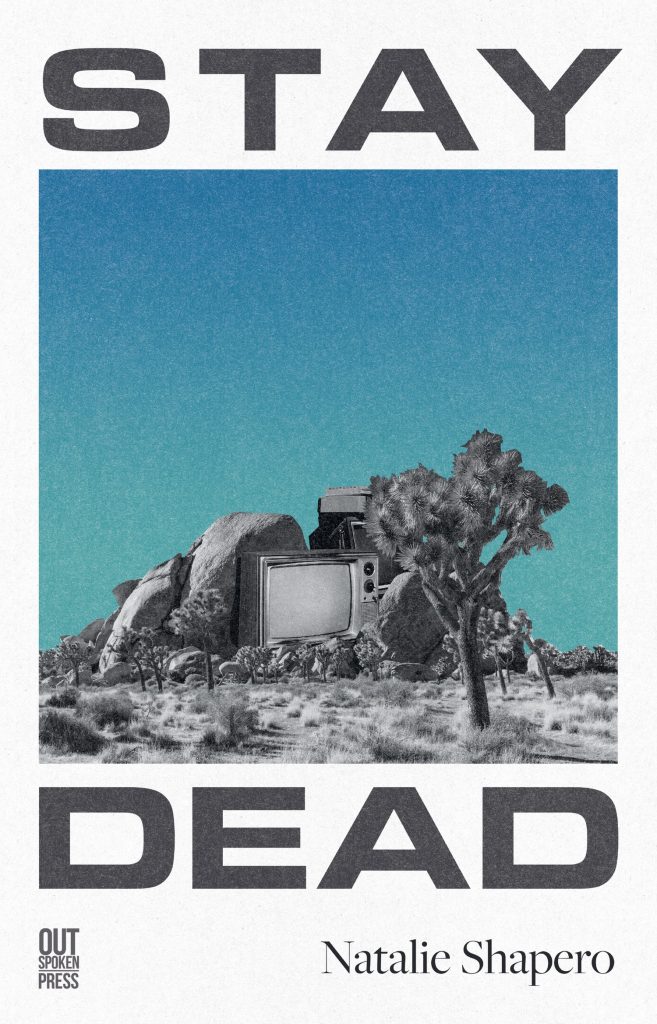
Natalie Shapero’s Stay Dead is a wake-up call, brilliantly parodying our language of doublethink and the contortions we subject ourselves to, writes John Field
Be among the first to receive updates on the latest T. S. Eliot Prize news by subscribing now!
Natalie Shapero’s Stay Dead is a wake-up call, brilliantly parodying our language of doublethink and the contortions we subject ourselves to, writes John Field
The blackly, bleakly comic Stay Dead is Natalie Shapero’s fourth collection. It can be enjoyed in a single sitting as its poems read like a stream of consciousness. The speaker has a magpie mind and their voice is wired and hyperactive as they muse on mortality. The collection parodies our language of doublethink, the contortions we subject ourselves to in order to make ‘no’ mean ‘yes’, to ensure that we continue to slumber as Earth spins into oblivion.
The collection’s title resurfaces early on in ‘Oh Boo Hoo’ – a title smacking of disingenuousness and mockery. The speaker adopts a tone of incredulity: ‘Five years on a research study / to unearth why former conscripts wouldn’t / talk about war. It turned out / to be because nobody wanted to hear it.’ The opening spondee, ‘five years’, expresses disbelief: how can academics fail to grasp the self-evident extent of our indifference? The poem proceeds to paint a world of narcissistic individualism, and the speaker concludes with an anecdote: ‘Have I told you / about when I died and came back / and everyone begged me / to please stay dead? It wasn’t, they promised me, personal – // they’d just gone all out on the funeral, and they didn’t / want all that money to be for nothing – ’. The poem’s built of quatrains, so that final couplet throbs with indignation. ‘Nothing personal’ is a cowardly euphemism as it hides indifference behind objective reason (or excuses).
Like many of the poems, ‘In Something’ uses acting as a conceit. We think of acting as a performing art, but the indeterminate quality of ‘something’ points to our uncritical response to the world: who cares what you’re in, as long as you’re in something? This indifference to the artwork is at odds with Mark Rothko’s vision of his own work (quoted at the start of the poem): ‘I PAINT VERY LARGE PICTURES… // TO PAINT A SMALL PICTURE IS TO PLACE YOURSELF / OUTSIDE YOUR EXPERIENCE, TO LOOK UPON AN EXPERIENCE / AS A STEREOPTICON VIEW OR WITH A REDUCING GLASS / HOWEVER YOU PAINT THE LARGER PICTURE, / YOU ARE IN IT’. Rothko’s stereopticon (double magic lantern) points to the faff, the artifice of realist painting, whereas his ‘in it’ offers instead a direct, elemental experience – an experience at odds with conspicuous consumption and property development. The poem shows us Rothkos hanging in New York lofts: ‘salon-style decor giving way to the ONE-PICTURE WALL, / the collectors clamouring not only for paintings of increasing dimension, but also for the loft layouts that were ideal / for their display.’ This, in turn, priced artists out of the studios necessary to create the art in the first place. It’s gorgeously circular, and the disjunction between Rothko’s aims and the poem’s language of ‘dimension’ and ‘display’ offers an unsentimental look at the self-lacerating nature of greed.
Black comedy is nihilism’s bedfellow and Shapero nails this in poems such as ‘Capacity Crowd’. Once again, the title points to a world in which we know the price of everything and the value of nothing, as the ‘Capacity Crowd’ at the venue is an unreliable proxy for the quality of the performance – it’s just a headline metric that speaks to popularity and profit. The speaker remarks that ‘I’m sorry to have died and not really / noticed, but I’ve been so busy loving / what you’re wearing’. The line turns on that ‘but’, the word we use to contradict/disavow everything we’ve said until that point.
‘Remember My Decision for One Day’ calls online location services to mind. Only a few years ago, precise location data was the domain of the military, search and rescue, and adventurous types sporting crampons. The poem opens with a hostile ‘Oh sure, keep referring to oxygenation / of the planet as a service / the woods provide. Everyone / is a worker’. It’s not so much a dystopian vision of the planet as it is a comment on the way in which people read, speak, and understand their relationships with others and with nature. Scrolling through a social media feed, one might think that ‘the premiere coffeehouse in East Hampton’, with ‘big / garage windows that tilt in the summer / to facilitate an indoor-outdoor setting’ was the stuff dreams are made of. But note that it’s house, not shop, because retail is all about building communities right now. Language has been emptied and, when governments and businesses tell us they care, then we should be asking questions.
Stay Dead is a wake-up call. As Shapero writes in the final poem, ‘Have You Been Wanting to Go to Sleep and Not Wake Up’: ‘Sleeping forever: / no thanks’, ‘What matters is securing / a different world to die in’.
Natalie Shapero’s Stay Dead (Out-Spoken Press) is shortlisted for the T. S. Eliot Prize 2025. John Field blogs at Poor Rude Lines.
Be among the first to receive updates on the latest T. S. Eliot Prize news by subscribing now!