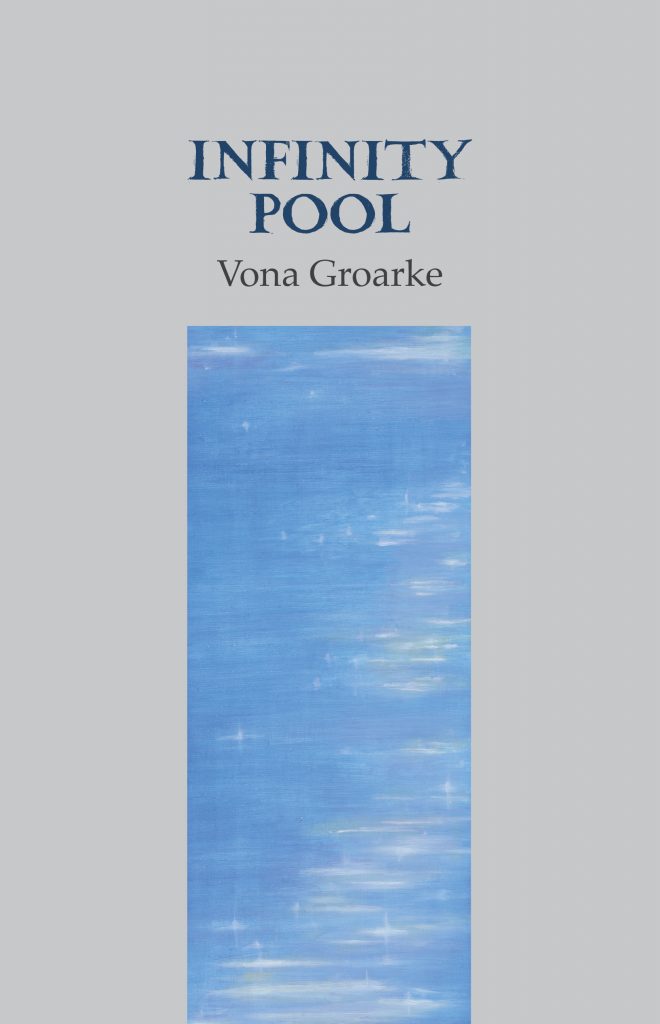

The title of Vona Groarke’s Infinity Pool promises disorienting tricks of the eye and doesn’t disappoint with its agile, playful delights, writes John Field
Be among the first to receive updates on the latest T. S. Eliot Prize news by subscribing now!
The title of Vona Groarke’s Infinity Pool promises disorienting tricks of the eye and doesn’t disappoint with its agile, playful delights, writes John Field
In On Poetry (Oberon Books, 2012), Glyn Maxwell opens by asking us to consider the effect of the white space around the poem: ‘Regard the space, that ice plain, that dizzying light. That past, that future. Already it isn’t nothing. At the very least it’s your enemy, and that’s an awful lot. Poets work with two materials, one’s black and one’s white’. Infinity Pool also problematises the relationship between printed page and white space, the distance between the poet and the speaker, between the speaker and the reader, just as the object of its title blurs the boundary between pool and lake, sea, or sky. The title of Vona Groarke’s ninth collection promises disorienting tricks of the eye and what unfolds is an agile, playful delight. To read the collection is to wrestle with Proteus.
The book begins with a pilgrimage: ‘Stansted to Knock, December 21st’. Although it’s a secular pilgrimage, a return to the family hearth, we’re mindful that Knock is not just an airport: many people believe that the Blessed Virgin Mary appeared there. 21 December is the winter solstice and this adds a mystical sense of rebirth. The speaker is open ‘like quartz / on a passage tomb the rising sun / had flicked to light this morning’. On the winter solstice, the sunrise is broken into a shaft of light by the rocks at the mouth of County Meath’s passage tomb, Newgrange, before it bisects the central chamber. This flight to Knock, high above the clouds, puts the speaker in ‘a sunlit evermore’, ‘riddled with light, / my full year split like a pomegranate, / all its days beaded like seeds’. Groarke’s lines sing with assonance. We’re all like Proserpina, bound to the underworld by the pomegranate seeds we have eaten but this is a poem suffused with hope: on the darkest day its radiant light transforms cheekily into ‘light’ luggage.
In her acknowledgements, Groarke notes that, ‘in the early 1600s, John Taylor (known as The Water Poet) sailed, for a bet, in a boat made of brown paper, down the Thames’ and in ‘The Future of the Poem’ poetry is both form and subject: ‘Make a tiny boat of it, / sail it, as John Taylor did, / down the Thames’. It’s an imperative, the poem itself becoming a set of workshop prompts allowing the reader, allowing nature, to write their own poems. ‘Leave it out on the windowsill / to sweet-talk the rain’, we’re instructed. The infinity pool depends on the lake, the sea, the sky for its visual impact, and Groarke reminds us that, although the poem is a little room, bounded on all sides by the white margins of the page, without the world beyond it, its impact is reduced.
‘The Copybook’ references Aisling copybooks, the Irish education system’s ubiquitous exercise books. Remember the childhood thrill at making your mark on the whiteness of the first page of a new book? Do you still experience a mild sense of horror when, in a moment of absence, you ‘blot your copybook’? The front covers of the Aisling maths books were once illustrated with a round tower which ‘gave no hint / of the stowed gold or frightened monks inside’. Like good little boys and girls, it will not have occurred to us to fill our maths books with words any more than we would have put our maths inside the ruled books given to us for English or history. The speaker misuses the maths books: ‘that’s where I put the poems, of course, / small poems with red titles in the taut blue grid, / like a page of slit windows, crossed with iron bars’. The squared pages become a creative constraint, grist to the mill of poetic composition. However, the slit windows and iron bars speak also of fear, the monks sheltering from the Viking raid inside the tower.
Rules and grids offer creative constraints but how difficult it is to leap out of the pool and to swim in free waters, or even to know where the pool ends and the ocean begins. Infinity Pool shows us new vistas and, as our eyes are led through Groarke’s avenues, we’re not constrained by the end of the line but released.
Vona Groarke’s Infinity Pool (The Gallery Press) is shortlisted for the T. S. Eliot Prize 2025. John Field blogs at Poor Rude Lines.
Be among the first to receive updates on the latest T. S. Eliot Prize news by subscribing now!