
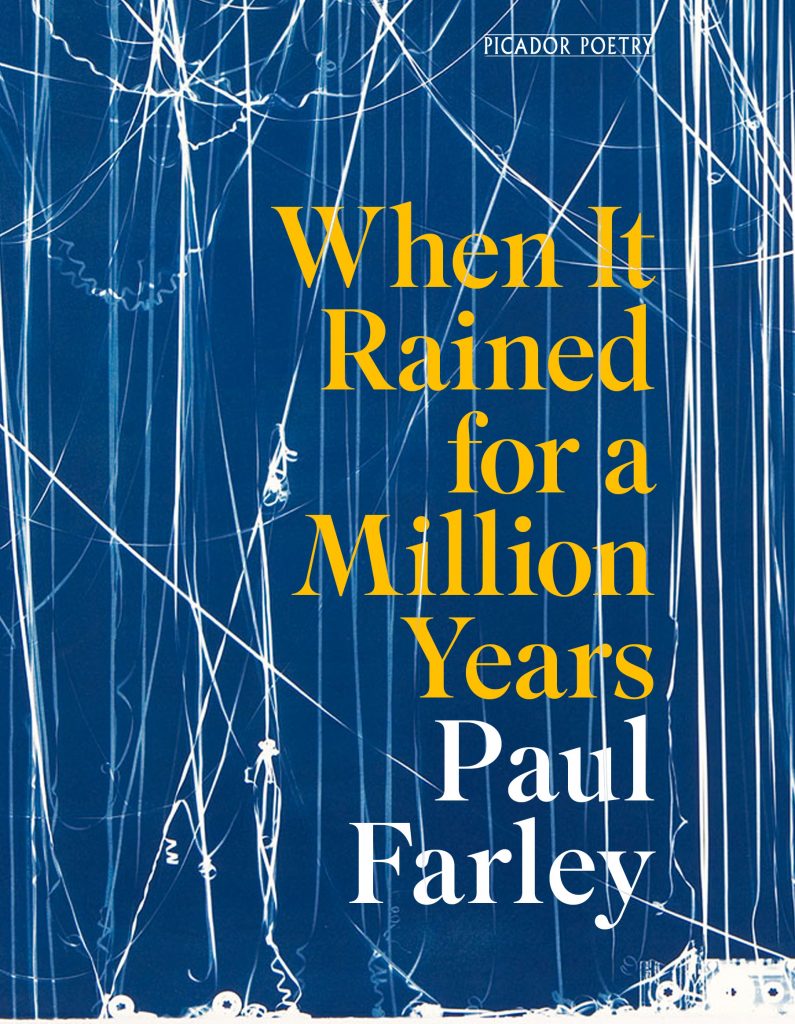

Celebrating and rewarding the act of reading, When It Rained for a Million Years is an opportunity to view the world through Paul Farley’s distorting lenses
Be among the first to receive updates on the latest T. S. Eliot Prize news by subscribing now!
Celebrating and rewarding the act of reading, When It Rained for a Million Years is an opportunity to view the world through Paul Farley’s distorting lenses
Reading Paul Farley’s latest collection is like walking through the house of mirrors at the circus: Farley views the world through a series of distorting lenses. However, looking at these crazy images, we’re shown parts of ourselves that we would have been unable to see otherwise.
‘Attack of the Fifty-Foot Poem’ evokes the science fiction horror of Nathan Hertz’s 1958 movie, Attack of the 50 Foot Woman. The ironic gap between the two titles is glorious: one a cult classic and other… a poem. In its opening lines we leave the cinema’s noise and awaken in the hush of St George’s Chapel, Windsor: ‘Dismantled in the long workshop of history, / the poem lies in state.’ The line is cut short by a portentous caesura: the queen is dead. The bathos puts the boot into the face of poetry – and the speaker cocks an irreverent snook at the workshop, that staple of the creative writing course, as it goes. Like a circuit breaker, electricity arcs across the stanza break and the poem is animated like a kitsch Hollywood monster: ‘It comes to life. / It rises! Where are my readers?’ It’s self-effacing, satirical, absurd. The effects of reading in time and space cause images to distort, warp, and morph as our eyes follow the line of the printed page.
‘The Execution of Anne Boleyn, Airfix 1:12’ asks us to imagine another dead queen. This one starts as five feet tall, standing on the scaffold, awaiting the swish of the sword but, as we read to the end of the title, she shrinks to five inches and, rather than awaiting decapitation, she is already butchered and awaiting assembly. It’s a disturbing image:
face and hood
back of hood
front of gown
back of gown
The parts of the kit challenge the way we read: we see a person’s head as distinct from their hood, but no model kit divides its subject in this way. Its lines, like cuts, are a brutal economy. Soon, the poem’s line breaks start to resemble a sprue; body parts and scenery connected as if by injection moulding in a moment of chilling surrealism.
Even the title of ‘In One of Your Urgent Poems’ disorients us: are we the reader, or are we the writer? The speaker riffs on the first person, offering us ‘A drunk I, still stupefied from a club, / swaying home on autopilot’, and ‘An italic I tilted like a lance’. In each stolen glance, we appear different… or are we just a ubiquitous italic I, the same in every image? Drunkenness and chivalry are both the work of the imagination. We are complicit in their making through the suspension of our disbelief. The typographical effects are a joy as ‘it turns out I is a terrible anchor / (not like the grapnel of a J or the hitch knot of Q)’.
‘Cross Bedding, Between Edge Hill and Lime Street’ opens with innuendo. In the notes, Farley remarks that ‘A review of The Concise Scots Dictionary that mentioned that “to get aff at Paisley” was a euphemism for coitus interruptus… brought a flood of correspondence reporting analogous local variants: for Merseysiders, “getting off at Edge Hill”, the last station before Liverpool Lime Street’. We read the poem’s ‘Cross Bedding’ and ‘unborn people who live in the metaphor / about getting off at Edge Hill crowd the platform / (metaphorically)’, even the poem’s trains and tunnels, in light of this comedy. But we’re also invited to imagine the cross bedding of the ‘city’s bedrock’, Triassic sandstone unearthed in the cutting between Edge Hill and Liverpool Lime Street. It’s a grand meditation on time as the speaker, travelling into the city, asks ‘Am I outside of time, watching the flow / of vast unnamed rivers and giant dune systems?’ The world shrinks and distorts as, looking back 200 million years, Liverpool looks ‘like Monument Valley in an aquarium’. The layers of sandstone become pages in a book and the carriage lights strobing through the windows create the film of the book. Finally, we’re reading the poem of the film of the book. ‘The odds against arriving / and being met under the clock’ look as small and miraculous as human life itself.
When It Rained for a Million Years celebrates – and rewards – the act of reading. An opportunity to read the world through Farley’s distorting lenses is not one to be missed.
Paul Farley’s When It Rained for a Million Years (Picador Poetry) is shortlisted for the T. S. Eliot Prize 2025. John Field blogs at Poor Rude Lines.
Be among the first to receive updates on the latest T. S. Eliot Prize news by subscribing now!