
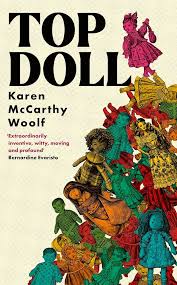

Top Doll

Dialogue Books
Woolf-Karen-McCarthy-photo-1200x1200-©-Yasmine-Akim
Born in London to English and Jamaican parents, Karen McCarthy Woolf FRSL is the author of three poetry books and the editor of numerous literary anthologies. As a postdoctoral Fulbright Scholar at UCLA, she was writer in residence at the Promise Institute for Human Rights. Her debut An Aviary of Small Birds (Carcanet Press, 2014), was an Observer Book of...

Review

Review

Karen McCarthy Woolf's Top Doll is a bravura, polyphonic exploration of obsession, mortality and an unflinching look at the history of slavery in America, writes John Field

Read the
Reader's Notes

Videos

Karen McCarthy Woolf reads from Top Doll at the T. S. Eliot Prize Shortlist Readings
Karen McCarthy Woolf talks about her work
Karen McCarthy Woolf reads from ‘Dolly’
Karen McCarthy Woolf reads ‘The General’
Karen McCarthy Woolf reads ‘Babysitter Barbie’
Young Critic Priya Abularach reviews Karen McCarthy Woolf’s Top Doll

Related News Stories

There was a brilliant response to the T. S. Eliot Prize 2024 Shortlist Readings, held at the Royal Festival Hall, London, on 12 January 2025. Each of the ten shortlisted poets, including Karen McCarthy Woolf (shown above) gave extraordinary readings at what is the largest annual poetry event in the...
McCarthy Woolf has […] breathed new life into this well-worn trope (Mannequin, Toy Story… erm Chucky), adding poignancy to the book’s “stranger than fiction” tale of a heiress who preferred dolls to people.’ – Yvonne Singh, Writers Mosaic Karen McCarthy Woolf, shortlisted for Top Doll (Dialogue Books, 2024), is the...
The T.S. Eliot Prize and The Poetry Society are excited to share the second set of video reviews created as part of the Young Critics Scheme. ‘Their inventiveness and attention to poetic detail is always such a delight’, writes Cia Mangat of The Poetry Society, on the Children’s Poetry Summit...
We are thrilled to announce the T. S. Eliot Prize 2024 Shortlist, chosen by judges Mimi Khalvati (Chair), Anthony Joseph and Hannah Sullivan from 187 poetry collections submitted by British and Irish publishers. The eclectic list comprises seasoned poets, two debuts, two second collections, and two previously shortlisted poets from...
Review of Top Doll

Karen McCarthy Woolf’s Top Doll is a bravura, polyphonic exploration of obsession, mortality and an unflinching look at the history of slavery in America, writes John Field

It was back in 2011 that Karen McCarthy Woolf first came across Huguette Clark’s obituary, the initial inspiration for her novel-in-verse. Heiress to one of the wealthiest of all Americans, William A. Clark, Huguette lived a closeted life on Manhattan’s Fifth Avenue and left behind extensive collections of dolls, furniture and paintings. In Top Doll McCarthy Woolf voices some of Clark’s dolls, viewing the world through their unclosing eyes.

The character of Dolly affects an amalgam of English and French, telling us ‘Dans le catalogue I am described as French composition’. This seems to suggest an alignment with ‘Huguette / so fiercely private [who] spoke English with a French accent’ (‘Obituaries as Found’) and invites us to see Dolly as, in part at least, Clark’s mouthpiece – and perhaps we wonder about the home life in which a child would feel the need to displace so much onto their porcelain pal. Dolly witnesses acts that belong behind a closed bedroom door: ‘In the mirror I am seeing the derrière / of Mr Husband, it is a fat white dome / bright as the moon! Maman is delirium / with fear and we must make her torture / to end. Regarde! How she is writing / and scratching with fingernails his pale back’. This opening sequence reads like a baroque horror – heightened by Dolly’s pre-recorded speech, activated by pulling her chatty string: ‘I don’t want / to go to bed yet’ and ‘Please change my dress’. As the innocence of childhood collides with ‘Mr Husband’s most violet / passions’ they assume a horrific quality. Throughout Top Doll McCarthy Woolf voices Dolly in coronas of sonnets, their first and last lines concatenating to create a bravura rococo flourish, poetic form helping to present her as immaculately turned out.

The voice of the General offers a contrast. He’s no bisque porcelain Parisian like Dolly but ‘testament to dear ample-Bosomed Miss Bessie’s estimable skills with needle, thread, thimble & dexterous Fingertips that did fashion this invincible Body’. He’s voiced in prose. He’s blunt. He witnessed the worst excesses exacted on enslaved African Americans on the wrong side of the Mason-Dixon Line, ‘where servitude gave way to iron Collars & Cuffs, Bloodhounds & Auction Blocks’. It’s an unflinching narrative and, where a person might be able to turn away, or close their eyes, the General has no choice but to stare.

Lady Mamiko, a Japanese doll, witnesses Clark’s decline in the final days before her hospital admission. Clark’s apartment, the largest on Fifth Avenue, comprised forty-two rooms spread across two floors and, in her final days, perhaps it was more of a liability than a luxury. Lady Mamiko comments that ‘Sometimes she gets lost because there are many rooms and many doors, some with mirrors and even though she is the architect of our citadel and aware of every detail, age is oblivious and exacts its price.’ Lady Mamiko’s prose is interspersed with haiku which reimagine Clark’s experience as a fragile moment of Japanese gothic: ‘There are many doors / in Chrysanthemum Castle / and dark passages.’

The novel’s final regular voice is Miss Ting, a Jamaican rag doll who left the UK in 1981 as Charles and Diana were getting hitched. ‘Miss Ting nah ooh an aah h-over no blondie-fairy-tale princess wid side-eye H’attitude same way nuff ah di Barbie-dem ah look upon di General’. Even within the confines of the apartment, Miss Ting is subject to the vacuousness of the world. Dolly ‘finds it quite extraordinaries how in Jamaica they also have television. Miss Ting rolls her eyes, spurred into action by irritation’. Rag doll she may be, but she’s no door mat.

As these reviews have noted before, Mimi Khalvati, this year’s judging chair, commented that, ‘Throughout these collections runs a strong strain of elegy, responding to our dark times with testaments of loss and grief.’ And so Top Doll, a polyphonic, experimental and elegiac exploration of history, oppression, obsession and escapism, offers an appropriate close to this year’s reading of the shortlist.

Karen McCarthy Woolf’s Top Doll (Dialogue Books) is shortlisted for the T. S. Eliot Prize 2024. John Field blogs at Poor Rude Lines.

Top Doll
Dialogue Books

Newsletter

Be among the first to receive updates on the latest T. S. Eliot Prize news by subscribing now!


The T. S. Eliot Prize on Social Media

Part of tseliot.com

Designed by thinking

Interview of Top Doll

Top Doll
Dialogue Books

Newsletter

Be among the first to receive updates on the latest T. S. Eliot Prize news by subscribing now!


The T. S. Eliot Prize on Social Media

Part of tseliot.com

Designed by thinking