
Carl Phillips’s Scattered Snows, to the North is ‘reflective, but resists the temptation to judge and exact retribution’, finds John Fields
Be among the first to receive updates on the latest T. S. Eliot Prize news by subscribing now!
Carl Phillips’s Scattered Snows, to the North is ‘reflective, but resists the temptation to judge and exact retribution’, finds John Fields
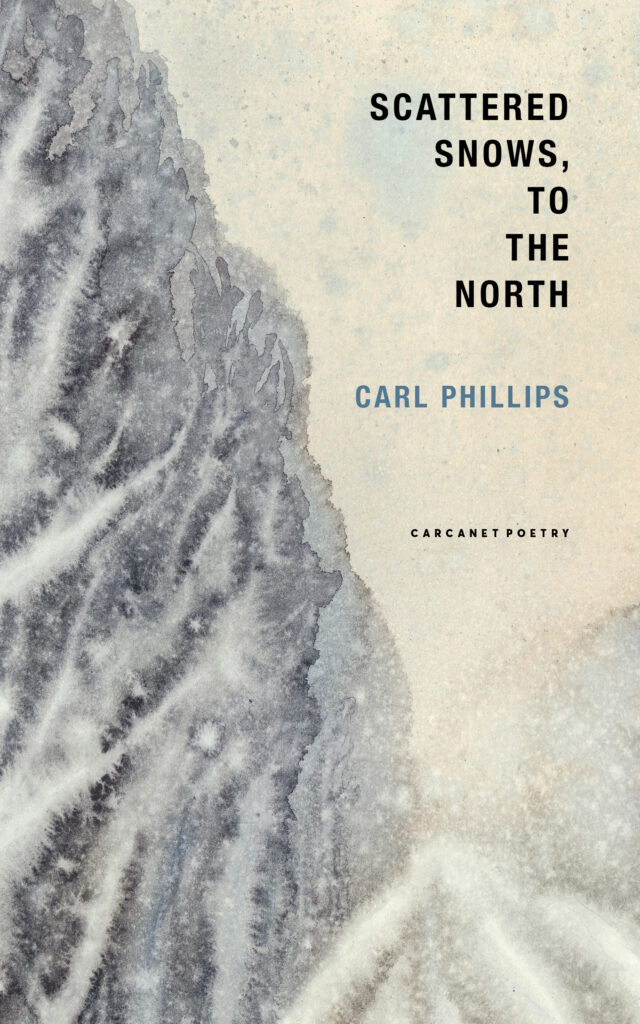
Last year, Phillips won a Pulitzer Prize for Then the War and Selected Poems, 2007-2020. He has authored seventeen collections of poetry and garnered a slew of awards. In Scattered Snows, to the North relationships are fragile and we feel the bite of mortality. However, the title reminds us that bad weather is patchy and localised.
Phillips opens with ‘Regime’, where we read that, ‘As I took off / my clothes, I / watched him taking // his own off.’ Although the speaker ‘watched him’, we are not told whether this is reciprocated. Nor do the subjects undress one another. Phillips find solitude, perhaps even loneliness, within an ostensibly intimate situation. His lines are terse and monosyllabic. We’re struck by the cold white space of the page. It’s subtly negative. We’re told that the sound of the rain was not, for once, the sound of the wind shaking the rain from the trees, but we’re never told what it actually was. We’re told more about absence than presence. ‘Regime’ is built from tercets, but the final stanza is cut short: ‘It’s hard / to believe in them, / the beautiful colors // of extinction; but / these are the colors.’ ‘Extinction’ detonates in that final couplet and we reappraise the relationship in its shock waves. The speaker resists the temptation to view the end using the usual clichés. If we only had the courage to look at life’s wreckage, we would see its ‘beautiful colors’. The snows are scattered and shafts of light illuminate the landscape. We re-examine the enigmatic title, ‘Regime’. Perhaps it speaks to our hubris, Ozymandias’s statue in the desert and the toppling of empires. Or perhaps we think of healthy living, a dietary regime – or a river’s pattern of flow.
A few poems on, in ‘Sunlight in Fog’, and we’re meditating on rivers, ‘how the river, running always away // the way rivers tend to, stands as proof that reliability / doesn’t have to mean steadfast’. Phillips’s lines have lengthened out and the knot of the double negative points to the thorny complexity of relationships. The collection has warmed in tone, as that little aside, ‘the way rivers tend to’, injects a conversational humanity. Perhaps the poem interacts with ‘Regime’ as, once again, we’re reflecting on a difficult relationship, the speaker confiding that ‘I’ve forgotten / entirely what it felt like to enter his body’ but ‘to look away had become / impossible’. It casts the speaker as a kind of Narcissus, staring into the river ‘running always away’, dependable in its undependability. The speaker has lost sight of the beloved as the self is reflected back from his eyes.
‘If Grief is Mostly Private and Always Various’ works with Sir Thomas Wyatt’s (1503–1542) ‘Whoso List to Hunt, I Know where is an Hind’. Wyatt was imprisoned in the Tower of London, one of the many accused of having committed adultery with Anne Boleyn. Indeed, he may have witnessed her execution. Phillips shows us the sea, snow falling into it ‘like words from / a severed head held aloft, upside down, and shaken’. It’s a reference to an untitled image by the German photographer Michael Schmidt, which Phillips describes the poem as being ‘in conversation’ with. The poem presents an unsettling image, as we usually imagine a severed head held aloft by the hair, but this one’s inverted and shaking it seems too disrespectful, even if it is the head of a traitor.
Scattered Snows, to the North is reflective, but resists the temptation to judge and exact retribution. Instead, the speaker contents himself by looking carefully. After all, as we’re reminded in the collection’s final poem, ‘Rehearsal’, ‘the dark lay / like – defiantly – a ship at anchor’ and ‘They swam out to the dark ship’. Darkness awaits, and our relationships with one another must be savoured.
Carl Phillips’s Scattered Snows, to the North (Carcanet Press) is shortlisted for the T. S. Eliot Prize 2024. John Field blogs at Poor Rude Lines.
Be among the first to receive updates on the latest T. S. Eliot Prize news by subscribing now!