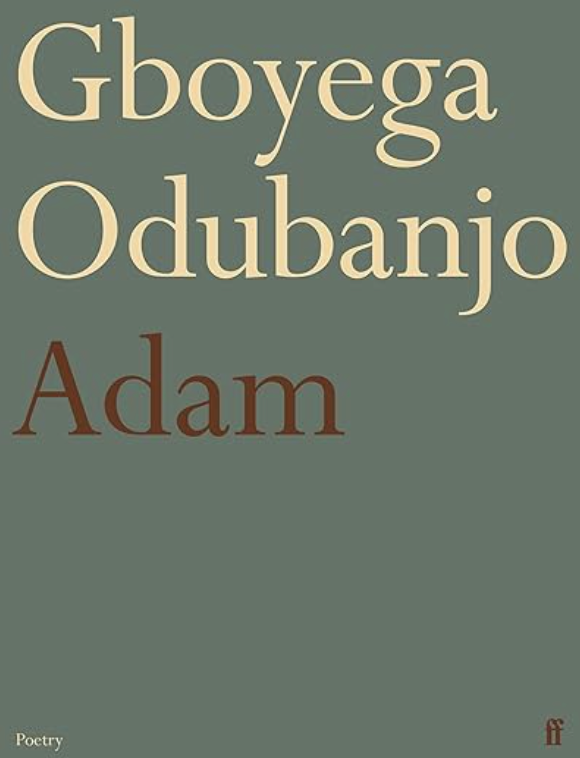

Adam by Gboyega Odubanjo is ‘a monumental work’ that ‘removes comfortable distance’ and ‘examines humanity’s darkest deeds’, writes John Field
Be among the first to receive updates on the latest T. S. Eliot Prize news by subscribing now!
Adam by Gboyega Odubanjo is ‘a monumental work’ that ‘removes comfortable distance’ and ‘examines humanity’s darkest deeds’, writes John Field
Together with the T. S. Eliot Prize shortlisted and posthumously published Adam, Odubanjo has left us three pamphlets, with Aunty Uncle Poems winning both the Michael Marks Award and an Eric Gregory Award. The Gboyega Odubanjo Foundation for low-income Black writers was established in Odubanjo’s memory in 2023. This year’s Chair of judges, Mimi Khalvati, said that through this year’s Shortlist there ‘runs a strong strain of elegy, responding to our dark times with testaments of loss and grief’. Viewed in these terms, Odubanjo’s Adam is the epicentre of the shortlist.
When we think of Adam, we think of apples, snakes. The title of Odubanjo’s opening poem, ‘The Garden’, invites this reading but, instead of a pastoral idyll, we encounter something dark. The UK is described as ‘the land where streets are paved with cousins’ and we’re reminded of Dick Whittington, a lone child, an economic migrant, travelling to a London he hopes to find paved with gold but, instead of Whittington’s happy ever after, we find a city built on bones. The poem descends into nightmare as ‘your uncle’s adam. your mother—adam floating. your cousin—adam bleeding in the masquerade. / and still there’s more arrivals—they’re greeted with cups of river and given a week to change their names to adam.’ Addressed in the second person, it’s as if the traumatised reader is experiencing waking hallucinations. The endless stream of arrivals brings Dante’s Inferno to mind, throngs of sinners waiting to be ferried across the Acheron.
It is at this point that we cross the threshold into the collection proper, a note explaining that, ‘On 21 September 2001, the torso of a black boy was discovered in the River Thames, near Tower Bridge in central London, clothed only in an orange pair of girls’ shorts’. Named Adam by the investigating detectives, forensic evidence suggests that his home was near Benin City, Nigeria, but that he had spent a brief time in Germany and, shortly after his arrival in the UK, he was drugged and ritually killed. An early poem, ‘Breaking’, brings breaking news to mind, as if the murder of Adam were important. However, it opens with ‘looks like it’ll be a rainy week ahead thank you now the body / of an unidentified boy’ and we sense the distasteful tonal shifts of the news media. It becomes absurd, grotesque, as, ‘coming up / goat arrested for armed robbery’.
The collection views Adam from multiple perspectives, including his own. ‘London Is the Place for Me’ works with the 1948 song of the same name by Aldwyn Roberts, AKA Lord Kitchener, which is associated with West Indian and West African expatriates. The song’s sunny calypso vibe is matched by the speaker’s tone: ‘cool as a lord i landed in the mother / blitzed and tipsy on the foreign extra’. It reads as excitement. However, as the BBC’s 2021 summary of the case explains, small amounts of the Calabar bean and ground-up seeds from the Datura plant had been fed to Adam – plants used in West African witchcraft. With this knowledge, everything darkens, and the image of Adam, ‘cruising and reclining in old albion / trafficating through the big city’ implies depraved international crime (explored in greater detail later in ‘Traffic’).
Each section of Adam opens with a reference to the Book of Genesis and Christian history’s scapegoating of Adam and Eve for humanity’s evil. These read like aphorisms: ‘if adam is naked and someone owns a pair of orange shorts from woolworths and covers adam what then is shame.’ By engaging with Christian tradition, Odubanjo requires his reader to confront something more disturbing about the impetus to scapegoat others for sin. The comfortable distance between the reader and West African witchcraft is removed.
Adam is a monumental work. Although it examines humanity’s darkest deeds, it celebrates the sanctity of life and the dignity of all people.
Gboyega Odubanjo’s Adam (Faber & Faber) is shortlisted for the T. S. Eliot Prize 2024. John Field blogs at Poor Rude Lines.
Be among the first to receive updates on the latest T. S. Eliot Prize news by subscribing now!