
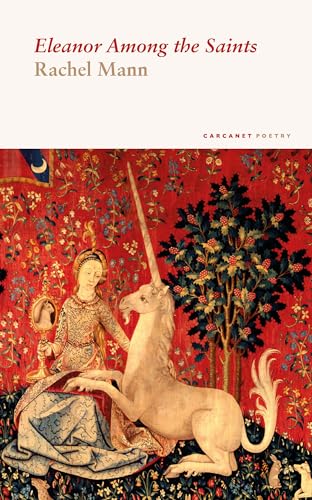

In Rachel Mann’s Eleanor Among the Saints, language is underpinned by trans history and the liturgy. It’s a collection of struggle, but also of consolation, writes John Field
Be among the first to receive updates on the latest T. S. Eliot Prize news by subscribing now!
In Rachel Mann’s Eleanor Among the Saints, language is underpinned by trans history and the liturgy. It’s a collection of struggle, but also of consolation, writes John Field
Through its engagement with Christian history and liturgy, Eleanor Among the Saints, Rachel Mann’s second collection, provides the reader with a lens through which to read trans identity.
Binary readings of gender are challenged by medieval texts such as The Book of Margery Kempe (c. 1430s). This is not just a work of Christian mysticism, it is earthly, emotional writing, anchored in the practical challenges of day-to-day life. Kempe visits a Doctor of Divinity and, once she has shared the revelations God has made to her, he tells her that she is ‘sucking even at Christ’s breast’ (itself a more literal paraphrasing of Julian of Norwich’s Revelations of Divine Love). Kempe’s language was by no means an unusual way of reaching for the ineffable. By working in dialogue with these Christian treasures, Mann is able to contextualise her ‘imaginary archive’ of the life of a medieval trans person, Eleanor ‘John’ Rykener, helping the reader to glimpse the shadows of trans identity through history.
The collection’s first section, ‘Eleanor Among the Saints’, considers Eleanor Rykener. In ‘Embroidering a Priest’, the opening poem, the speaker imagines Rykener as embroiderer. It reminds us that the priest, the local patriarch, is seen in the sanctuary, the sleeves of his alb a flummery of lace, his chasuble blazing with embroidered silks. Mann catches the ambiguity of this as her speaker comments on the ‘thrill of flounce and picot’. ‘Flounce’ is feminine – we’re at the hem of a lady’s skirts, watching their loose open pleats bounce as she moves. It’s a yonic image, whereas the ‘picot’, while also ornamental, is phallic. Picots give the lace an ornamental edge of twisted loops of thread – it’s borrowed from French: point, pointed weapon. The poem’s opening echoes Genesis, the beginning of all things, except, instead of light, ‘In the beginning, hem and line of thread’. Flounce and picot are both incarnations of thread. Masculine and feminine threaded together, not opposites.
In ‘Eleanor and Rolandina in the City of God’, we’re imagining her as sex worker (she was arrested in 1394 and questioned about prostitution and sodomy). Even Mann’s London is gloriously ambiguous. It’s fitting that the poem opens with gates: ‘Ald and Bishop, Moor and Cripple, Alder, New and Lud’, reminding us of the feminine aspects of urban topology. Identity resists absolutes as there are still Roman ‘temple traces, half the churches recycling’ but, in Eleanor’s revelation of future London, we see something ‘Risen’ too: ‘glass, concrete, towers’.
The second section, ‘Praise’, engages with the rhythms of Church liturgy: its calendar of feasts, the hours of its days. In ‘A Morning Prayer’ we see a city gridlocked by rush hour traffic where ‘half-hidden faces // Recede in rear-view mirrors, and what was once / Shall never be again, smaller and smaller’. We catch echoes of the Gloria: ‘As it was in the beginning, is now, and ever shall be: world without end. Amen’. However, it has been negated, implying a degree of hopelessness – of Godlessness. However, halfway through the poem, the opening of the Anglican Morning Prayer cuts through: ‘O Lord / Open thou’. In the liturgy, this would read as ‘open thou our lips’, but Mann’s ‘open thou’ is instead an appeal to God to open himself – an appeal for acceptance, for an embrace. The day is a ‘new day held in old’ as the ancient rhythms of the Divine Office provide foundations and scaffolding to support daily living.
Sleepless nights fill the final section, ‘A Charm to Change Sex’: ‘Awake at 4 a.m. and conclusions to be drawn’; ‘Awake at 4 a.m., and young again’. Early in the sequence ‘Seven Proof Texts on a Transitioned Body’ concealment and shame present themselves as obstacles to a Christian life as Matthew 7:7’s ‘seek and ye shall find’ becomes both playful and troubling: ‘Seek and ye shall hide’. However, by the end of the sequence, the speaker, like the priest in ‘Embroidering a Priest’, achieves a kind of ontological difference: ‘transfiguration is fluid – / Yellow, red, brown; bags of liquid God, pierced one’. Gender-affirming surgery evoking the wounds of Christ: a reminder that all suffering is an imitation of Christ.
In Eleanor Among the Saints, Rachel Mann’s language is underpinned by trans history and the liturgy. It’s a collection of struggle, but it’s also one of consolation. It’s both a literary achievement and an important pin in the map for trans people – for people.
Rachel Mann’s Eleanor Among the Saints (Carcanet Press) is shortlisted for the T. S. Eliot Prize 2024. John Field blogs at Poor Rude Lines.
Be among the first to receive updates on the latest T. S. Eliot Prize news by subscribing now!