
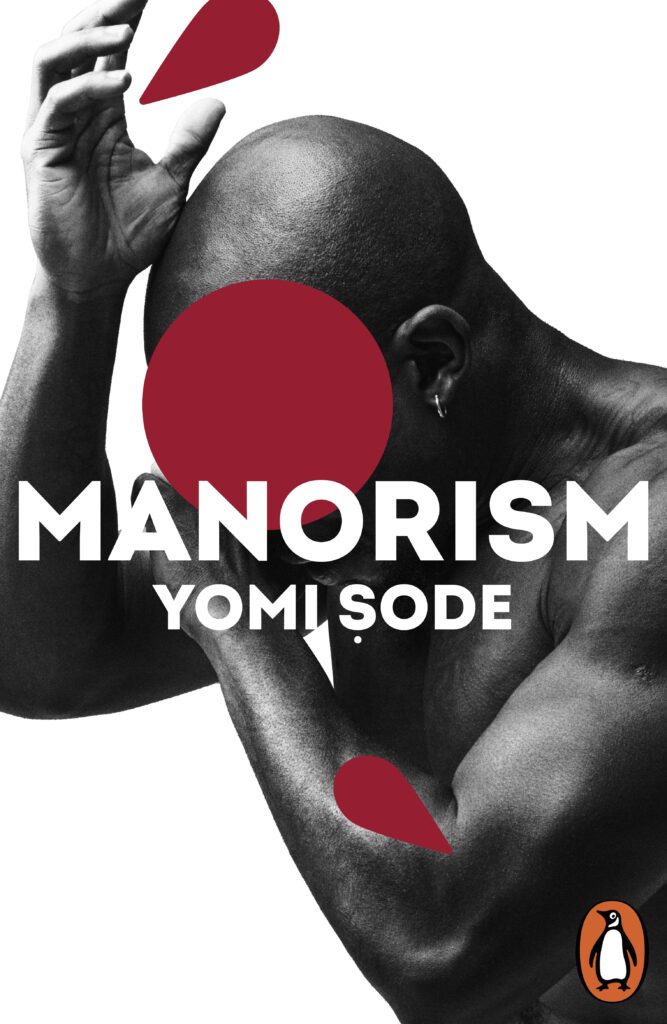

Manorism

Penguin Poetry
Sode-Yomi-by-Jolade-Olusanya
Yomi Ṣode is an award-winning Nigerian British writer and lives in London. He was a 2019/20 Jerwood Compton Poetry Fellow and was shortlisted for the Brunel International African Poetry Prize 2021. His acclaimed one-man show COAT toured nationally to sold-out audiences, including at the Brighton Festival, Roundhouse Camden and Battersea Arts Centre. In 2020 his libretto Remnants, written in collaboration...

Review

Interview

Review

Yomi Ṣode’s Manorism is an urgent interrogation of double standards and lays bare the doublethink Black men and boys are required to negotiate, writes John Field

Interview

Yomi Ṣode is shortlisted for the T. S. Eliot Prize 2022 for his debut collection, Manorism (Penguin Poetry, 2022). We asked him about its themes of identity, violence, masculinity, resistance and rest

Read the
Reader's Notes

Videos

Yomi Ṣode reads from Manorism at the T. S. Eliot Prize Shortlist Readings
Yomi Ṣode talks about his work
Yomi Ṣode reads ‘Fugitives’
Yomi Ṣode reads ‘Distant Daily Ijó’
Yomi Ṣode reads ‘[Insert Name]’s Mother: A Ghazal’

Related News Stories

The T. S. Eliot Foundation is delighted to announce that the winner of the T. S. Eliot Prize 2022 is Anthony Joseph for his collection Sonnets for Albert published by Bloomsbury Poetry.
Judges Jean Sprackland (Chair), Hannah Lowe and Roger Robinson have chosen the 2022 T. S. Eliot Prize shortlist from a record 201 poetry collections submitted by British and Irish publishers. The eclectic list comprises seasoned poets, including one previous winner, and five debut collections. Victoria Adukwei Bulley – Quiet (Faber &...
Review of Manorism

Yomi Ṣode’s Manorism is an urgent interrogation of double standards and lays bare the doublethink Black men and boys are required to negotiate, writes John Field

On The National Gallery’s YouTube channel, Yomi Ṣode responds to Caravaggio’s life and work. He says, ‘I’m watching an art historian being interviewed. The news anchor asks the expert about Caravaggio, the painter and the murderer. His chapters of violence, and troubled upbringing. The historian, like witchcraft, mouths an enchanting response: “He was a man of his time”. A denial of Caravaggio’s foul behaviour. An erasure spell passed on through generations; one that’s excused the crimes, privilege and power of white people.’ In Manorism, Ṣode works with black and white, light and dark, creating a kind of chiaroscuro as he considers the lives of Black British men and boys and the challenges they face.

Ṣode opens in Yoruba with ‘Àdúrà Màmá Mi’ (which translates as ‘My Mother’s Prayer’) reminding us that, from the cradle, negotiating blackness and whiteness is a complex business. Ṣode’s speaker, praying for her son, asks ‘Ọlọrun á là’nà fún ẹ ní ilẹ́ aláwọ́ funfun: / Bí ó ti lẹ̀ jẹ́ pé èniyàn dúdú ni ẹ́’ [‘May God bless him with a white house / Because he is a black man’]. The prayer reminds us that, in the Western imagination, God and Christ are depicted as white – even the contemplation of the eternal may be problematic.

In ‘Manorism I: On the Cultural Representation of ‘Black Britain’’, Ṣode explores a concept he dubs manorism. In an interview with The Guardian, Ṣode describes this as the ‘innate manorism that comes from where you grew up – your manor – and goes with you wherever you travel’. One of the poem’s epigraphs is taken from Piers Morgan’s Good Morning Britain interview with the then fifteen-year-old Alex Mann, pulled from the Glastonbury crowd in 2019 to perform ‘Thiago Silver’ with Dave. On the sofa, Morgan told Mann that ‘That’s what the youth of today should be doing more of. Taking their chance & slaying it.’ To hear a paunched quinquagenarian bandying idioms like ‘slaying’ is sufficient to make anyone queasy. However, Mann’s performance on the Other Stage was described by the BBC as ‘Glastonbury Magic’ and, to date, has been viewed 33 million times on YouTube. Having mouthed the words of AJ Tracey, Mann was feted – even by the likes of Morgan – but, with a diagonal slash across the page, Ṣode juxtaposes this with Tracey’s interview as ‘Both are being interviewed on separate channels at the same time. / I watch […] AJ, some of your other / videos. It’s almost like / a bit of a shout out / to gangs in London. // AJ’s body shifts in discomfort. A manorism not shared by Alex from Glasto’.

Ṣode’s use of juxtaposition works to biting effect across the collection and his sustained engagement with Caravaggio informs our response to racism. In ‘A Plate of Artichokes’ Ṣode works with the story of Caravaggio’s 1604 dispute with a waiter at the Osteria del Moro, one of his favourite inns. It ended with Caravaggio attacking the waiter with the plate and wounding him. In all probability, it was his patron, Cardinal del Monte, who stepped in to smooth things over with the authorities. In Ṣode’s poem, ‘Caravaggio felt like he had been treated like a commoner – some barone. The same way I felt when a waiter asked me to pay as soon as I ordered my food. My man did not ask the couple sat beside my lady and me. Why? He took their orders first. Yet there I was, thumbing the first of my digits into the card reader.’

Manorism is an urgent interrogation of double standards and lays bare the doublethink Black men and boys are required to negotiate. Ṣode shines the torch of truth towards the centre of the canvas, disclosing an evil that has always hidden in plain sight, shielded by the light.

Yomi Ṣodes Manorism (Penguin Poetry, 2022) is shortlisted for the T. S. Eliot Prize 2022. John Field blogs at Poor Rude Lines.

Manorism
Penguin Poetry

Newsletter

Be among the first to receive updates on the latest T. S. Eliot Prize news by subscribing now!


The T. S. Eliot Prize on Social Media

Part of tseliot.com

Designed by thinking

Interview of Manorism

Yomi Ṣode is shortlisted for the T. S. Eliot Prize 2022 for his debut collection, Manorism (Penguin Poetry, 2022). We asked him about its themes of identity, violence, masculinity, resistance and rest

T. S. Eliot Prize: ‘[P]rivilege, irrespective of time, allows a grace period’ (‘Fugitives’); ‘And who gets the pardon?’ (your postscript). Both these quotes link to Caravaggio, a key figure in Manorism. Can you say what your exploration of Caravaggio’s life and work yielded in terms of the inspiration behind your poems and Manorism more broadly?

Yomi Ṣode: I found Caravaggio while researching mannerist art of the sixteenth century. His work came just after that time period and I was struck by the story surrounding him, his work and his life.

Craft-wise, Caravaggio and I are not that far apart. I didn’t grow up with many male role models, our work is made through the lens of our communities, and our lives are not clean, easy or pretty.

To many, his work and the way he painted figures such as Jesus was not considered palatable, and this is something that I connected to because, initially, my work (and manuscript) was probably not considered palatable enough for anyone to know what to do with it. In many ways, his work inspired me to be as honest and raw as I could be when it came to telling my stories. I am pushing against the privilege that Caravaggio, a white man was routinely given, forcing myself to be braver and less self-conscious. To have the same audacity that he had to push against the narrative in exploring themes like microaggressions, racism and power through the lens of whiteness; this is purely my experience as a Black man.

Caravaggio had no filter and all of the entitlement. While his work was important, when I talk about being inspired by him, it is almost me pushing back against the absolute gall of a man like him and asking myself and everyone else, if he can be that unapologetic, why can’t I?

This then led me to see how I could jar the system. How I could take traditional poetic form and push it to a point of agitation. What was my version of chiaroscuro, against traditional forms of art? How could I bring all of me (mother tongue, slang with the mandem, uncomfortable truths, taboo subjects, wit) within the context of craft and poetics? What would I have needed as a Black boy doing GSCE English Lit, to stay engaged and connected?

TSEP: Though you reference specific Caravaggio paintings, your poems seem to be less about them, they rather restage or reframe them. Is that right?

YS: The reality is, none of these paintings are about me. Nobody looks like me, my children, my friends or the young people that I work with on a daily basis. Walking through any of the galleries that house the paintings is a constant reminder that the world would rather me be invisible.

The Gypsy Fortune Teller, to me, is less about the boy being so enchanted that he is unaware that his ring is being taken by the lady but more about hands and how hands can often lead to bad things. In ‘About Hands: An Uncle’, a mother uses her hands, going to extremes in order to keep her son alive while in ‘About Hands: Somebody’s Child’, a mother grieves the consequences of a son’s forgetfulness. The form gave me licence to transport myself to where I needed to be.

The ‘Michael’ trilogy was an exploration of messianic power and the places it can take you. How the relationship between Jesus and Matthew, to many, is no different to the relationship between olders and youngers in the manor. The rise and fall of Michael is a familiar tale.

TSEP: Here’s a somewhat connected question… you write plays and the third section of the book, Araá Rí (The Body Sees), has been performed as a play. Do the four sections of the book follow an arc like a play? Is the fourth section a kind of reprise of the book’s themes, the Chorus closing the action?

YS: When I wrote the third section it was a purging of sorts. I was deep in grief and needed to write it out of me. It was never written with the intention of it becoming a play, but – damn! – it goes to show the power and malleability of poetry. How it can easily sit into other artforms. I aim to represent this in all of my work.

I am a playwright, a song writer and essayist. All of these artforms have narrative arcs and so I couldn’t imagine creating Manorism without this being an element. The collection doesn’t have one singular story arc though – we journey with the ‘I’ through the book, experiencing the highs and lows.

The fourth section is shorter because I wanted it to almost be a warning and a reminder. I come from a community of people who hold memory. For me, this meant that everything didn’t need to sit on the page. These words, they want out! I feel like at night they are thumping away, jolting the body of the book to move at times. Allow them the room (where possible) to fly. Our traditions, pain, dreams and histories all sit firm and will not be erased. It speaks to who it needs to speak to and serves as an archive to culture. 

TSEP: Your neologismAneephya’ is a very powerful idea. You’ve described it ‘as a toxin that never leaves a body, why my body never rests’.

YS: There is a video of a young Black boy playing basketball in his front garden when he suddenly stops and hides behind his parents’ truck. A few moments later we see a police car pass by. Once the boy feels it’s safe enough, he comes back out and continues playing basketball. This to me is the perfect illustration of Aneephya. When they saw the film, both of his parents were surprised by his actions, but it’s almost as though there was something else, some other kind of feeling that led to him making that move. This is what Aneephya is, this unwritten, little spoken about thing that we all just know and feel.

When we all saw George Floyd murdered there was an acute and specific pain felt by Black people around the world. This shared pain, frustration and lethargy. Aneephya is the entry point to a wider conversation about the Black body and I am focusing on Black men in relation to this exploration. When Black men are met with a type of trauma, it stays with us forever.

In many of our indigenous communities we have rites of passage ceremonies that take you from child to adult. Manorism is my playpen. My room to explore sci-fi, horror, and spirituality. Aneephya is my twisted version of a rite of passage process. A thing that follows you, like a shadow.

TSEP: You like coining words – ‘Aneephya’, ‘Anamnesia’, ‘Manorism’ (punning Mannerism – and is it ‘man or -ism’, too?). Why? Is it connected to the free use of different kinds of language in the book – Yoruba, dialect, academic-art-speak…?

YS: Made-up words are in the DNA of my landscape and naturally, you’ll find sprinkled and (in some cases) blatant language used to unapologetically describe a feeling.

Manorism is made up of three elements;

Mannerism: a way of speaking or behaving that has become habit

Mannerism: a 16th century Italian style of painting that didn’t follow the rules of the time, but rather distorted perspectives and proportions.

The Manor: the area that I, and many other people like me, grew up.

As it pertains to the book title, when these things are combined, they relate to a set of behaviours that are specific to a certain demographic of people. To dig a little further we add the element of code switching as a way to survive in a society that looks down on you and your culture, unless they want something from it.

I’m from a generation of Garage, Grime, afrobeats, Nollywood, and hip hop. I embody these cultures, its pros and cons and, most importantly, its language. I’m not an afrobeats artist for example, but Pidgin English is often used in songs I love. I’m not a Grime artist but its use of repetition is used by a range of emcees.

The use of Yoruba in Manorism is important. It is as much spiritual as it is political. It is me fighting my own anxieties of what poetry in England should be. It is the 11-year-old secondary school kid hearing me read a poem in Yoruba and coming to me afterwards saying ‘I can’t wait to read this book to my mum’. You’ll notice that none of the Yoruba is italicised in the book. This was a deliberate choice to assert the normalisation of my mother tongue.

TSEP: You give a brilliant reading of ‘Distant Daily Ijó’ in your Eliot Prize film. Can you say something about it? It feels as if ‘My Mother’s Prayer’ that immediately follows it is a kind of blessing.

YS: To ijó, in Yoruba, means to dance. This poem is about the daily dance that we do in our separate lives but how we are all connected spiritually. It is also about the sacredness of communal dancing.

I walk in these spaces and I’m allowed to just be. I am with my community of people and we all get it. The politics of the world, the rent is due, the break-up was bad, we can’t believe x is dead, but here we are. It’s hot in this place, but here we are in this communal space where it probably might be chaos at some point but we are here, doing this distant daily dance (ijó) of life. A language we know without saying a word.

DDI speaks of the freedom that we experience when we dance together but also the freedom I felt when creating this body of work. I can honestly say that this is the most ‘me’ that I’ve felt in a long time. All the parts of me are in Manorism – the joy, the grime, the messy, the beautiful, the happy, the geek, the grief, the taboo and, again, the archive.

‘My Mother’s Prayer’, immediately following that, is a protective layer for wherever I go. This prayer that hovers over me as I walk every day. So yes, you are right. A blessing.

TSEP: The debate in Manorism is tireless but rest is also a powerful idea in the book. Would you say something about this?

YS: There is a feeling of burnout and exhaustion that I wanted to convey in the book, which makes the lighter moments, whether it’s poems like ‘The Barbershop’ or ‘YNWA: Karaoke Interlude’, more special. The pockets where there’s room to breathe also speak to the ups and down of life in general.

As I type right now in my writing space, I’ve just had a run-in with a family member. Both of us were surprised to see each other, the convo starting light and ending heavy. I came in here not expecting that to happen, but I’ve carved out enough space to not allow it to swallow me whole. People are surprised when I smile while reading or speak so lightly about Manorism. I’ve taken time to prioritise myself more, maybe.

Tricia Hersey of Nap Ministry says that ‘Rest is Resistance […] My rest as a Black woman in America suffering from generational exhaustion and racial trauma always was a political refusal and social justice uprising within my body.’

The idea that we, as Black people, should allow ourselves the time to rest is, in itself, an act of liberation. This is what Manorism is to me.

TSEP: You work so freely in so many different media – theatre, music, dance, film, and in the Araá Rí (The Body Sees) podcast explained how you avoid simple, straightforward presentations of a text. Poetry’s more than books, right? (Is it?)

YS: Poetry is definitely more than books. I’m not a purist like that and people may disagree and that’s fine. I’m no more an art historian than I am an expert on poetry/poetics, all I know is the truth that I’m standing in. I entered this via open mic and live music, sharing session bands with the likes of Ed Sheeran in rehearsal, who was also playing a ton of open mic nights at the time. This entry point, and the communities I am part of, mean that I am always willing to experiment, push myself and try new things. 

While poetry sits at my centre, I see it as something fluid. Something that absorbs and compliments all of the other skills that I have picked up along the way. It is literally the roots and trunk of a tree with many branches. All of these fruits may grow at the end of the branches but they are sustained by the roots and the trunk.

TSEP: In your acknowledgments you talk about the ‘puzzle of this book’. Would you like to say something about that? Manorism does puzzle – on identity, racism, violence, masculinity, fatherhood – and the question of ‘who?’ is very loud in it. Were you able to resolve the puzzle?

YS: Writing Manorism was a reflective process for me. While I don’t think the puzzle is resolved, I feel like I’m in a confident place with my voice, and understanding all of the things you mentioned above, as they relate to me. For now, that’s enough.

Manorism is a bit like my bat signal, it’s a way for me to let other Black men, boys and young men know that they are not alone and that we are all trying to resolve the same puzzle.

As Dave says, ‘We’re all alone in this together’ – right?

Yomi Ṣode’s Manorism is published by Penguin Poetry. Watch the T. S. Eliot Prize filmed readings and interview, and read the reviews and Readers’ Notes online to find out more.

Manorism
Penguin Poetry

Newsletter

Be among the first to receive updates on the latest T. S. Eliot Prize news by subscribing now!


The T. S. Eliot Prize on Social Media

Part of tseliot.com

Designed by thinking