
With its fanciful etymology and cautious optimism, Zaffar Kunial’s England’s Green is a joyful exploration of how language and sound shape the self, writes John Field
Be among the first to receive updates on the latest T. S. Eliot Prize news by subscribing now!
With its fanciful etymology and cautious optimism, Zaffar Kunial’s England’s Green is a joyful exploration of how language and sound shape the self, writes John Field
The title of England’s Green, Kunial’s second collection of poetry, echoes William Blake’s ‘Jerusalem’. Where Blake saw ‘dark Satanic Mills’, Kunial is cautiously optimistic; he manages to see the green even in our urban spaces. England’s Green is a journey down leafy lanes, along suburban streets and into the nation’s hallowed oval Os – its cricket grounds. Reading the collection is a joyful experience in which Kunial shows how language and sound shape the self.
The opening poem, ‘Foxglove Country’, strikes a playful note: ‘Sometimes I like to hide’, confides the speaker, evoking games of hide and seek, probably the last time when many of us were prepared to sit in a hedge. However, in Kunial’s poem, the speaker disappears down a rabbit hole of the absurd as he confesses that his hiding place is the middle of the word foxgloves, in the ‘Xgl / a place with a locked beginning / then a snag, a gl / like the little Englands of my grief, / a knotted dark that locks light / in glisten, glow, glint, gleam / and Oberon’s banks of eglantine’. Letters become magical, runic ideograms with the X literally barring the way. The ‘knotted dark that locks light’ has the characteristics of amber – the power to petrify and to preserve. Words are conduits to the past: ‘glisten’ takes us back to the year 1000 and its first use in runic poetry; it places us back in Anglo-Saxon England. The poem performs the miracle of splitting the atom: Kunial opens a chasm in something impossibly small, revealing a new beauty and fresh spaces in which to play, as ‘Gulliver whose shrunken gul’ evokes the Persian word for rose. Kunial’s fanciful etymology demonstrates how the refraction of personal experience through language creates an unexpected spectrum of colour.
‘The Hedge’ riffs on a similar theme as land becomes text, this time via a sleight of hand in which a folio is at once both a leaf and a page. Britain’s miles of privet transform themselves into ‘Thorned blank verse, strange runes, folioed text’ and ‘A bewitched curtain’. We seek the magical through impossible Narnian wardrobes though Kunial also reminds us of the secretiveness of those privet hedges, which render every house a revelation.
Language refracts through the collection too. That Persian rose resurfaces in ‘The Newly Bred Rose’, a response to a rose bred in 2018 to celebrate the bicentenary of the birth of Emily Brontë, and this echo reverberates over the page in ‘Little Books’, a sequence of sonnets celebrating the Brontës’ Little Books, the hand-drawn miniature books in which they created the mythic world of Gondal. (The Friends of the National Libraries saved the last of these books for the nation earlier in the year.) Indeed, if you look at Charlotte and Branwell’s Blackwood’s Young Men’s Magazine on the British Library website, you’ll find a Brontë rose drawn on the final page. Perhaps the speaker of the first poem in the sequence, ‘Gulliver’s Travels’, is God. It’s a moving, personal address (‘Charlotte, I’m remembering when you were / eight’) and the sonnet itself has the qualities of a fractal as it zooms into the little book of nature’s whorl only to see fresh spirals: ‘In any seamed thing / or stone, lives, lands, stories, are crammed / like a wish for more world.’
This playful collection serves a banquet of language. In ‘The Newly Bred Rose’ the speaker displays a willingness to get down and close to his subject and to savour each exquisite sensory detail. In England’s Green language wafts like perfume, savoured for each note, and enjoyed as a whole.
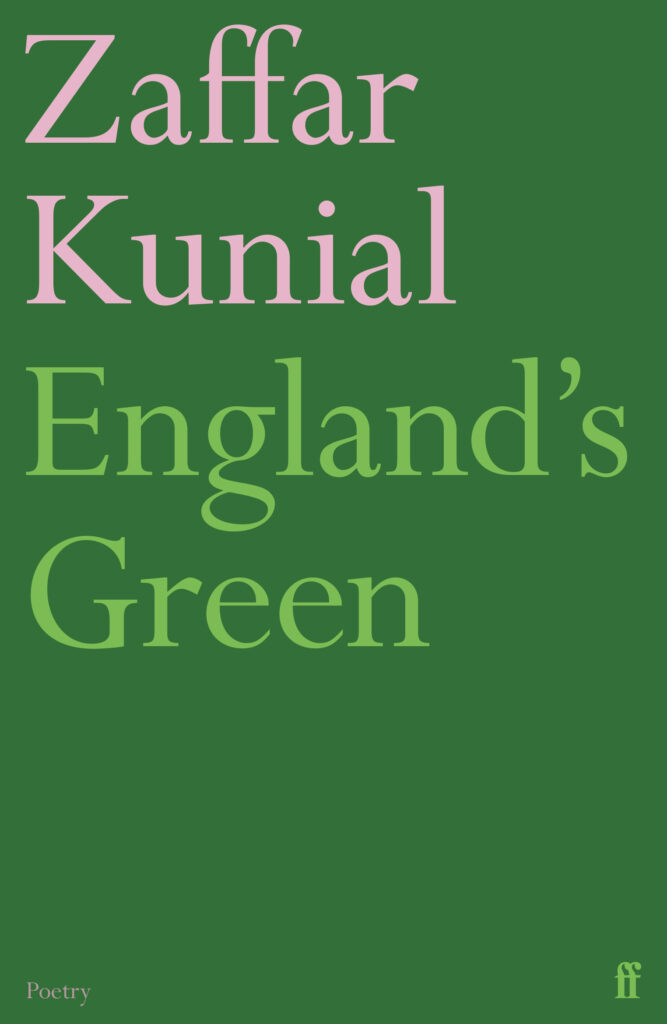
Zaffar Kunial’s England’s Green (Faber & Faber, 2022) is shortlisted for the T. S. Eliot Prize 2022. John Field blogs at Poor Rude Lines.
Be among the first to receive updates on the latest T. S. Eliot Prize news by subscribing now!