In Quiet, Victoria Adukwei Bulley’s debut collection, the poems subvert and problematise the language of the establishment by forcing open old ideas and creating new spaces for thought and dialogue, writes John Field
Be among the first to receive updates on the latest T. S. Eliot Prize news by subscribing now!
In Quiet, Victoria Adukwei Bulley’s debut collection, the poems subvert and problematise the language of the establishment by forcing open old ideas and creating new spaces for thought and dialogue, writes John Field
In 2018, Adukwei Bulley was poet, writer and artist-in-residence at the Victoria and Albert Museum, London, and if you’ve only seen her work on the page, take a look at the beautiful films she made, such as ‘Men Like You Say Mankind’. ‘Men like / you go on grand tours & gap years, dig up other / men’s bones & call it science,’ she says, in a low, hushed tone that adds ironic heft and power. In combining grand tours and gap years, Adukwei Bulley signals a problem not yet consigned to history.
An early poem in Quiet, ‘revision’, is knock-out stuff. Its four sections, ‘i. consider’, ‘ii. compare’, ‘iii. consolidate’ and ‘iv. conclude’, co-opt the language of examination questions and evoke the oppressive silence of the examination room, a silence in which some candidates will simplify problems in an attempt to control their material. That first word, ‘consider’, appears to invite thoughtful, holistic responses, but the text which follows constructs statements from multiple-choice options: ‘from the 1400s, the area later known as the gold coast would be […]’. We’re familiar with this voice. It’s the authoritative, ostensibly objective voice of ‘History’, here offering up the idea that there was nothing there before the British gave the Gold Coast a name – it was simply ‘an area’. As the line ends, the reductive rules of the game are revealed through the examination’s rubric: ‘(choose one)’. Despite appearances, there’s little to ‘consider’ in this examination; all that is required is to distil history until all nuance is removed. And once again the annexation is not over; ‘sabbatical’ (in the list ‘visit / residency / occupation / sabbatical / stay’) echoes those ‘gap years’ in ‘ Men Like You Say Mankind’.
The poem ‘How Not to Disappear’, which explores the 2021 disappearance and death of Richard Okorogheye, works with a different kind of silence. Its epigraph, words spoken by Okorogheye’s mother, reveal police indifference to his disappearance. Here, silencing the inner self becomes a possible survival strategy, as we, addressed in the second person, hope that we ‘have spoken to no one lately / about bad days, hard times, or worse have written / a poem or two about them’. At 19 (Okorogheye’s age when he disappeared), surely everyone has the right to voice their angst on a silent page without fearing that, in doing so, they may compromise their safety? How can we tolerate a society in which access to this inner silence – the sort of silence cited in the collection’s epigraph, from Kevin Quashie’s The Sovereignty of Quiet – might be deemed unwise?
The poem ‘[ ] noise’ approaches silence from another angle. In the notes, Adukwei Bulley reminds us that, because it cuts through environmental sound, white noise is used by the emergency services. It is also weaponised in the hands of interrogators and torturers. Just looking at ‘[ ] noise’ on the page, you see its whiteness strobing through the text, disrupting the language. This poem contrasts with the blackout poem, ‘black noise’, where the speaker’s voice has been almost entirely occluded by redactions. Despite this or through this, we are reminded again of the collection’s epigraph, its description of how an inner life of dreams and ambitions enriches people all too often forced into a loud language of protest. Kevin Quashie writes that, ‘It is this exploration, this reach toward the inner life, that an aesthetic of quiet makes possible.’ And so, in ‘black noise’, through the silence, stripped to its essence, the self emerges all the clearer from the page and the speaker asks ‘can you // see me // now?’ Yes! Clearly!
Through the pages of Quiet we see Victoria Adukwei Bulley emerge. We hear her voice, and hear its authority, eloquence and nuance aplenty… without recourse to shouting.
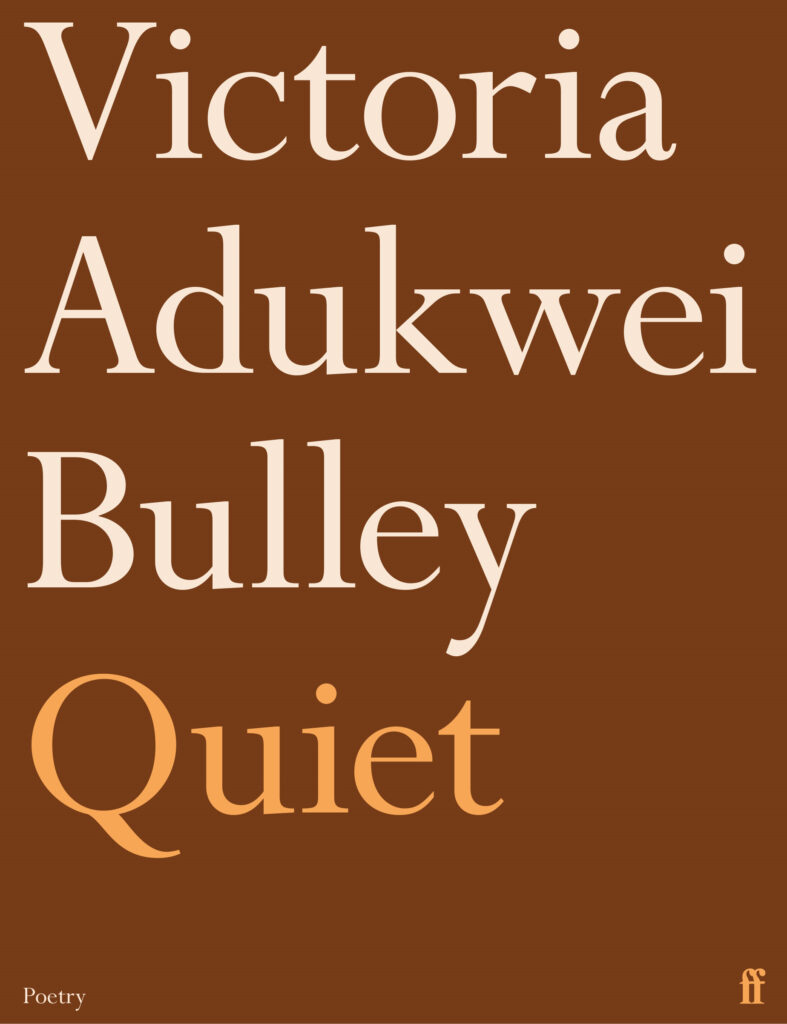
Victoria Adukwei Bulley’s Quiet (Faber, 2022) is shortlisted for the T. S. Eliot Prize 2022. John Field blogs at Poor Rude Lines.
Be among the first to receive updates on the latest T. S. Eliot Prize news by subscribing now!

T. S. Eliot Prize: You have really thought-provoking epigraphs: ‘this reach towards the inner life, that an aesthetic of quiet makes possible […] a black expressiveness without publicness as its forebearer, a black subject in the undisputed dignity of its humanity’ (Kevin Quashie) and ‘… you got to hold tight a place in you where they can’t come’ (Alice Walker). This touches on the Big Theme in your book – but might you like to say a bit about it? What is the place Walker refers to?
Victoria Adukwei Bulley: That place, as I perceive it, is an interior landscape that might even be described as a forest or nature reserve of the self. Everything from the mundane to the sensual and the cerebral has a place in that landscape, and I wanted the book to be capacious enough to hold each of these with respect – so that it could contain a kaleidoscope of moments that make up a life. Whether that’s a speaker reminiscing upon her time at school, or enjoying the company of good friends (complete with the kinds of language, laughter and in-jokes that happen here); or being with a lover; thinking about a crush; thinking about history, the state or abolition; experiencing a miscarriage; everything from watching a cat at play to watching a snail sleep. I wanted to take each of these moments as emblems of a quiet but rich life and place them on the mantelpiece of the interior, to sit with them and call them sacred, and affirm them as safe.
I use the word ‘safe’ because the book is rooted in a black subjectivity, particularly that of black girlhood and womanhood. This is a subject position rich with creative agency (as echoed through many of the other epigraphs in the book) but, given the racialised and gendered structural realities of the world, insisting upon that agency involves risk, as the third part of ‘fabula’ explores. At the same time, the book is not an attempt at transparency, at a redemptive representation in which the subjects demand recognition of validity or humanity. To me, the speakers of the poems always hold a little something back. They keep one hand in their pockets, they aren’t always facing the camera – sometimes their backs are turned completely. The subjects are more concerned with becoming known to themselves than being known. This is their reward, whether it’s witnessed or otherwise.
TSEP: The organisation of your book and the enigmatic section titles are very interesting. There’s the suggestion of progression beyond a door, a lock into a garden, a journey deeper into the interior, a garden, a landscape, towards a meditative, more confident self. Keats’ ‘Mansion of Many Apartments’, the progression from ‘the infant or thoughtless Chamber’ came to mind…
VAB: The progression that happens as you move through Quiet definitely has much in common with the spirit of what I understand Keats to be talking about. My intention for setting the book out as a progression through rooms separated by brief poems that operate as keys, doors and seals was for myself as the writer, as well as the reader. In the early stages of putting the book together I knew that I as the author also wanted to travel – to find myself, by the end of the book, at a new position with a greater sense of possibility and direction than before. In its most obvious form, the idea of a house reflects the interiority that the book takes as its focus. But the organisation of the text was also itself a provisional map, a blueprint – an experimental framework that I imagined and then wrote into (with no guarantee of success!).
I thought about how I wanted to feel at the close of the book. I called that feeling a ‘garden’ because the image this conjured felt sensorially accurate. The risk was that in order to write the poems that would go in this section, I knew that I would have to actually arrive at the garden – emotionally, intellectually – so that I could write poems that were honest and reflective of ideas I truly felt and believed (and not just as sterile, abstract concepts). I didn’t know if I could get there but one of the ways that I did was through the things I was reading, which gifted me that sense of possibility that I had been yearning for. I wanted to pass this gift on, so I included a selection of these books in the ‘Further Reading’ list at the end of the collection. These are some of the texts that guided me to that ‘night garden’. Some of these authors are the ‘luminaries’ I see as working together in that night garden.
Coming back more squarely to this passage from Keats – and it’s been a long time since I’ve read Keats in any depth, so I’ve had to brush up on this slightly – I think there’s a very real commonality here, particularly in that sense of moving through ‘chambers’ of knowledge and understanding. But I’m especially drawn to the words ‘… we are in a mist’. We are in that state, we feel ‘the Burden of the Mystery’. In ‘fabula’ and across the final section of the book there’s a lot of mention of darkness, and while that darkness is reflective of the looming apocalyptic time in which we live, it’s also at other times darkness that’s also of richness and depth, of a mist-like unclarity that asks of us that we develop new vision, new ways of being and being-with one another that are not fearful of the unknown. There is a need to befriend that mist so as to get through – survive – that burden of the mystery. I see this in that passage from Keats, and likewise in his concept of ‘Negative Capability’ which is something I feel incredible affinity with.
TSEP: There is a circling/reordering of a door, a seal and a key in the section heads too. Perhaps these suggestive and mysterious devices connect with the equally mysterious black mirror?
VAB: I think this is accurate – even if not entirely deliberate or conscious in relation to the black mirror. I wanted the book to have recursive elements, to have a sense of progressions, of coherence, but also of echo. I thought that this would create a growing sense of familiarity within the reader that makes the book feel immersive and possessed of its own logic. And so the circling is a big part of this.
TSEP: You have talked about Quiet being written in a fairly concentrated period after you’d read, at the recommendation of Lynnée Denise, Kevin Quashie’s The Sovereignty of Quiet: Beyond Resistance in Black Culture. So, was the book written out of the ideas that reading Quashie freed up?
VAB: I would absolutely say that Sovereignty was a catalyst for Quiet. The lines I was thinking along before I came across Kevin Quashie’s work were more about the difficulty of speaking, of language and its slippages, of how words fail. This isn’t too far afield from the book that exists now. Many of the poems pre-existed my reading of The Sovereignty of Quiet but while I had an established thematic focus it was much more vague and had less of a motor. Encountering Quashie’s work was a lightbulb moment because I felt that his work described not only a poetics that my work embodied but also that it provided a language for many of the ways that I had seen myself experiencing life – ironically as someone who had so often been called ‘quiet’. There was a very particular loneliness that his work removed from me. This was a gift that allowed me to write without over-compensating, without apologising for that quietness. And actually to take that very quietness as a subject and really toy with it, look at it from all angles, and see what else it holds.
TSEP: Hair memory (‘Epigenetic’) – (which had me thinking of Pixar’s Inside Out!) – ‘someone written in you / still knows what it felt like’. Can you say a bit about this?
VAB: When I was little I used to think that hair was like paper coming out of a printer, that it contained records of our every thought and all you had to do was find the right strand and you could (with some kind of technology) scan and replay an experience like a videotape. But also, yes – there’s a lot of hair in this book: hair as recalled from childhood, hair found in food as interruption, hair as a riff on the word heir, hair as a place into which seeds were literally sown, hair as an inherited trait, and in excess of the book, hair as something shaven off in grief or mourning, biblical hair as Samson’s strength (and downfall)… etc. I think hair has so many significations that it was impossible not to have some of my fascinations about it arise in the book. It’s a very mysterious part of our bodies.
TSEP: Air (in ‘six weeks’: ‘leaving brief & careful tellings on the air with my breath’, and ‘the unreadable air’ in ‘Air’) and hair (see above) recur in the book with a kind of a rangey metaphorical resonance. Was this a very conscious part of your planning of the book? (Water is there too!)
VAB: The instances of air are much less conscious than those of hair. I wouldn’t say they were planned at all. Water, on the other hand, like the hair aspect, probably has more of a charged meaning in my consciousness and so while this wasn’t deliberately included as a theme or recurrence, it doesn’t surprise me that it’s there – ie I have a long lyric essay titled ‘On Water’ online at The White Review and so elements of that thinking are unlikely to have been far from the surface. But not planned.
TSEP: ‘The Ultra-Black Fish’ – the scored out words are ‘discovery’ and ‘discovered’ – why?
VAB: I wanted to blatantly make a correction in the text that would loudly deny the validity of that word but also signify how easily it would be used, and to correct my own impulse to use it. Captured was an important replacement because I also felt that it was more true.
TSEP: ‘Shut up about Freud’ (‘Dreaming is a Form of Knowledge Production’). Me too! But what do you mean?
VAB: My sense is that Freud is overrepresented in how we think about dreams (and many other things). Not irrelevant but overrepresented. I also felt like this last sentence struck me as the kind of thing you’d hear someone say in a dream completely out of context before you wake up.
TSEP: There is a lovely idea in ‘Dedication’: ‘we are always // accountable / to the stranger // on the skyline’. Can you say something about this?
VAB: I feel that we are answerable to people that we’ve yet to even meet but know will be coming our way. The idea of being accountable to a stranger is strange perhaps but it’s an idea that feels worth practising, especially if we imagine ourselves as once having been that stranger. The warmth of not needing to be known in order to be cared for; to be cared for as a given, even when still in potentia.
TSEP: In our video interview, you talked about some of Quiet taking the mick and it is often slyly funny – in for example ‘The Ultra-Black Fish’ and ‘note on exiting’ (I love ‘ the [ ] supremacist capitalist [insert -ist] [insert -ist] patriarchy is working faultlessly today, running at full service; no disruptions, even with your small axe in its back’).
VAB: Humour is key because I do feel that the book demands a lot at times. It’s quite text-heavy, sometimes theory-heavy, and formally unpredictable. So – even for myself – it’s helpful to keep the jokes in because they offer moments of lightness but also because they are another way of being honest. They are a way of handling the truth whilst also admitting its absurdity.
Victoria Adukwei Bulley’s Quiet is published by Faber & Faber. Watch the T. S. Eliot Prize filmed readings and interview, and read the reviews and Readers’ Notes online to find out more.
Be among the first to receive updates on the latest T. S. Eliot Prize news by subscribing now!