

WINNER
2021

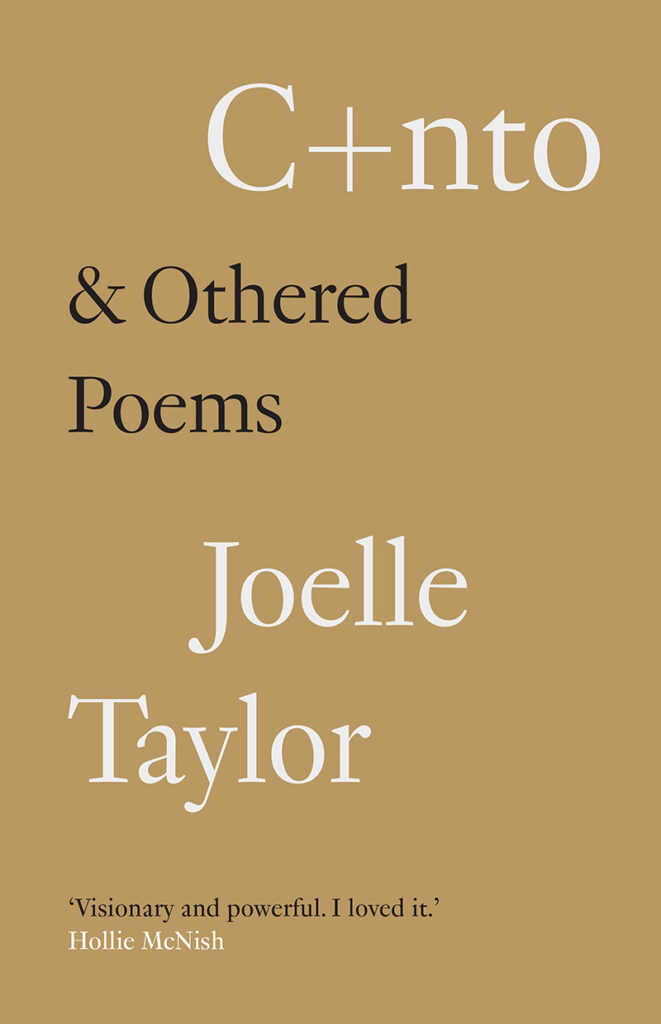
Cunto & Othered Poems

The Westbourne Press
Joelle Taylor 1200 x 1530 Adrian Pope
Joelle Taylor is an award-winning poet, playwright and author whose poetry collections include: Ska Tissue (Mother Foucault Press, 2011), The Woman Who Was Not There (Burning Eye Books, 2014), Songs My Enemy Taught Me (Out-Spoken Press, 2017) and C+nto & Othered Poems (The Westbourne Press), winner of the T. S. Eliot Prize 2021. It also won the Polari Prize 2022...

Review

Review

Joelle Taylor's C+nto & Othered Poems is a collection that walks the revolutionary road of this country’s finest radical writers as it explores the lives of women from the butch counterculture, writes John Field

Read the
Reader's Notes

Videos

Joelle Taylor reads from C+nto and Othered Poems at the T. S. Eliot Prize Shortlist Readings
Kathryn O’Driscoll reads from Joelle Taylor’s C+nto and Othered Poems
Joelle Taylor reads ‘Scene One’
Joelle Taylor reads ‘Angel’
Joelle Taylor reads ‘Valentine’
Joelle Taylor reads ‘Heaven, 1995’
Joelle Taylor talks about her work

Related News Stories

In 2023 the T. S. Eliot Prize celebrated its 30th anniversary. We marked the occasion by looking back at the collections which have won ‘the Prize poets most want to win’ (Sir Andrew Motion).  When Joelle Taylor’s collection, C+nto and Othered Poems, won the T. S. Eliot Prize, Chair of...
The T. S. Eliot Foundation is delighted to announce that the winner of the T. S. Eliot Prize 2021 is Joelle Taylor for C+nto & Othered Poems, published by The Westbourne Press. Chair Glyn Maxwell said: Every book on the Shortlist had a strong claim on the award. We found...
Lynn Gaspard of Saqi Books on ‘a poetic tour de force, earth-shattering in its impact and vital in its representation of a community increasingly losing space within the mainstream’ For over thirty years, Saqi Books has released seminal, cutting-edge works about the Middle East and North Africa, offering an independent...
  Judges Glyn Maxwell (Chair), Caroline Bird and Zaffar Kunial have chosen the T. S. Eliot Prize 2021 Shortlist from a record 177 poetry collections submitted by British and Irish publishers. The Shortlist consists of an eclectic mixture of established poets, none of whom has previously won the Prize, and...
The T. S. Eliot Foundation is delighted to announce the judges for the 2021 Prize. The panel will be chaired by Glyn Maxwell, alongside Caroline Bird and Zaffar Kunial. The 2021 judging panel will be looking for the best new poetry collection written in English and published in 2021. The...
Review of Cunto & Othered Poems

Joelle Taylor’s C+nto & Othered Poems is a collection that walks the revolutionary road of this country’s finest radical writers as it explores the lives of women from the butch counterculture, writes John Field

It’s rare to encounter a collection that opens with a Preface. Think of Wordsworth’s Preface to the 1800 edition of Lyrical Ballads – it announces the collection’s radical politics. As revolutionary France shook off the old order, Wordsworth worked to bring the elevated language of poetry ‘near to the language of men’. Taylor’s Preface is no less radical. She reminds her reader that, ‘according to the Human Dignity Trust it is illegal to be a lesbian in almost a quarter of the world’s countries’. She concludes by writing that ‘Unity has never been more important, but in order to achieve that, we must reflect on our histories, when they converge, where they differ, and make a joint decision on where we are going — and how we get there. We build the road we walk on together’. This is a collection that walks the revolutionary road of this country’s finest radical writers as it explores the lives of women from the butch counterculture.

The first chapter, ‘Vitrine’, mourns the loss of the spaces that permitted LGBT+ culture the air it needed to breath, and the light required to flourish. Instead, Taylor reimagines the sun as ‘a hole through which the sky is draining’, leaving us trapped in the lifeless sterility of a vacuum. Wandering the streets of London, ‘A man is taking down a sign that reads Old Compton Street & replacing it with a sign that reads Old Compton Street’. Everything appears to be the same, but that which once lived and breathed has been curated, deprived of its life, and placed behind the bars of a museum where ‘Tourists shoal, mobile phones pointing to a series of large glass display cases lining the pavement’. Taylor presents her poem in the form of a shot list – the list of camera angles and movements a director uses to compose a film, and this adds to the impression that Old Compton Street, once a focus for the LGBT+ community, has been preserved in aspic: ‘my pretty Pompei’, as Taylor describes it.

‘C+nto’, the collection’s second chapter, is Taylor’s personal response to her sexuality. These poems are listed numerically as bouts in a boxing match and so, like ‘Vitrine’, life is imagined as a semi-choreographed media event. The stage is lit for the cameras and the protagonist is trapped within the confines of a ring that guarantees confrontation and violence. ‘ROUND ONE the body as battleground’ addresses the reader in the second person, denying us a comfortable distance from which to view the drama. ‘you awaken / in no man’s land     gunfire from over the horizon     & / women     are crucified on hashtags across the dark hills’. At face value, ’No man’s land’ is a blunt statement, and reminds us that the female body is not male property. However, even attempting to name it as such automatically turns it into that other no man’s land: a dangerous, disputed territory and neatly – tragically – encapsulates the difficulties and dangers of being lesbian.

The final sequence, ’O, Maryville’, follows the narrative of a night in a dyke bar. Here Taylor shifts register and a poem like ‘Psalm’ reads like a skit on the ‘O Antiphons’, the Magnificat antiphons used during the last seven days of Advent, addressing Christ’s many names using the vocative: O Wisdom; O Root of Jesse; O Dayspring. Taylor’s litany of praise gives us ‘o Maryville / o swagger / o keychain & denim’ and appropriates a language of love and adoration. Inua Ellams describes C+nto as ‘an altar of a book’ and, after pain and sacrifice, Taylor gives us a moment of transcendence, of all that is holy veiled in flesh in a glorious celebration of sex and sexuality.

Taylor refuses to let her reader escape with a misplaced sense of euphoria and, as the collection closes, she gives us ‘Eulogy’. It works with ‘The Litany of the Saints’ — an invocation and appeal for the intercession of the saints. Taylor’s ‘Eulogy’ carries the memories of murdered lesbian woman and recognises their deaths as martyrdoms and, by extension, shows us that they bore witness to something sacred. Taylor opens: ‘& I carry / Roxanne Ellis / within me. / & I carry / Ashanti / Posey within / me’.

Using the tools of a Judeao-Christian tradition, Taylor works with some of the oldest forms of poetry, and C+nto demands that the reader acknowledges how these histories converge. We are asked to build a road that all are safe to walk: day, or night; accompanied, or singly.

Joelle Taylor’s C+nto & Othered Poems (The Westbourne Press) is shortlisted for the T. S. Eliot Prize 2021. John Field blogs at Poor Rude Lines.

Cunto & Othered Poems
The Westbourne Press

Newsletter

Be among the first to receive updates on the latest T. S. Eliot Prize news by subscribing now!


The T. S. Eliot Prize on Social Media

Part of tseliot.com

Designed by thinking

Interview of Cunto & Othered Poems

Cunto & Othered Poems
The Westbourne Press

Newsletter

Be among the first to receive updates on the latest T. S. Eliot Prize news by subscribing now!


The T. S. Eliot Prize on Social Media

Part of tseliot.com

Designed by thinking