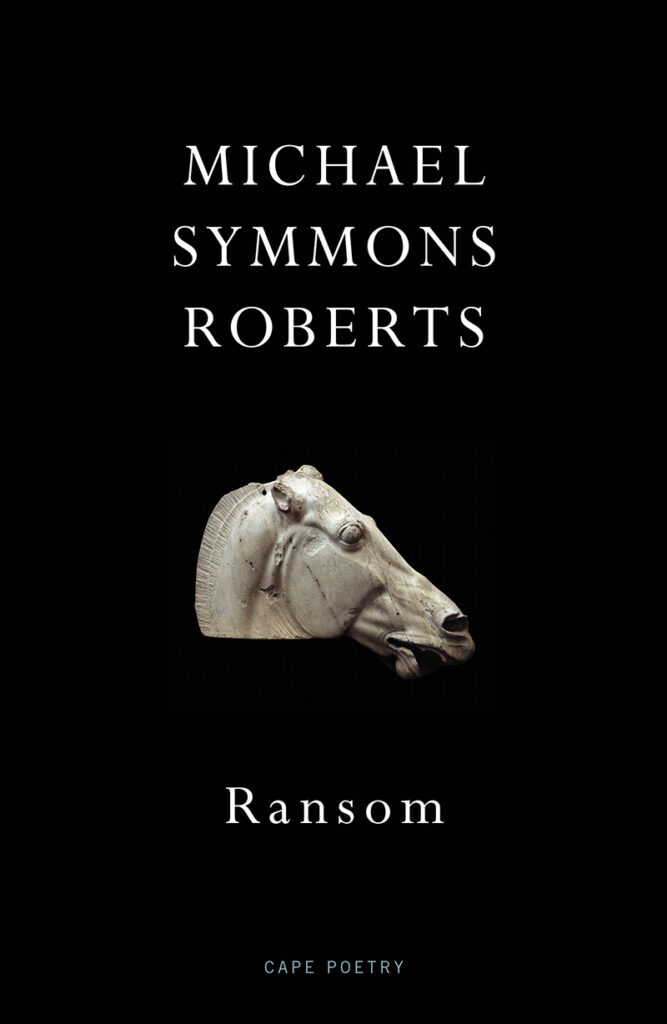

Michael Symmons Roberts's Ransom is both a dazzling cinematic treatment of confinement and release, and a contemplation of the divine, writes John Field
Be among the first to receive updates on the latest T. S. Eliot Prize news by subscribing now!
Michael Symmons Roberts’s Ransom is both a dazzling cinematic treatment of confinement and release, and a contemplation of the divine, writes John Field
In Mancunia, shortlisted for the T.S. Eliot Prize in 2017, Symmons Roberts explores our urban spaces, touring dive bars and scraps of wasteland. Ransom is something more metaphysical and is both a dazzling cinematic treatment of confinement and release, and a contemplation of the divine.
It’s fitting that a poem entitled ‘The Note’ opens Ransom. Both the reader and the speaker are tempted to think along the well-worn lines of the cinematic cliché of the ransom note: ‘scissors and glue, // a stack of newspapers / to spell out where and when’. However, the poem also strikes the collection’s key musical note – the heart of the collection is ‘Vingt Regards’, a response to Messiaen’s Vingt Regards sur l’Enfant-Jésus, a series of piano pieces contemplating different aspects of Christ. Ironically, the poem’s attentive listening also presents us with a cinematic cliché: we listen not to the music but to the sounds beneath it, searching for the ‘dialects of distant dogs, / to figure where they held you’. Headphones plugged in, we believe that we are paying close, critical attention but still, somehow, manage to miss the point. Symmons Roberts’ final couplet surprises us with joy – and a jump – as, ‘When you walked in, / you scared the life out of me’. It’s gloriously disarming – at one level we all recognise that jolt, but there’s a quiet spiritual profundity to it too – the miracle of the incarnation.
The collection sees the digital world as one of imprisonment. In ‘The Tears of Things’, even the natural world is subject to its strictures: ‘the night sky winter-clear, / universe bent to the shape of an eye, // curved to the full extent of vigilance’. Again, we’re reminded of just how far we now view the world through the photographic lens: ‘My neighbour leaves home and walks out of shot’. On the next page, the title ‘Ware’ primes us to expect watchful care and safe-keeping, but what we find instead is ransomware, a malicious piece of software that encrypts the victim’s files until a ransom is paid. Needless to say, on attempting to open a file, the hapless victim will instead receive a ransom note, and so the poem is addressed to the second person, presenting the attack as ‘no jail cell // but a curl of hair / shut in a heart-shaped pendant’, in a grotesque piece of self-delusion.
If ransomware is the darkest form of digital ransom, we probably find that, post-COVID, we view streaming TV services as benign – as a godsend, even. Instead, ‘I Saw Eternity the Other Night’ prefers to imagine the simpler screen of the evening, viewed from a domestic window: ‘I sat and waited for the shapes // of rooftops, geese, mill chimneys, / to soften as my window // pulled the world outside to in’. The practical details of the physical world contrast with the cynical artifice of ‘TV’s illumined bait’ where ‘all its shows […] captivate’. Symmons Roberts resists rhyming his couplets until this point, but ‘bait’ and ‘captivate’ snap his couplet shut like the spring on a mantrap.
The collection concludes with ‘Takk’, a sequence named after a coffee shop on Manchester’s Oxford Road, directly below the Mancunian Way flyover. Again, the world is viewed in cinematic terms, or perhaps as a hipster’s photographs, ready to be uploaded to social media. The speaker looks out at ‘the scene framed by this crate window’ and sees a world of off-white walls. However, as the reflections seen in the window of ‘I Saw Eternity the Other Night’ reflect into infinity, so does the view imagined from the coffee shop. It reveals ‘a vista worth waiting for, / like some imagined Finca Miravalle / with swathes of ice-cream-bean and cypress trees’. The poem acknowledges our need to escape and Takk serves as the perfect metaphor: it is a series of shipping containers, themselves contained by the concrete walls and the roof of the flyover – boxes within boxes. Yet, even here, under tons of concrete, we can experience revelation and escape.
The poems in Ransom reflect one another like shards of mirror. Using the collection as a whole, Symmons Roberts creates our gilded cage and the glimpses of infinity we snatch through its bars.
Michael Symmons Roberts’s Ransom (Cape Poetry) is shortlisted for the T. S. Eliot Prize 2021. John Field blogs at Poor Rude Lines.
Be among the first to receive updates on the latest T. S. Eliot Prize news by subscribing now!