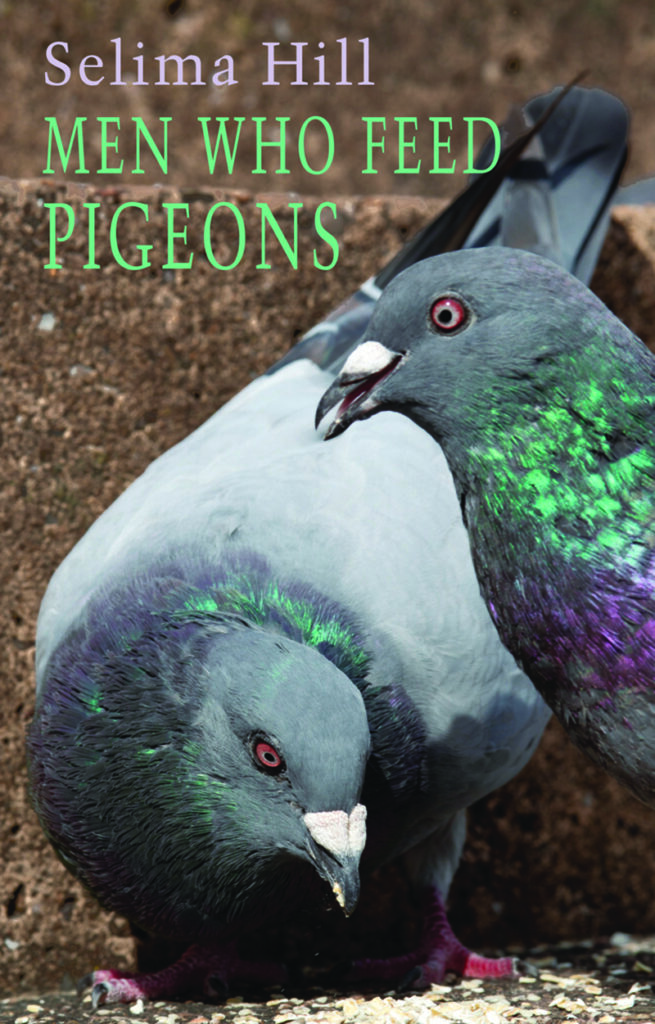

Selima Hill's Men Who Feed Pigeons explores the relationships between women and men in eight sequences. 'To read these is to enter a world in which the everyday suffers a sea-change into something rich and strange', writes John Field
Be among the first to receive updates on the latest T. S. Eliot Prize news by subscribing now!
Selima Hill’s Men Who Feed Pigeons explores the relationships between women and men in eight sequences. ‘To read these is to enter a world in which the everyday suffers a sea-change into something rich and strange’, writes John Field
Selima Hill’s Jutland was shortlisted for the T.S. Eliot Prize in 2015 and, in my review, I commented that ‘the world Hill creates seethes with obsessive energy and her poetry sings with painful authenticity’. Men Who Feed Pigeons presents the reader with eight sequences exploring the relationships between women and men, and to read these is to enter a world in which the everyday suffers a sea-change into something rich and strange. Relationships and friendships are placed under the microscope and Hill finds both comedy and tragedy in the prosaic details of everyday life.
The opening sequence, ‘The Anaesthetist’, is a miscellany of men, some defined by their professions and others by relationships. Here, Hill’s pairs of couplets land with devastating satirical effect and signal her mastery of a craft stretching back to Alexander Pope. In the first stanza of ‘The Care Worker’ we encounter unconditional love: ‘The residents are old and so in love / it’s all the same to them if he’s chubby’. There’s a quiet little tragedy simmering away here already as the residents’ ‘love’ speaks of emotion with nowhere to go, displaced onto the only available object, the paradoxically entitled ‘Care Worker’. The professional distance implied by his job title only serves to make their love for him more painful for the reader. At the very least, the professional distance implied by this title should ensure the residents’ safety but, in the second stanza, Hill delivers the sucker punch: ‘or permanently stoned or if it’s him / stealing stuff from their bedside lockers’. The word ‘stuff’ implies worthless rubbish and feels like it belongs to the care worker’s idiolect. His casual pilfering of those final memories – wedding and engagement rings – reveals his contempt for their love, and the residents’ ‘lockers’ become pitiful. A locker might protect their stuff from other residents and their guests but, as everyone knows, the threat in the care home comes chiefly from within and not from without. Powerful as this poem is, it’s just one picked at random: they are all this good, and the power of the sequence lies in its cumulative effect. Some of its poems are affectionate, or just plain funny (read ‘The Duke’ and ask yourself why he’s afforded just a single couplet) but, overall, the focus of Hill’s vision makes reading this sequence as thrilling as wandering the galleries of the National Portrait Gallery.
‘Billy’ presents a friendship between a man and a woman and, in many of these poems, Hill works with just a single couplet. Poets have forever mined the couple(t) for expressions of union but Hill finds other possibilities. ‘Raging Torrents, Soaring Peaks’ promises the sublime, a transcendental moment of connection between a couple, but ‘Unmoved by raging torrents, soaring peaks, / he’s busy looking forward to the cakes’. It’s a brilliant piece of bathos and, in the seething silence flowing around the poem, we feel the female subject’s raging torrent of anger. In just two lines, ’Semolina’ presents a vista of Gothic horror. It starts: ‘If he’s fed until he can’t move’ and casts the speaker as Hansel and Gretel’s witch, her conditional ‘if’ plotting a crime. The poem finishes ‘I can do whatever I want’. Given the opening line, my first thoughts were of John and Lorena Bobbitt, of knife-wielding domestic horror, but there’s a simpler, more painful desire for space here too: a space savoured in fleeting snatches, waiting for him outside the gents and hoping that ‘he’ll take ages’.
Selima Hill is a one-off, and her restless magpie mind unpicks the fragile seams of everyday experience, revealing the darkness beneath. We can choose to laugh, or we can choose to cry, but there’s no easy escape from the disconcerting experiences Hill promises her reader.
Selima Hill’s Men Who Feed Pigeons (Bloodaxe Books) is shortlisted for the T. S. Eliot Prize 2021. John Field blogs at Poor Rude Lines.
Be among the first to receive updates on the latest T. S. Eliot Prize news by subscribing now!