
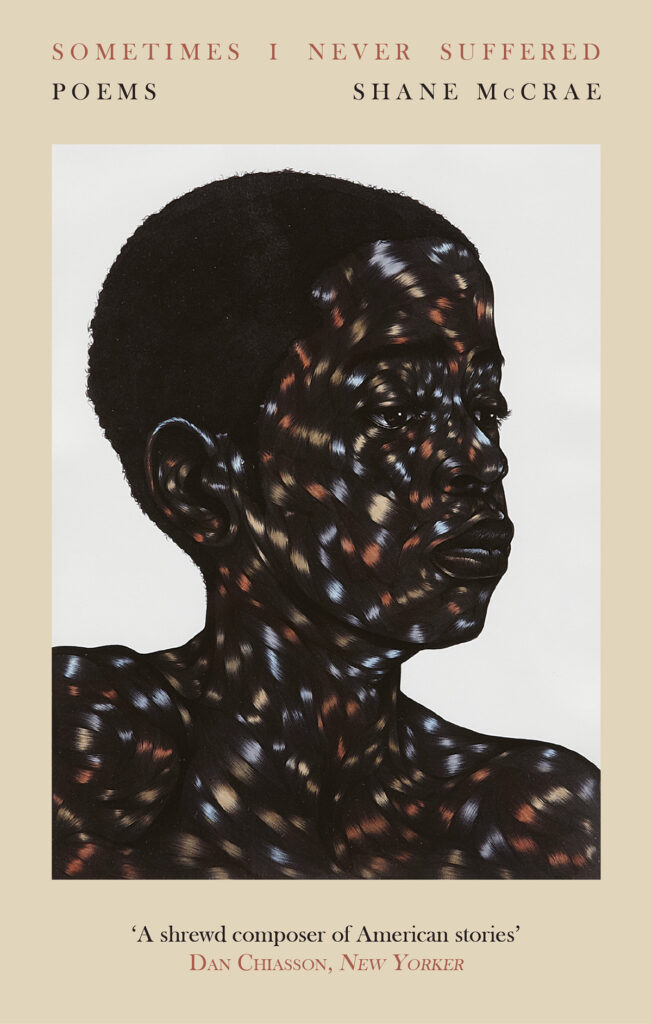

Sometimes I Never Suffered

Corsair Poetry
Shane-McCrae_web_bw
Shane McCrae grew up in Texas and California and lives in New York City. He is the author of numerous poetry collections, including In the Language of My Captor (Wesleyan University Press, 2017), which was a finalist for the National Book Award and the Los Angeles Times Book Prize; The Animal Too Big to Kill (Persea Books, 2015), winner of...

Review

Review

Shane McCrae's Sometimes I Never Suffered 'opens with a fall but, by the journey’s end, we see Jacob’s ladder, the golden staircase connecting Heaven and Earth, and the possibility of justice, redemption and reward', writes John Field

Read the
Reader's Notes

Videos

Shane McCrae talks about his work
Shane McCrae reads ‘Heaven in Heaven’
Shane McCrae reads ‘Jim Limber on the Gardens of the Face of God’

Related News Stories

The T. S. Eliot Foundation is delighted to announce that the winner of the T. S. Eliot Prize 2020 is Bhanu Kapil for How to Wash a Heart, published by Pavilion Poetry (Liverpool University Press). Chair Lavinia Greenlaw said: Our Shortlist celebrated the ways in which poetry is responding to...
Judges Lavinia Greenlaw (Chair), Mona Arshi and Andrew McMillan have chosen the 2020 T. S. Eliot Prize Shortlist from 153 poetry collections submitted by British and Irish publishers. The shortlist comprises work from five men and five women; two Americans; as well as poets of Native American, Chinese Indonesian and...
The T. S. Eliot Foundation is delighted to announce the judges for the 2020 Prize. The panel will be chaired by Lavinia Greenlaw, alongside Mona Arshi and Andrew McMillan. The 2020 judging panel will be looking for the best new poetry collection written in English and published in 2020. The...
Review of Sometimes I Never Suffered

Shane McCrae’s Sometimes I Never Suffered ‘opens with a fall but, by the journey’s end, we see Jacob’s ladder, the golden staircase connecting Heaven and Earth, and the possibility of justice, redemption and reward’, writes John Field

Sometimes I Never Suffered feels like a Medieval Dream Vision: a rebuke to the present and an arresting reimagining of eternity, a hope for a better future. Like Paradise Lost, the collection opens with a fall as ’The Hastily Assembled Angel Falls at the Beginning of the World’ but, by the journey’s end, we see Jacob’s ladder, the golden staircase connecting Heaven and Earth, and the possibility of justice, redemption and reward.

The collection’s first sequence of poems, the ironically entitled ‘Fresh Eyes for a Fresh World’, follows the deeds of the Hastily Assembled Angel, a mix of Adam and Satan. Like Adam, he attempts to name the beasts ‘but nobody / Would name the things he saw the way he named them’. The poem reminds us that language is a consensus and that a world of fake news and Kellyanne Conway’s ‘alternative facts’ is a world in which language and truth are destroyed. The Tower of Babel, overreaching humanity’s attempt to build its own golden staircase between Heaven and Earth, only brought dissonance and chaos.

It’s oblique, but McCrae’s dream vision satirises Trumpism. The angels did not want to live with the other creatures on Earth ‘and so had voted to / Build their own angel but they hadn’t asked / Permission first instead they all together / Threw him together’. We’re in the Book of Exodus and the people of God, impatient, build and worship a golden calf. Or perhaps it’s 2017 and we’re at the West Front of the Capitol, watching the inauguration of the 45th president. The poem is riven by deeply tabbed caesuras. Left and Right, blue and red, are forced apart. The body politic is broken. Punctuation, the rules governing the rational and intelligible have been abandoned and the jarring internal rhyme of ‘together’ and ‘together’ feels awkward and thoughtless.

‘Variations on Jim Limber Goes to Heaven’ is a sonnet sequence exploring the life of Jim Limber, a boy of both White and Black descent who was adopted by the family of Jefferson Davis, President of the Confederate States. In the cultural imagination, Heaven is surely the whitest of spaces and McCrae’s reimagining of it challenges this stereotype. ‘Jim Limber on the Peace Which Passeth All Understanding’ opens ‘First thing I saw that heartened me in Heaven / Was a dead field first         thing behind the gates’. The plantation house pops into focus for a moment and we realise that the verdant avenue and the white house are symbols of oppression. Read against this context, the Pearly Gates promise pain, not peace, to the African American. The White idyll carries a heavy Black cost. The dead field usually takes us to Exodus, to the wrath of God, to the aftermath of the plague of locusts, to desolation and starvation. Here, the dead field means no slaves have been broken tilling the land, and Limber concludes ‘I had never seen that / Before            death with no people in it’. Perspective is everything and a new language, a new iconography, a re-imagining of heaven, is required if the mind is also to be freed from the shadow of bondage. Again, even reading the poems is an awkward experience as the eye stutters across McCrae’s caesuras, struggling to make sense of a voice marginalised by another Babel.

Sometimes I Never Suffered is both timeless and timely. Humanity has always erred and strayed like lost sheep but the collection ends with an opportunity for a Paradise Regained. The final poem, ’The Ladder to Heaven’, references Jacobs’s Ladder, and offers the hope that humanity will be restored to a better version of itself. McCrae’s anonymous protagonist climbs the ladder and ‘stepped from the rung to Heaven’. We hope he steps up, not down – although we cannot be sure.

Shane McCrae’s Sometimes I Never Suffered (Corsair Poetry) is shortlisted for the T. S. Eliot Prize 2020. John Field blogs at Poor Rude Lines.

Sometimes I Never Suffered
Corsair Poetry

Newsletter

Be among the first to receive updates on the latest T. S. Eliot Prize news by subscribing now!


The T. S. Eliot Prize on Social Media

Part of tseliot.com

Designed by thinking

Interview of Sometimes I Never Suffered

Sometimes I Never Suffered
Corsair Poetry

Newsletter

Be among the first to receive updates on the latest T. S. Eliot Prize news by subscribing now!


The T. S. Eliot Prize on Social Media

Part of tseliot.com

Designed by thinking