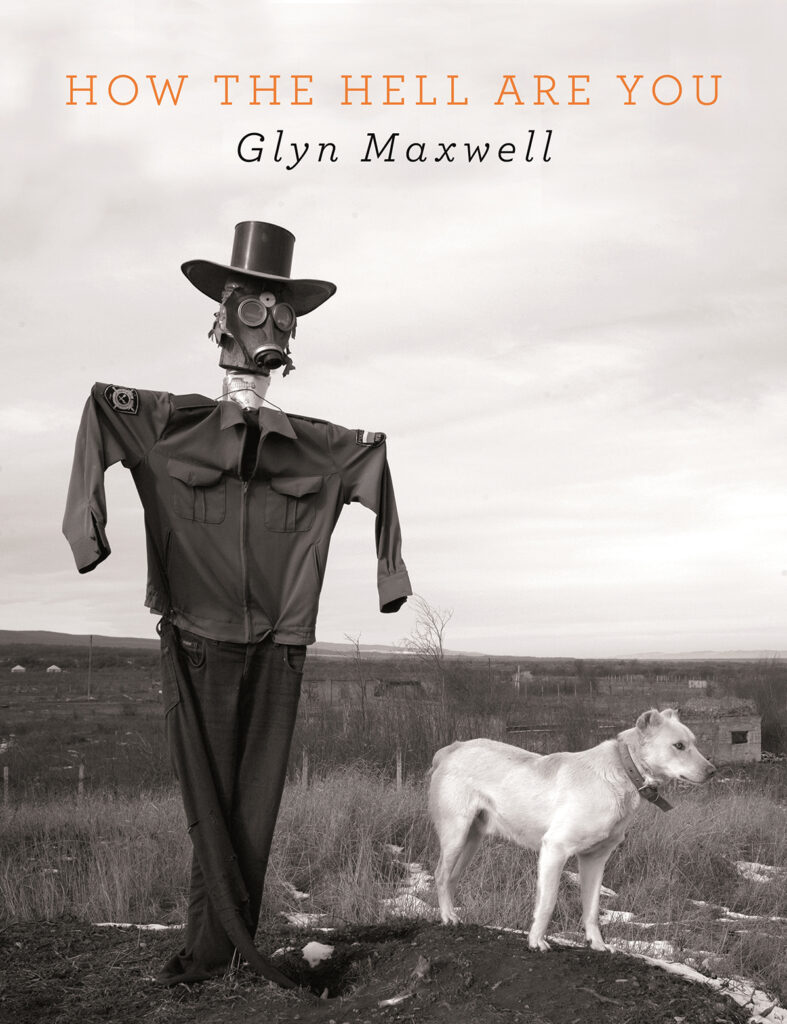

Glyn Maxwell's How the hell are you 'is rooted in pain and loss, in humanity’s insignificance. Yes, it’s brilliant on writing (and reading) but it’s warmly human too, with poems that are authentic and urgent', writes John Field
Be among the first to receive updates on the latest T. S. Eliot Prize news by subscribing now!
Glyn Maxwell’s How the hell are you ‘is rooted in pain and loss, in humanity’s insignificance. Yes, it’s brilliant on writing (and reading) but it’s warmly human too, with poems that are authentic and urgent’, writes John Field
Like Wayne Holloway-Smith’s Love Minus Love, also shortlisted for the T. S. Eliot Prize 2020, Glyn Maxwell’s collection How the hell are you points us towards Maxwell’s On Poetry (Oberon Books, 2012) – the most helpful, entertaining book I’ve read on the subject. In the first chapter, ‘White’, Maxwell considers the empty page: ‘Regard the space, that ice plain, that dizzying light. That past, that future. Already it isn’t nothing. At the very least it’s your enemy, and that’s an awful lot. Poets work with two materials, one’s black and one’s white. Call them sound and silence, life and death, hot and cold, love and loss’. It’s easy to dismiss writing about writing as narcissistic, to view it as a hothouse flower too delicate to survive in the real world. However, How the hell are you is rooted in pain and loss, in humanity’s insignificance. Yes, it’s brilliant on writing (and reading) but it’s warmly human too. These poems are authentic and urgent – sweated in the night.
‘The White’ celebrates creativity and opens by reminding the reader that ‘When you first made a sound you made a sound / on nothing. Not on peace, / on nothing’. I’m reminded of John, chapter one: ‘In the beginning was the Word, and the Word was with God, and the Word was God’. The addressee enacts the miracle of creating sound ex nihilo (from nothing) and Maxwell reinvigorates language, endowing it once again with a spiritual power. There’s a simplicity, a confidence and an honesty to his restrained vocabulary. This is a quality of the whole collection and his words feel weighed – and weighty. There’s a gravitas to them. ‘The White’ was written in homage to the Metaphysical poet and clergyman, George Herbert and, looking back at Herbert’s work (’Jordan’(II), for example) we see the self-satisfied writer suddenly realising the impossibility of his task, the inadequacy of his language. Maxwell’s speaker realises the same thing as ‘you saw that stanza break…’ and ‘vague oblivion’ pushes against him. This human chain, from Herbert to Maxwell, is never contrived or heavy-handed and reading the collection is an encounter with the spirit of Poetry – with a capital P.
‘Pasolini’s Satan’ engages with Pasolini’s film, The Gospel According to Saint Matthew, his retelling of the life of Jesus using ordinary people instead of professional actors. One of the actors speaks: ‘I’m no one still, like every / face you’ve seen. They cast us from round here. / We looked real, we’re gone now, / we are nobodies, we happened to be there // when the maker came’. Once again, the page is marked momentarily by black ink, a moment’s rage against the dying of the light but oblivion beckons Pasolini’s ordinary actors.
However, oblivion is not the worst thing we can imagine. In ‘The Shudder’, the speaker, in an unguarded moment, imagines his ‘grim suitcase / packed, the kitchen thrown a final look, / keys posted through, street gone from, all the work / of time and trace of us // discarded’. Maxwell’s quatrains, his first person speaker and his intimate tone echo another Metaphysical poet – John Donne. (‘The Heyday’, a couple of pages before, was written as a homage to Donne). Faced with this terrible prospect, the speaker looks again at the white void of oblivion, comparing it with the loss of love, and concludes that at least ‘death was a local, of this parish’. It’s heady stuff. Love and death. Black and white.
‘Seven Things Wrong With The Love Sonnet’ celebrates the white space, the breeze, the unpredictability of life. Sonnet form, the speaker contends, ‘lets no silence in’. ‘It’s planned – we weren’t’. There’s no glib, insincere fetishisation of poetry here. Maxwell understands his tools: black and white, sound and silence, and this qualifies him to speak of love and loss, life and death in a way that demands our attention and tears at our hearts.
Glyn Maxwell’s How the hell are you (Picador Poetry) is shortlisted for the T. S. Eliot Prize 2020. John Field blogs at Poor Rude Lines.
Be among the first to receive updates on the latest T. S. Eliot Prize news by subscribing now!