
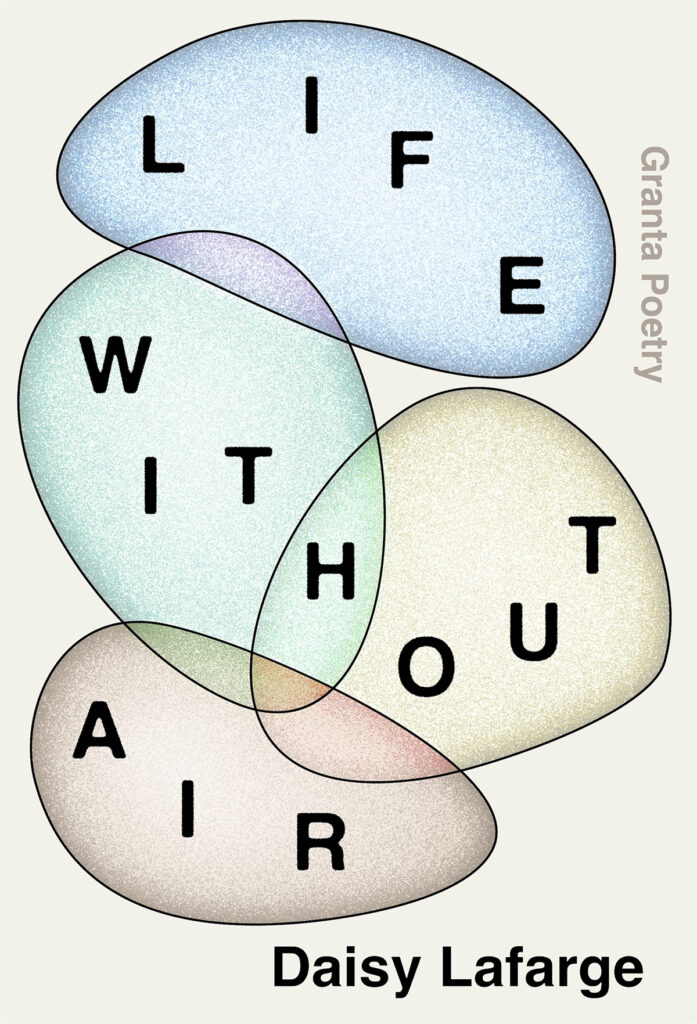

Life Without Air

Granta Poetry
Daisy-Lafarge-c-Sophie-Davidson_web_bw
Daisy Lafarge was born in Hastings and studied at the University of Edinburgh. She has published two pamphlets: understudies for air (Sad Press, 2017) and capriccio (SPAM Press, 2019), and her visual work has been exhibited in galleries such as Tate St Ives and Talbot Rice Gallery. She has received an Eric Gregory Award and a Betty Trask Award, and was runner-up in the...

Review

Review

Daisy Lafarge's Life Without Air 'challenges our narrative of progress and reveals that the species remains the troupe of naked apes that it always was – and the stewardship of the planet is in our hands', writes John Field

Read the
Reader's Notes

Videos

Daisy talks about her work
Daisy LaFarge reads ‘Jennifer’
Daisy LaFarge reads ‘parasite climax’

Related News Stories

The T. S. Eliot Foundation is delighted to announce that the winner of the T. S. Eliot Prize 2020 is Bhanu Kapil for How to Wash a Heart, published by Pavilion Poetry (Liverpool University Press). Chair Lavinia Greenlaw said: Our Shortlist celebrated the ways in which poetry is responding to...
‘The list really began through these poets’ trust in me’ – Rachael Allen I am very inspired by a number of presses in North America, including WAVE books, Ugly Duckling Presse and Black Ocean, and the way these presses (and others like them) create space for erudite, visually innovative, essential...
Judges Lavinia Greenlaw (Chair), Mona Arshi and Andrew McMillan have chosen the 2020 T. S. Eliot Prize Shortlist from 153 poetry collections submitted by British and Irish publishers. The shortlist comprises work from five men and five women; two Americans; as well as poets of Native American, Chinese Indonesian and...
The T. S. Eliot Foundation is delighted to announce the judges for the 2020 Prize. The panel will be chaired by Lavinia Greenlaw, alongside Mona Arshi and Andrew McMillan. The 2020 judging panel will be looking for the best new poetry collection written in English and published in 2020. The...
Review of Life Without Air

Daisy Lafarge’s Life Without Air ‘challenges our narrative of progress and reveals that the species remains the troupe of naked apes that it always was – and the stewardship of the planet is in our hands’, writes John Field

The impetus driving Life Without Air, Daisy Lafarge’s debut collection, is Louis Pasteur’s investigation of how organisms respond to airlessness. The collection’s coda works with material from his notes from ‘The Physiological Theory of Fermentation’ and, to the modern ear, the colourful scientific language of the nineteenth century is troubling: ‘Under observation she seemed to languish / She showed every sign of intense unease and asphyxia’. Although yeast is alive, assigning it a gender and endowing it with emotions adds a cruelty to his endeavours. Lafarge’s collection is rich and allusive. Airlessness speaks of the claustrophobia of modern living but also of a world facing the Climate Emergency.

The collection opens with ‘axiology’ and ‘axia’ is the Greek word for worth or value. We start in the familiar territory of the aubade, the hymn to the dawn, as the speaker tells us that ‘I woke up’, but she’s awoken by ‘the grating / wrack of a mechanical sun, / it was ticking on its side / just across the street, spun / off its great medieval wheels’ and not by rosy fingered dawn. The reader is presented with the remnants of a pre-Copernican universe and we realise that this is no aubade – it’s a lament. There are echoes of axle in axia and, at the centre of the Copernican universe, the Earth is fixed to an axle and the universe orbits around it. We have failed to reconcile ourselves to our obscure position on an arm of the Milky Way and, despite the fact that we should know better, we cannot help but  view ourselves as central. In the poem, ‘wrack’ suggests catastrophic destruction, flotsam from a wrecked ship. The world is broken, as is our misplaced sense of power and importance.

A sequence of poems, ‘Dredging the Boutou Lake’, explores the Inner Mongolian man-made lake of toxic waste – a catastrophic byproduct of the tech industry. The title of one of these poems, ‘Discharge’, suggests a positive action – release from an unhappy state. Lafarge’s speaker uses the first person plural: ‘we would like to leave the city’, suggesting the force of the sentiment, but the subjunctive ‘would’ sees the people trapped – not by an oppressive regime, or economic necessity – but by their own fear and paralysis. The positive ‘Discharge’ becomes a ‘rip’. Change is too unpalatable, too violent to entertain and we remain where we are – like a frog in a pan of slowly boiling water, unwilling to leap out until it’s too late.

‘Fossil Dinner’ explores the suffocating vacuity of relationships. The poem opens with a stage direction, ’Enter my husband’. We become an audience, watching the drama of a dinner party unfold. Given that the speaker is writing the play, we hope that she might also be in control of the situation. The gap between the rational and animal self creates bathos; as one guest, a theologian, ‘holds forth about the ecclesia’, while the speaker notices that ‘Tonight there’s a papery crust around his mouth like yeast’. It’s a repulsive undercutting of humanity’s airs and graces, and the reference to yeast points the reader back to Pasteur’s experiments with fermentation – and the airlessness of the situation. By the end of the poem, the guests are ‘forcing me under on all fours’, behaving like animals.

The poems suggest that society is becoming less comfortable with air and space. ‘How to leave a marriage’ opens with the observation that ‘To begin with I watched the dentist’s  / receptionist select a four-hour video / of sea-turtles on YouTube’. The duration of the video is mentioned first: time and space must be filled and the content doesn’t matter as long as the time is filled with something offensively inoffensive.

Life Without Air is an unsettling experience. It challenges our narrative of progress and reveals that the species remains the same troupe of naked apes that it always was – and the stewardship of the planet is in our hands.

Daisy Lafarge’s Life Without Air (Granta Poetry) is shortlisted for the T. S. Eliot Prize 2020. John Field blogs at Poor Rude Lines.

Life Without Air
Granta Poetry

Newsletter

Be among the first to receive updates on the latest T. S. Eliot Prize news by subscribing now!


The T. S. Eliot Prize on Social Media

Part of tseliot.com

Designed by thinking

Interview of Life Without Air

Life Without Air
Granta Poetry

Newsletter

Be among the first to receive updates on the latest T. S. Eliot Prize news by subscribing now!


The T. S. Eliot Prize on Social Media

Part of tseliot.com

Designed by thinking