

WINNER
2020

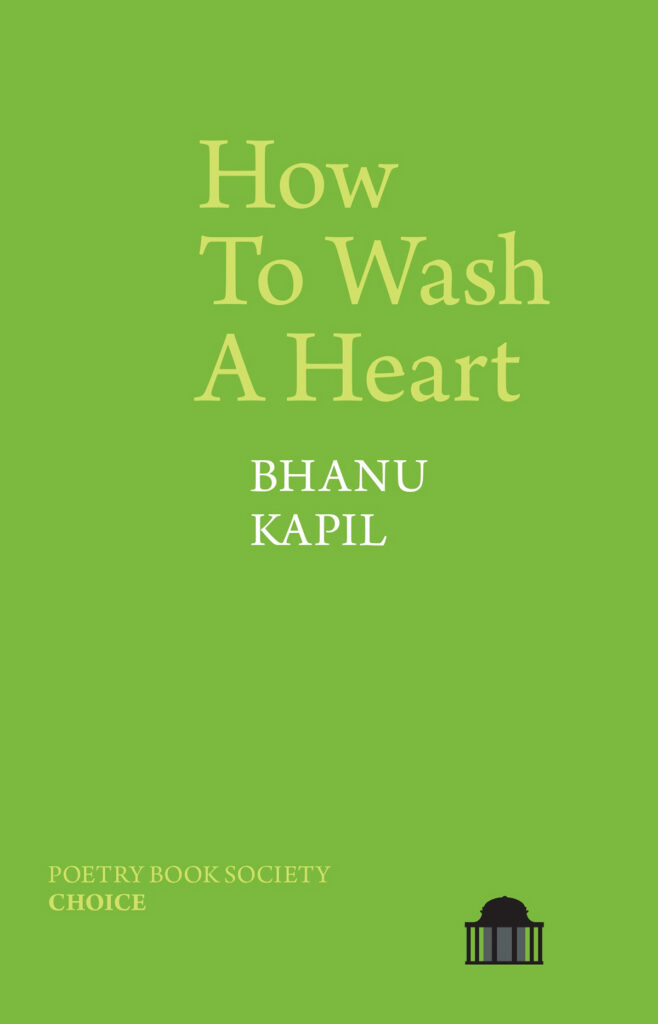
How to Wash a Heart

Pavilion Poetry (Liverpool University Press)
Bhanu-Kapil-edit 2
Bhanu Kapil was born in England to Indian parents, and she grew up in a South Asian, working-class community in London. She lives in the UK and US where she spent 21 years at Naropa University in Boulder, Colorado. She is the author of six books of poetry/prose: The Vertical Interrogation of Strangers (Kelsey Street Press, 2001), Incubation: a space...

Review

Review

The poetry in Bhanu Kapil’s How to Wash a Heart is courageous and honest. There is no convalescence for the immigrant heart and the domestic microaggressions it endures at its destination are just a different kind of war, writes John Field

Read the
Reader's Notes

Videos

T. S. Eliot Prize Shortlist Readings 2020
Aea Varfis-van Warmelo reads from Bhanu Kapil’s How to Wash a Heart
Bhanu reads an extract from How to Wash a Heart
Bhanu Kapil talks about her work
Bhanu Kapil reads an extract from How to Wash a Heart

Related News Stories

In 2023 the T. S. Eliot Prize celebrated its 30th anniversary. We marked the occasion by looking back at the collections which have won ‘the Prize poets most want to win’ (Sir Andrew Motion). Bhanu Kapil won the T. S. Eliot Prize 2020, judged by Lavinia Greenlaw (Chair), Mona Arshi...
The T. S. Eliot Foundation is delighted to announce that the winner of the T. S. Eliot Prize 2020 is Bhanu Kapil for How to Wash a Heart, published by Pavilion Poetry (Liverpool University Press). Chair Lavinia Greenlaw said: Our Shortlist celebrated the ways in which poetry is responding to...
‘The poets we have published so far each has a distinctive voice, but all share a desire to take a risk with form and ideas’, writes Deryn Rees-Jones 2021 will mark the seventh anniversary of Pavilion Poetry. Our list is small – we usually only publish three books each spring...
Judges Lavinia Greenlaw (Chair), Mona Arshi and Andrew McMillan have chosen the 2020 T. S. Eliot Prize Shortlist from 153 poetry collections submitted by British and Irish publishers. The shortlist comprises work from five men and five women; two Americans; as well as poets of Native American, Chinese Indonesian and...
The T. S. Eliot Foundation is delighted to announce the judges for the 2020 Prize. The panel will be chaired by Lavinia Greenlaw, alongside Mona Arshi and Andrew McMillan. The 2020 judging panel will be looking for the best new poetry collection written in English and published in 2020. The...
Review of How to Wash a Heart

The poetry in Bhanu Kapil’s How to Wash a Heart is courageous and honest. There is no convalescence for the immigrant heart and the domestic microaggressions it endures at its destination are just a different kind of war, writes John Field

In the notes at the back of How To Wash A Heart, Kapil quotes from her discussion with interventional cardiologist Ankur Kalra. He explains that the immigrant heart is subject to the trauma of anxiety and shock, and that ‘There’s a medical diagnosis attributed to it: broken heart syndrome or Takotsubo cardiomyopathy. Takotsubo is the Japanese term/word for octopus trap. The heart gets ‘stunned’ during acute emotional/psychological stress, and it affects the heart muscle and its pumping function. It loses a lot of its pumping function and assumes the shape of Takotsubo’. In her collection, drawn from her 2019 Institute of Contemporary Arts show, Kapil explores the convalescence of the injured immigrant heart.

The way in which the poems sit on the page is striking. They are compact (around twenty lines), short, and justified to the left. Squeezed into the corner of the page, despite the space available, this creates an impression of awkwardness. Have they retreated, self-consciously, arms folded defensively, or have they been corralled there, trapped like an octopus? Kapil concludes that it’s a bit of both.

The collection opens on an optimistic note as the speaker thinks ‘Perhaps I can write here again’. Addressed in the second person, the reader becomes the speaker’s host. Our relationship with the immigrant seems to enjoy a foundation of kindness as we are told that ‘You made a space for me in your home’ and ‘your adopted daughter, an “Asian refugee” / As you described her’ makes the speaker feel happy. Perhaps the comment was well-intentioned, but the inverted commas around the crass generalisation “Asian refugee” hit the wrong note. This nugget of insensitivity is filed away by the immigrant and the cracks in the relationship start showing.

A couple of pages on and the life of the immigrant guest looks like a relaxing weekend with its ‘Mornings with coffee / And TV’, yet the simplicity of Kapil’s language and the emptiness of the page suggest social exclusion, boredom and fatigue. Beneath this relaxed surface, the speaker confides that ‘It’s exhausting to be a guest / In somebody else’s house / Forever’. Being a guest ought to be a temporary state, not a ‘forever’ one so, scaled-up to eternity, it has a hellish character. Hospitality assumes an unwholesome power dynamic as ‘the host invites / The guest to say / Whatever it is they want to say’. ‘Invites’ foregrounds the host’s despotism: even free speech is a luxury, a gift to receive, when you are the mercy of charity. The tone continues to darken: ‘Prick me’, the guest imagines the host threatening, ‘And I will cut off the energy / To your life’. Beneath a thin film of kindness we catch an echo of Shylock (‘If you prick us, do we not bleed?’) and we worry how this great debt will be repaid.

The collection’s terse lines become rich and lyrical when the immigrant imagines her past. Her grandfather invites her to taste the sweetest fruit and ‘On the far side of the orchard / He grew saffron and the mangoes there / Were red and pink’. The orchard looks idyllic but a repressed memory bursts the bubble: ‘This is where they threw / The bodies […] I smell the pollen of the flowers of the mango tree / Which once concealed / A kill’. In the reader’s mind, the sweet, swollen pink and red fruit becomes grotesque, inedible, fleshy. Faced with a monotonous present, most of us can retreat into the pleasures of memory but, for an immigrant trapped between states, memory becomes another country from which she flees.

How To Wash A Heart breaks a powerful taboo: the requirement for gratefulness. Kapil’s poetry is courageous and honest. There is no convalescence for the immigrant heart and the domestic microaggressions it endures at its destination are just a different kind of war.

Bhanu Kapil’s How to Wash a Heart (Pavilion Poetry / Liverpool University Press) is shortlisted for the T. S. Eliot Prize 2020. John Field blogs at Poor Rude Lines.

How to Wash a Heart
Pavilion Poetry (Liverpool University Press)

Newsletter

Be among the first to receive updates on the latest T. S. Eliot Prize news by subscribing now!


The T. S. Eliot Prize on Social Media

Part of tseliot.com

Designed by thinking

Interview of How to Wash a Heart

How to Wash a Heart
Pavilion Poetry (Liverpool University Press)

Newsletter

Be among the first to receive updates on the latest T. S. Eliot Prize news by subscribing now!


The T. S. Eliot Prize on Social Media

Part of tseliot.com

Designed by thinking