Karen Solie's The Caiplie Caves is the literary equivalent of a geological core sample, drilling deep into Fife’s history. In so doing, Solie achieves a rich simultaneity of experience as she explores our relationship with space and place, writes John Field
Be among the first to receive updates on the latest T. S. Eliot Prize news by subscribing now!
Karen Solie’s The Caiplie Caves is the literary equivalent of a geological core sample, drilling deep into Fife’s history. In so doing, Solie achieves a rich simultaneity of experience as she explores our relationship with space and place, writes John Field
The Caves of Caiplie are inscribed with both Pictish and Christian symbols and were occupied by a hermit in the mid-twentieth century. It is believed that Saint Adrian (Ethernan in Gaelic) who lived on the nearby Isle of May was also associated with them. The first part of the collection opens with ‘The North’, voiced by Ethernan and his brothers, perhaps, as they travel north in search of a suitably austere ascetic experience. The speaker asks: ‘Where should we find consolation, / dwelling in the north?’ It’s tempting to see ‘consolation’ as synonymous with comfort. However, it’s a curious choice of word and echoes Boethius’ The Consolation of Philosophy. In this context, it suggests the stoical strength to endure – to offer one’s suffering to Christ. This asceticism is set against worldly power as ‘The leisure class // commends the virtues of hard work / above all else, and we labour under / frost-cramped statutes, the black / letters of legislation’. The next poem, ‘Sauchope Links Caravan Park,’ suggests that little has changed and that those trying to eke anything more than a meagre living from the land are still subject to black lettered legislation: ‘Here is the insurance to tell us we’re not // safe, and here is the loophole which allows it / to not pay’.
The environment too is unchanging in its changeability. In ‘The Meridian’, we are presented with the tragedy which claimed the Anstruther trawler, ‘The Meridian’, as it guarded shipping from repairs to an oil pipeline. It’s a hard lesson as, despite the tragedy, ‘The harbour’s full of sightsee daycruisers’ and ‘the sea, // even knowing what it knows, dares flood back in here’. On the facing page, Solie presents the reader with ‘Whose Deaths were Recorded Officially as Casualties of ‘The Battle of May Island’’. ‘The Battle of May Island’ is a grim euphemism for the deaths of 104 Royal Navy personnel on their way to exercises in the North Sea. Solie nods to Kline’s translation of Ovid’s great homage to change, Metamorphoses, referencing Book 1’s opening creation myth: ‘Unstable land, unswimmable water, air needing light’. In the Loeb Classical Library edition, Frank Miller translates the lines as: ‘Though there was both land and sea and air, no one could tread that land, or swim that sea; and the air was dark’. We should be able to swim in the sea but, for those doomed sailors, the environment was transformed: ‘Chains of the wake around their ankles’.
‘Goodbye to Cockenzie Power Station, A Cathedral to Coal’ celebrates a power station once named by the World Wildlife Fund as the nation’s least carbon efficient. We see its ‘Brutalist winding tower’ and ‘Two five-hundred-foot towers / visible from Edinburgh’. Naming the Brutalist qualities of the architecture condemns it, perhaps, as an affront to the landscape. However, it also has a stark dignity wholly in keeping with the sea-lashed rocks. Solie offsets stanzas describing Cockenzie on the left of the page against stanzas detailing May Island (‘Stevenson’s lighthouse / a gothic castle’) on the right. Solie’s opposites suggest that it’s too easy to be sententious regarding modern developments. May Island’s lighthouses, typically regarded as picturesque features by tourists, are referred to in utilitarian terms as ‘infrastructure repurposed’, denying us that simple contrast between an idealized past and a polluting present: humans have been using and abusing the islands since Ethernan’s time – and before.
The Caiplie Caves is a rich, even-handed meditation on our impact on the environment, and the environment’s impact on us. The Fife coast enjoys an empty, stark beauty and these poems are as cold as stone and as salt as the sea.
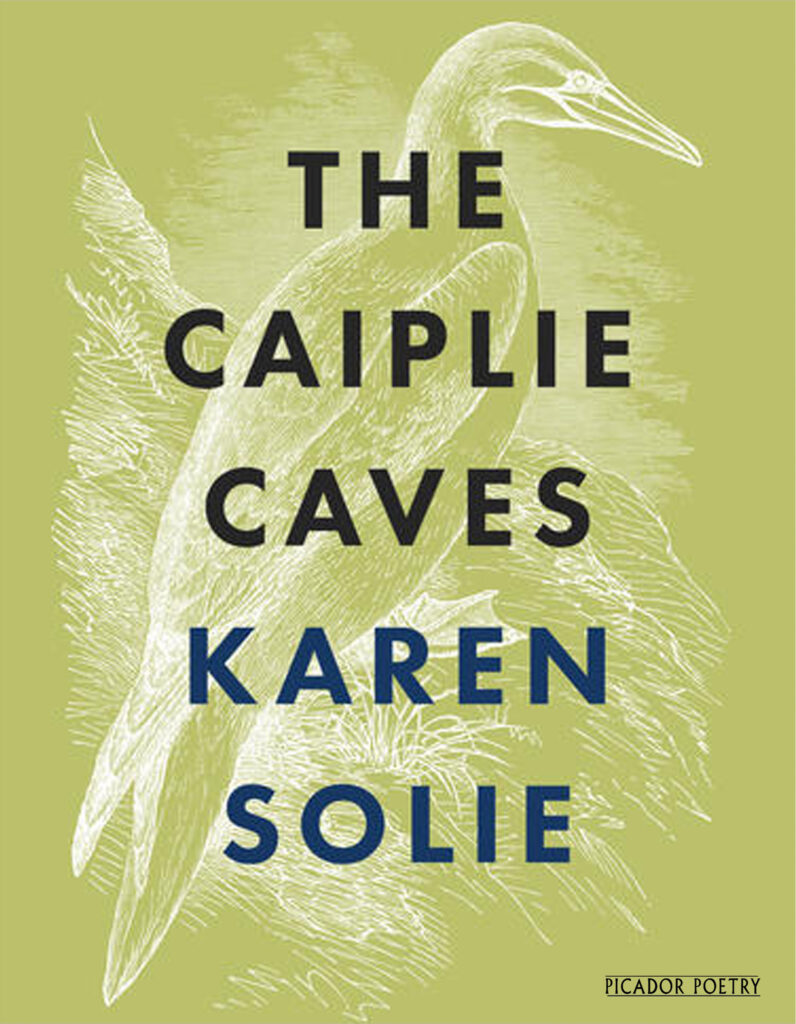
Karen Solie’s The Caiplie Caves (Picador Poetry) is shortlisted for the T. S. Eliot Prize 2019. John Field blogs at Poor Rude Lines.
Be among the first to receive updates on the latest T. S. Eliot Prize news by subscribing now!