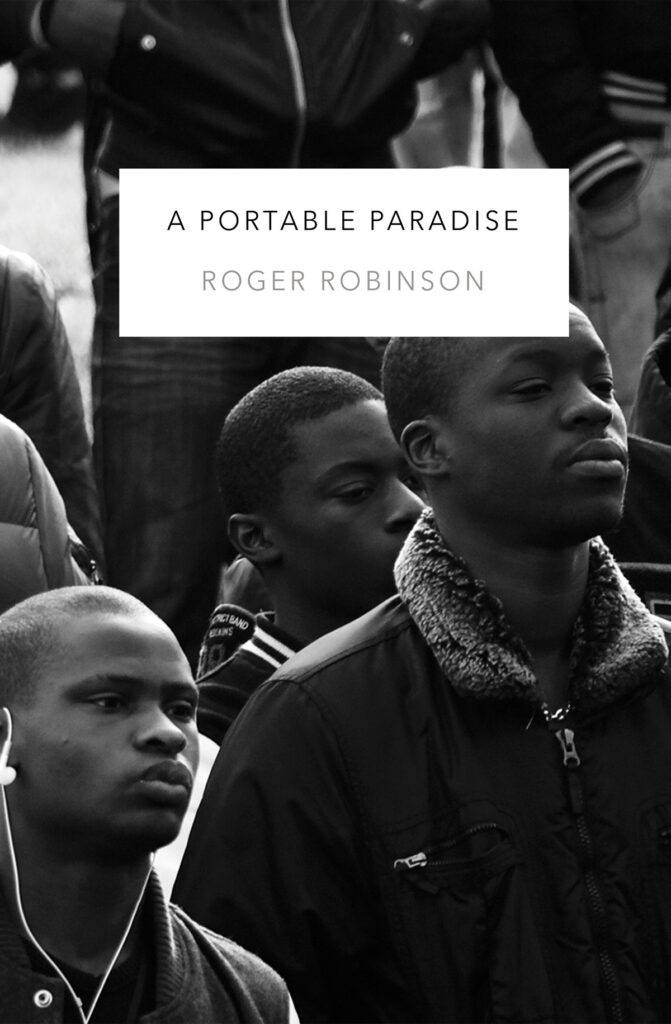

A collection that explores our interconnectedness, Roger Robinson’s A Portable Paradise is a portrait of the worst of us that never loses sight of our better selves, writes John Field
Be among the first to receive updates on the latest T. S. Eliot Prize news by subscribing now!
A collection that explores our interconnectedness, Roger Robinson’s A Portable Paradise is a portrait of the worst of us that never loses sight of our better selves, writes John Field
Roger Robinson’s A Portable Paradise is a scathing polemic, and a meditation on love. It attacks the economies which saw Grenfell Tower clad with substandard materials. It stares unflinchingly at the legacy of slavery and yet, at its heart, it believes in kindness and community.
The collection explores our interconnectedness. It opens with a series of poems considering the Grenfell Tower disaster. ‘Haibun for the Lookers’ works with the Japanese haibun form: an agglomeration of prose and haiku. There’s a voyeuristic quality to the public’s response to the disaster as ‘In the lights of mobile phones, shadows wave like makeshift flags’. As the poem continues, the aestheticization of horror deepens as ‘The spectacle’s now more like a painting of a building on fire […] black velvet night rippling orange-yellow and punch-red acrylic flames’. In a shocking culmination to the description, Robinson shifts perspective and writes in the first person with the arresting immediacy of a haiku: ‘The heat at my back, / I throw my baby out the window. / Catch him Lord!’ The reader has a different perspective, aware of the multitude below, phones in hands, and we’re left hoping for an act of heroism unoffered by Robinson. ‘Blame’ also presents those keen to keep their distance. It is structured as a series of buck-passing clauses: ‘the council blamed the contractors / who shredded all the papers; / so the contractors blamed / health and safety’.
The collection makes arresting, painterly use of perspective. ‘Ghosts’ sucks us in with its provocative use of the second person: ‘You feel it as soon as you settle in your new flat, perhaps when you are making rocket salad with lemon dressing’. The mise-en-scène is a picture of affluence, disturbed by the phantom smoke and screams of Grenfell as you sit ‘looking out your extra large window at the view you’ve paid so dearly for’.
The ekphrastic ‘A Young Girl with a Dog and a Page’ responds to Dandridge’s 1725 portrait of a girl, her dog and a slave, euphemistically referred to as a page, as it provides another shocking painted perspective. Although boy and dog wear matching collars, he is confined to the background shadows, whereas the dog shares the foreground with the girl. Robinson’s speaker addresses the boy – and even this simple act is a powerful revision of the painting’s hierarchy.
The collection’s final section presents the best of humanity. ‘Grace’ also opens with an image: ‘green blips on screen’, this time measuring the fragile life of the speaker’s newborn child – who weighed just one kilogram at birth. The nurse, Grace, refuses to give up, even with the dying, ‘rocking that well-fed baby // held to her bosom, slowly humming the melody of “Happy” by Pharrell’ and the title gains a theological resonance, as we witness her love, freely bestowed.
‘A Portable Paradise’ closes the collection, acknowledging the links that bind the generations. The speaker recalls his grandmother’s advice to store paradise in his heart. Her suggestions are vivid and sensory as she imagines a paradise with a ‘piney scent’ and ‘white sands, green hills and fresh fish’. However, our loved ones are all the paradise we need – and their foundational support is immediately obvious to us. The first line of Robinson’s poem reads: ‘And if I speak of Paradise, / then I’m speaking of my grandmother’. The collection is outward facing. This is its final poem and it exhorts the reader to return to the world with a renewed love for our brothers and sisters in life.
While A Portable Paradise is a portrait of the worst of us, Robinson never loses sight of our better selves. Yes, the collection is challenging but it is also rewarding and, ultimately, uplifting.
Roger Robinson’s A Portable Paradise (Peepal Tree Press) is shortlisted for the T. S. Eliot Prize 2019. John Field blogs at Poor Rude Lines.
Be among the first to receive updates on the latest T. S. Eliot Prize news by subscribing now!