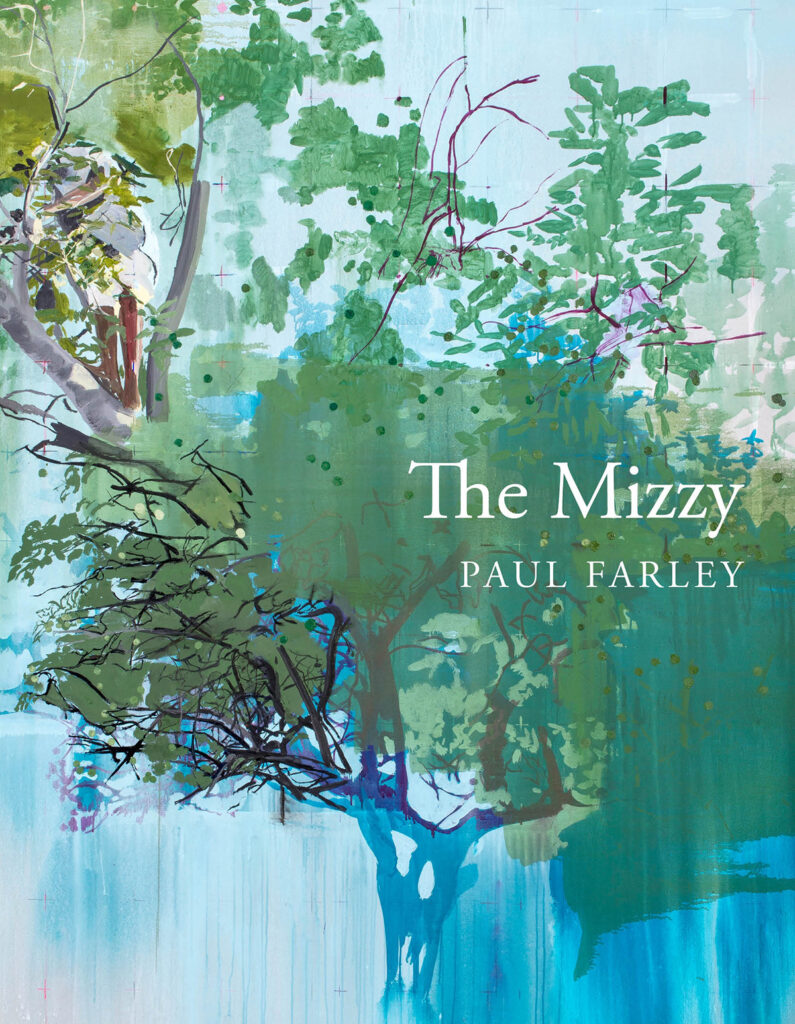

Even the title of Paul Farley's latest, The Mizzy, is a pleasure, the Gawain Poet having been credited with the first recorded use of a beautiful word meaning ‘bog, quagmire’. And it’s a wonderful collection in its play of language, wry wit, rumbles, grumbles and debunking, writes John Field
Be among the first to receive updates on the latest T. S. Eliot Prize news by subscribing now!
Even the title of Paul Farley’s latest collection The Mizzy is a pleasure, the Gawain Poet having been credited with the first recorded use of a beautiful word meaning ‘bog, quagmire’. And it’s a wonderful collection in its play of language, wry wit, rumbles, grumbles and debunking, writes John Field
The Mizzy explores our changing relationships with landscape and society. Tyre swings strung from trees jostle with smartphones as the individual is pushed to the margins. Above all, it’s a wonderful collection of poems: even the title is a pleasure. Mizzy is a beautiful word for ‘bog, quagmire’. It looks great on the page and that ‘z’ – an alveolar hissing sibilant – fizzes in the mouth. It’s a mysterious word with a poetic pedigree as, although its origin is now lost to time, the Gawain Poet is credited with its first recorded usage – Sir Gawain and his horse, Gryngolet, journey through ‘mony misy and myre’ in their quest to find the Green Chapel, thought by some to be Lud’s Church in Staffordshire. This dialect word anchors The Mizzy to a place – and, as a homophone for ‘mossy’, mizzy also evokes lush, green nature – and even, perhaps, the glories of Lud’s Church.
The opening poem, ‘Starling’, debunks quests, heroes and heroic deeds as ‘All I’ve ever done with my life / is to follow the average course of the crowd / and witter on about my hole in the wall’. Humanity becomes a river, a course, and we take the path of least resistance. The starling’s hole comments on the circumscribed nature of our lives and ‘witter’ sees Farley working with more dialect. It’s defined by the OED as ‘to chatter or mutter; to grumble; to speak with annoying lengthiness on trivial matters’ and feels like a wry jab at Twitter. Farley tackles this head-on in ‘The Gadget’, a not so fanciful mythologizing of the smart phone ‘that knows my blood type and search history’, equating the two.
The smallness of our lives is threaded through the collection. In ‘Oiks’, the word ‘oik’ initially connotes loutish obnoxiousness but, unlike the murmuring starlings, our communities have broken, knocking the wind from the sails of male bravado: ‘each bud, each mate, / each bruv were sappy words that glued them together, / then new words came to loosen those, like solvents, / and as the cities grew, oiks could be seen / in cafes, buses, or walking oikily along / keeping their sadness to themselves’. The collection also mourns the fading of the dialects that bound us together in communities as, instead, we celebrate television’s ‘blue communion’, each slack-jawed and alone in a darkened room, soaking up the monoculture offered by Netflix and Amazon.
In ‘Moss’, human society is pushed to the margins. Manchester’s close by and we can hear the traffic rumble. Perhaps we’re even at Lud’s Church – it feels like it. Nature is in charge and has the power to stop traffic ‘where buddleia // holds the signal at maroon’ and the moss has reclaimed the motorway cutting with ‘ferns the green of a banker’s lamp’. There’s a hint of the apocalypse to the poem as ‘plinths // of concrete stand with no discernible function’ and ‘the first landscape of speed is gathering moss’. There’s something old and powerful at work. Farley echoes the fissure in the rock with a deep caesura. As the cutting ‘passes through the fossil record’, so the caesura jolts us from the present and into an Old English poetic form. We see something similar in ‘Swing’, where the childhood rope swing looks more like a pendulum marking our time, a hangman’s scaffold, dispatching the generations at the crack of doom: ‘History isn’t looking. Before / they hand the tethered baton on / and everybody in the line moved up one, / they practise their escape until it’s dark. / The tree records them in its rings and bark’.
If all this sounds rather earnest, be assured that it isn’t. The Mizzy is deft and joyful and, above all, it revels in language.
Paul Farley’s The Mizzy(Picador Poetry) is shortlisted for the T. S. Eliot Prize 2019. John Field blogs at Poor Rude Lines.
Be among the first to receive updates on the latest T. S. Eliot Prize news by subscribing now!