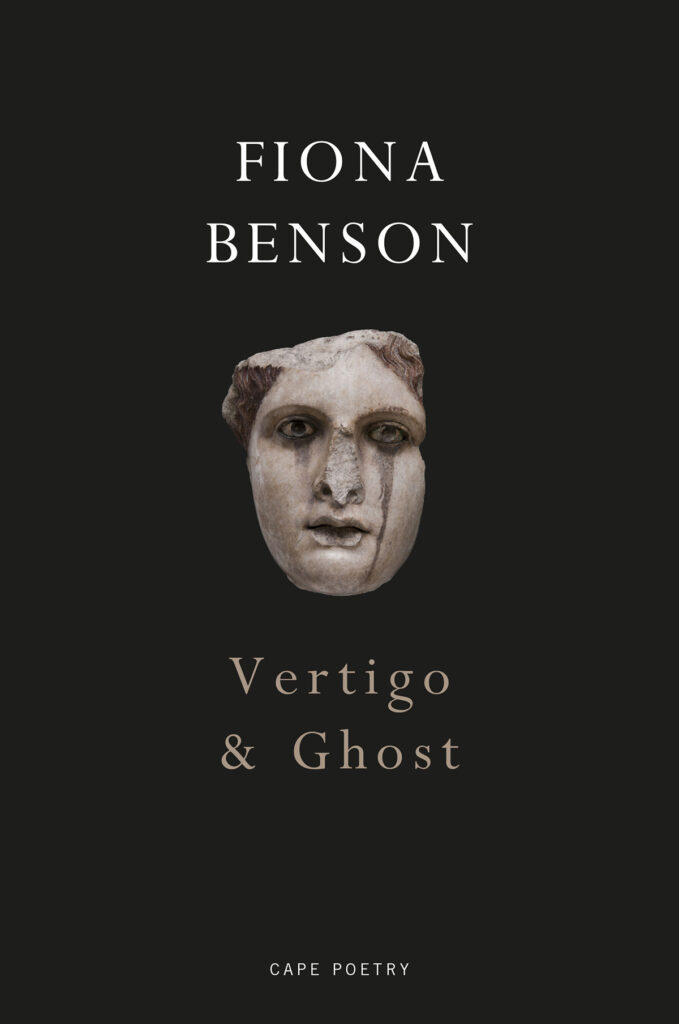

Exploring emerging sexuality and sexual violence, freedom, horror and indifference, Fiona Benson's Vertigo & Ghost resensitizes its reader to myth. In reworking old culture, Benson breaks new ground, writes John Field
Be among the first to receive updates on the latest T. S. Eliot Prize news by subscribing now!
Fiona Benson’s Vertigo & Ghost resensitizes its reader to myth in her exploration of emerging sexuality and sexual violence, freedom, horror and indifference. In reworking old culture, she breaks new ground, writes John Field
In Part One of Fiona Benson’s Vertigo & Ghost, the fig leaf of culture is whipped away, and the weaponized phallus of the rapist is revealed. It’s an uncanny effect as, through history, some writers and artists have treated sexual violence as a pretext for a gawp: we’re desensitised to myths where rape no longer looks like rape. The integrity of Part Two supplants the salacious painterly gaze and breaks a few taboos with its look at the woman’s body.
Part One opens with the joyful, colourful sexual yearning of ‘Ace of Bass’. Cliché is reinvested with power: ‘That was the summer / hormones poured into me / like an incredible chemical cocktail / into a tall iced glass, my teenage heart / a glossy, maraschino cherry.’ There’s a tempting ripeness here, but also the seductive artifice of emerging sexuality (the maraschino cherry is soaked in food colouring to catch the eye). Desire distorts language as the girls escape ‘from the boarding house to practise our backhand’.
However, in ‘Zeus’, we revisit this gentle, sporting euphemism ‘as you let him do / what he wants / on your own familiar sheets / to stop the yelling / and the backhand to the face’. The teenage girls in ‘Ace of Bass’ are the mistresses of their destinies, the active subjects of the poem’s sentences, united by the first person plural. In this section of ‘Zeus’, we’re in the second person, isolated even from ourselves as we’re ‘looking down / thinking slut’ even judging ourselves as that innocent backhand becomes something else: the studied violence of the rapist. No space or age are safe as ‘familiar’ evokes the home – and the family home in particular – reminding us that Zeus rapes women in many guises.
Benson’s Medusa poems are exceptional. Perplexingly, Medusa persists in culture as demonised female rage. We’re supposed to breathe a sigh of relief when Ray Harryhausen’s stop motion horror gasps her last and Perseus wins Andromeda. Benson opens ‘[not-Zeus: Medusa 1]’ with the statement: ‘Poseidon the sea god / raped Medusa’ and we need to reflect on this. Why isn’t this the nucleus of the myth? Why does our culture gloss over this? On the opposite page, in ‘[not-Zeus: Medusa 2]’ we visit the unmarried mothers incarcerated in the Magdalene laundries of Catholic Ireland. The certainty of Benson’s statements ring like judgements and the third person perspective adds to their isolation as ‘The priest will tell them / they’re the devil’s own whores, / that he’s all around them, / hissing in their ears’. In Christian myth the serpent’s voice is the embodiment of evil, and Benson’s subversion of the priest’s judgement is bitterly ironic. Medusa’s snaky punishment is meted out by Athena, as women too are complicit in the abuses of patriarchy. Benson’s nuns ‘take their soft little babes / and bury them’.
In Part Two, human savagery is read against the indifference of nature. In the first of the ‘Two Sparrows’ poems, a sparrow is grabbed by a hawk but the flock ‘can’t seem to figure which one of them’s gone, / and the nameless dead of the human world / float endlessly down the corpse-choked river’. Life is cheap, death is banal and that ‘choked river’ teeters on the edge of environmental catastrophe. The collection sizzles with honesty. In the blood, excrement and offal of ‘Afterbirth’ Benson takes the trouble to view the body of a new mother eschewing pop culture’s maraschino cherries.
Vertigo & Ghost has already bagged the 2019 Forward Prize for Best Collection and it’s easy to see why. As she reworks old culture, Benson breaks new ground.
Fiona Benson’s Vertigo & Ghost (Cape Poetry) is shortlisted for the T. S. Eliot Prize 2019. John Field blogs atPoor Rude Lines.
Be among the first to receive updates on the latest T. S. Eliot Prize news by subscribing now!