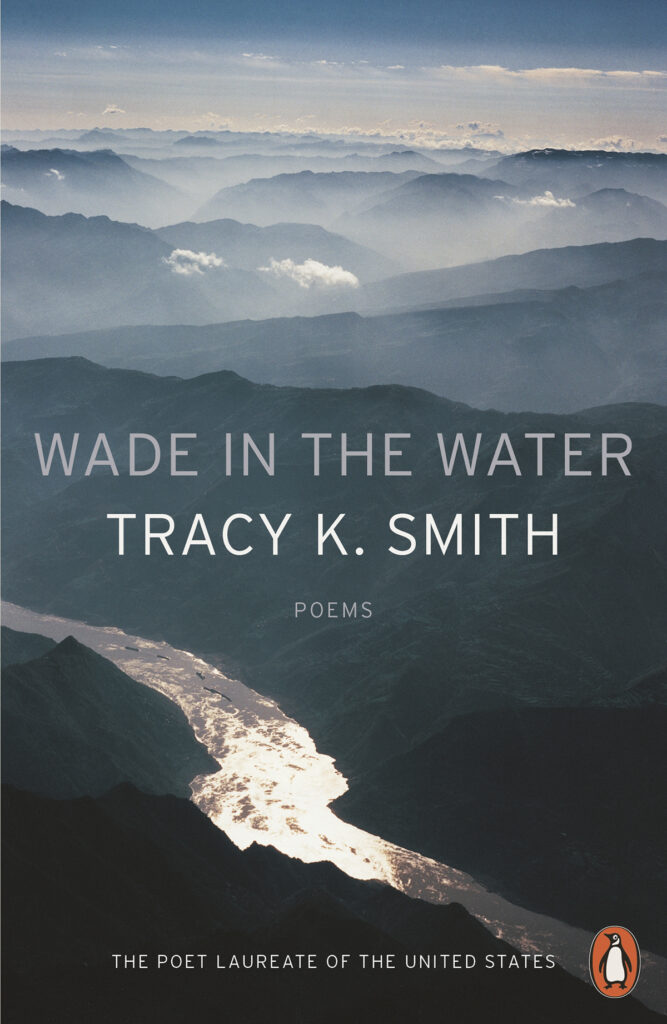

'In Wade in the Water, Tracy K. Smith writes with an economy of word and symbol, allowing a deep engagement with history and our husbandry of the planet', writes John Field
Be among the first to receive updates on the latest T. S. Eliot Prize news by subscribing now!
In Wade in the Water, Tracy K. Smith writes with an economy of word and symbol, allowing a deep engagement with history and our husbandry of the planet, writes John Field
As a cultural artefact, the song ‘Wade in the Water’ carries a range of meanings: most recently it is associated with the Biloxi Beach civil rights wade-ins of the 1950s and ‘60s, when people waded into the water to demand equal access to the public beach; it was sung at the full-immersion baptisms conducted along the rivers and deltas of the South; it was coded guidance given to slaves contemplating an escape to freedom on the Underground Railroad, where wading in the water was a means to elude pursuing bloodhounds. Smith writes with an economy of word and symbol, allowing a deep engagement with history and our husbandry of the planet.
The opening poem, ‘Garden of Eden’, wrong-foots us: we presume that the title is simply a Biblical reference but it initially refers to ‘the Garden of Eden / On Montague Street’, a fresh food store. Exclamations and lists fill each line to capacity, mirroring a basket stuffed with ‘glossy pastries! / Pomegranate, persimmon, quince!’ However, as we are lured into the poem’s fullness and salivate at its exotic abundance, the speaker distances herself from this fallen behaviour: ‘My thirties. / Everyone I knew was living / The same desolate luxury, / Each ashamed of the same things’ and the poem abruptly closes as something – her bank balance, the march of time – slams her ‘in the face – / The known sun setting / On the dawning century’, echoing Adam and Eve’s expulsion from Eden, suggesting that decadent profligacy cannot be sustained.
If ‘Garden of Eden’ documents our inadvertent, individual abuses of the planet, ‘Watershed’, partly written in response to Rob Bilott’s New York Times article, ‘The Lawyer Who Became DuPont’s Worst Nightmare’, implicates big business in its calculated exploitation. There’s a circularity to this as J sells 66 acres to DuPont. He ‘did not want to sell / but needed money poor health / mysterious ailments’ caused by DuPont polluting his drinking water. Smith’s free verse disconnects the whys and wherefores with space on the page, suggesting DuPont’s desire to deny the link between J’s ‘poor health’ and the behaviour of his ‘deranged’ cattle. Water, that sacramental symbol of life and rebirth, has been perverted for profit.
Smith locates many African American slave experiences within this context of capitalist rapaciousness. The erasure poem ‘Unwritten’ works with a family’s correspondence regarding the sale of the slaves Patience, Porter and their children. ‘Much as I should miss the mother, I am / Persuaded that we might come / To some understanding about a change / Of investment’. Even in personal letters, common nouns are employed to reduce the slave: initially to a functionary, and then to an asset in a ledger. In ‘I Will Tell You the Truth About This, I Will Tell You All about It’, Smith works with the letters and statements of former slaves who enlisted in the Civil War to powerful effect. Illiteracy and fluidity of name leave soldiers and their families ripe for yet more exploitation as pay and pensions are stolen. With heart-breaking patriotism, these new citizens uphold democratic values as they express their grievances in painstaking print, writing to ‘Mr abarham lincon’.
A review can only scratch the surface of a collection as wide ranging as this. In ‘Unrest in Baton Rouge – after the photo by Jonathan Bachman’, Smith suggests that only the civil disobedience of ‘love’s blade’ – the dignified nonviolence of protestors like Leshia Evans, nurse and mother to be – has the possibility of defeating ‘the men in black armour’. However, the historical repetitions Smith observes do not underestimate the task ahead. Wade in the Water is a book of love, but it resists glib platitudes posing as solutions for America’s troubles.
Tracy K. Smith’s Wade in the Water (Penguin Poetry) is shortlisted for the T. S. Eliot Prize 2018. John Field blogs at Poor Rude Lines.
Be among the first to receive updates on the latest T. S. Eliot Prize news by subscribing now!