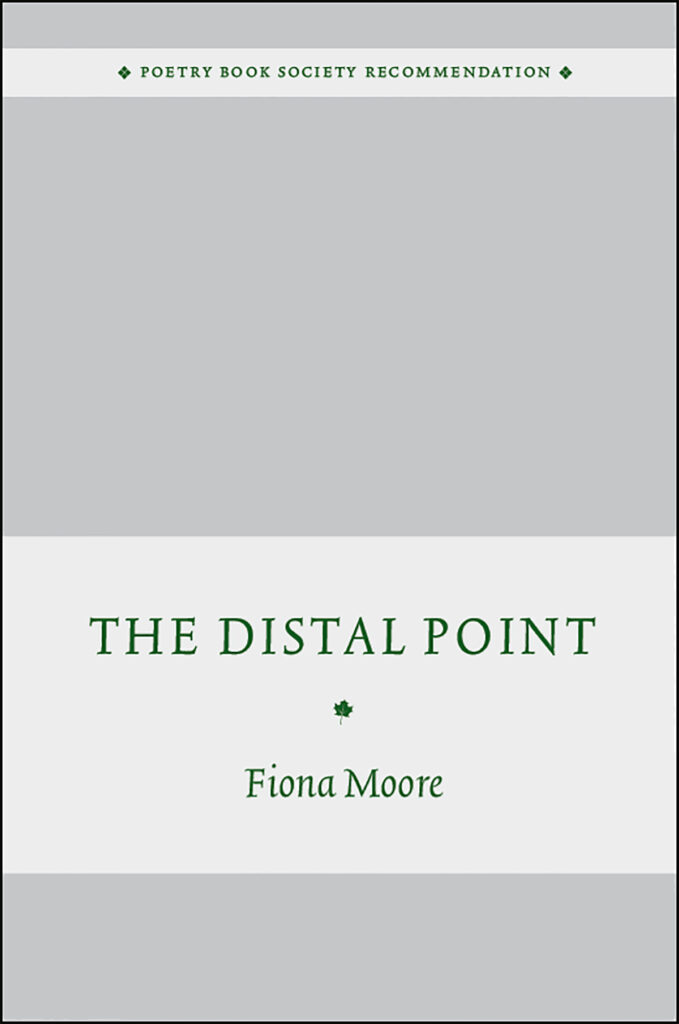

The Distal Point

HappenStance
Moore_Fiona_bw-Naomi-Woddis
Fiona Moore lives in Greenwich, London. In 2004 she left her career in the Foreign Office to write and work part-time for a sustainable development NGO. She reviews poetry, was an assistant editor at The Rialto and is currently on the editorial board of Magma. The first of her two HappenStance pamphlets, The Only Reason for Time, was a Guardian...

Review

Review

Unflinchingly rational and objective in its exploration of dark personal and historical moments, Fiona Moore's The Distal Point punches with tremendous emotional force, writes John Field

Read the
Reader's Notes

Videos

Fiona Moore reads from The Distal Point at the T. S. Eliot Prize Shortlist Readings
Fiona Moore reads ‘Night Letter’
Fiona Moore reads ‘In the middle of a discussion about Brexit’
Fiona Moore reads ‘To the Moon’
Fiona Moore talks about her work

Related News Stories

The T. S. Eliot Foundation is delighted to announce that the winner of the T. S. Eliot Prize 2018 is Hannah Sullivan for her thrilling collection Three Poems, published by Faber & Faber. After months of reading and deliberation, judges Sinéad Morrissey, Daljit Nagra and Clare Pollard unanimously chose the...
Fresh from reading a record 176 submissions, T. S. Eliot Prize 2018 judge Clare Pollard celebrates the boom in poetry By most measures, this is a good year for poetry. As life moves increasingly online, poetry suits the internet – it fits in a tweet, a blogpost, an Instagram snap,...
Judges Sinéad Morrissey (Chair), Daljit Nagra and Clare Pollard have chosen the T. S. Eliot Prize 2018 Shortlist from a record 176 poetry collections submitted by, as Sinéad Morrissey says, ‘a plethora of poetry publishers’. The Shortlist comprises five debut collections, one small press, five men, five women, and two...
Review of The Distal Point

Unflinchingly rational and objective in its exploration of dark personal and historical moments, Fiona Moore’s The Distal Point punches with tremendous emotional force, writes John Field

Forgive me the indulgence of writing this introduction to Fiona Moore’s poetry in the first person. I have read and reviewed her work since the publication of her debut HappenStance pamphlet, The Only Reason for Time, in 2013. Indeed, the review of this pamphlet is quoted on the back of this, her T. S. Eliot Prize nominated debut collection, The Distal Point. It is unflinchingly rational and objective as it explores some dark personal and historical moments and it punches with tremendous emotional force.

That first pamphlet was a meditation on loss, time and memory, and opened, as this collection does, with ‘The Shirt’: ‘I didn’t find it for months, your shirt / bundled into a corner of the airing cupboard. I / shook it out. It had been cut / with long cuts all the way up the sleeves / and up front, so it looked like a plan / of something about to be put together.’ Finding the shirt, the speaker is ambushed by grief, and by the futility of her denial: laundering and storing the tattered, useless shirt in the usual manner. The repetition of ‘cut’ jars: it’s both an unpoetic, raw statement of fact and an act of surgical precision. There’s a Gothic quality to this too: the shirt is a proxy for a body. There was no plan available for the physical repair of the body and the shirt haunts the house.

‘Taking Visitors to Auschwitz’ seeks refuge in that quintessentially modern void: the car park. However, even the speaker admits that this is a liminal space: ‘It’s here / except it’s not’ and, as such, is inside the threshold. The speaker hopefully continues ‘This could be anywhere […] except it’s not’. Again, like the laundered shirt, the poem presents a refusal to engage but Auschwitz asserts itself regardless. Moore’s terse, short lines and crisp observations provide the scaffolding and Auschwitz is contained within. The poem’s repetitions as ‘Coaches drop off groups’ echo the trains of the Holocaust. Then and now, Auschwitz continues its industrial processing of humanity which Moore presents as uncanny, haunted, ‘except it’s not’.

Moore’s is a compassionate world. In ‘The Sounds Crowds Make’, it’s our systems that are violent, not people themselves. ‘The tube bursts out of the tunnel’ and the train doors have a ten-year-old boy’s neck ‘clamped’ in its ‘double guillotine’, trapped ‘between two worlds’. The tube train, like Auschwitz’s car park, assumes a liminal quality as at any time, in place, a portal to the timeless world of the dead threatens to open up. The audience in this theatre respond emotionally with ‘oh, a collective moan of shock’ but ‘the boy stays still, silent’ as if time stands still and we dumbly accept.

In the ‘Distal Point’, the collection’s title poem plays with a word that applies both to the anatomy (an extremity, a distant part of a limb, or organ) and to geology (far from a point a geological activity but close enough to have been influenced by it). ‘We stand at the point of greatest change – / the distal point’, a chaotic but beautiful landscape in which ‘the waves curl / and spill, lacing each other, forming a landscape that moves / leached of colour’. The poem is both Romantic and romantic as we feel awe and a sense of our insignificance but also the tenuousness of our togetherness as limbs and fingers – our own distal points – provide fleeting moments of connection. Yet, against the chaos, ‘no-one has stood here before’ and, in the chaos of Moore’s universe, this is a moment for celebration.

Moore writes with integrity, discipline, economy and, above all, bravery. Medium and message combine to produce something truly memorable.

Fiona Moore’s The Distal Point (HappenStance Press) is shortlisted for the T. S. Eliot Prize 2018. John Field blogs at Poor Rude Lines.

The Distal Point
HappenStance

Newsletter

Be among the first to receive updates on the latest T. S. Eliot Prize news by subscribing now!


The T. S. Eliot Prize on Social Media

Part of tseliot.com

Designed by thinking

Interview of The Distal Point

The Distal Point
HappenStance

Newsletter

Be among the first to receive updates on the latest T. S. Eliot Prize news by subscribing now!


The T. S. Eliot Prize on Social Media

Part of tseliot.com

Designed by thinking