
Nick Laird's Feel Free is a collection of fragility and tenderness which retains the power to shock, writes John Field
Be among the first to receive updates on the latest T. S. Eliot Prize news by subscribing now!
Nick Laird’s Feel Free is a collection of fragility and tenderness which retains the power to shock, writes John Field
In ‘Crunch’, Laird writes that ‘poetry / is weather for the mind / not an umbrella’ and in his collection, Feel Free, he presents his reader with challenging material. Poetry rarely flinches in the face of death but, by writing about Grenfell and refugees taking their chances on the Mediterranean, Laird presents some of the darkest moments of recent years. The result is an arresting, moving presentation of a cold, tangible world and a chillier digital universe.
The opening poem, ‘Glitch’, dehumanises us as a serious fall is described as ample to ‘crash the OS’. It’s a brilliant metaphor to describe the fragility and ineffability of consciousness. The fall threatens the ‘moist robot I currently inhabit’ and suggests a disregard for the physical person in the modern world as if, beyond death, we can migrate, via the Cloud, to a new device. The sonnet ‘Chronos’ claws the form to pieces. Torn into 7 unrhymed couplets, little remains of the sonnet beyond its fourteen-line husk. We are presented with a video game universe with a strict relationship between cause and effect: ‘I swim to earn endorphins and eat my greens / because I need the fibre and the vitamins’. However, the poem rehearses a moral collapse as ‘I do my best to clean the bath, / and then separate the bodies of the zombies’. Video gamers invest hours in virtual work: chopping firewood in Skyrim’s lumber mills for a few extra coins but then this world of ordered domesticity sits uneasily alongside the unhinged visceral experience of the inevitable bloodbath.
Laird develops this idea across the collection and its penultimate poem, ‘Extra Life’, delivers the body blow: ‘Press esc and wait. White / light. Five tender reports. / You are in a new room / and Father has gone missing’. This is standard videogame fare and begins in the middle of things like an action movie. Roleplaying games (RPGs) can force the player to make agonising moral choices and Laird’s poem simulates these branching narratives as it adopts the features of the form: ‘Click to turn the keys left / in the ignition, and ride the Harley // off the ramp and into Dover’. Laird’s final stanza opens: ‘Click to bring your children / back. Click to kiss them / on their lips. Click to resurrect / your wife and pick / the seaweed from her hair’. It’s a thrilling, sickening poem. ‘Click’ is repeated ad nauseum, suggesting, perhaps, our sense of impotence given the scale of the disaster, or perhaps the poem shines a light on a society which finds it easier to like and dislike images and videos in a digital world instead of reacting in a useful, physical way.
A series of elegies also runs through the collection and Laird’s pained phraseology recurs, like the imagery from a nightmare. Early in the collection, in ‘The Vehicle and the Tenor’ we see ‘black stuff bubbling’ from a dying mother’s lungs and then again towards the end in ‘Cinna the Poet’. This structure helps the poems to worry away at the wound. The sonnet sequence, ‘The Folding’, offers a powerful experience of this as the speaker’s children cut snowflakes, oblivious to ‘that dull, almost inaudible pat / of obliterative fleck on the glass, / and the clock, and the held breath / as the kids concentrate on symmetries / or the blades’ irresistible path’.
Feel Free is a collection of extraordinary variety and ranges from formal to free verse. It is a collection of fragility and tenderness which retains the power to shock.
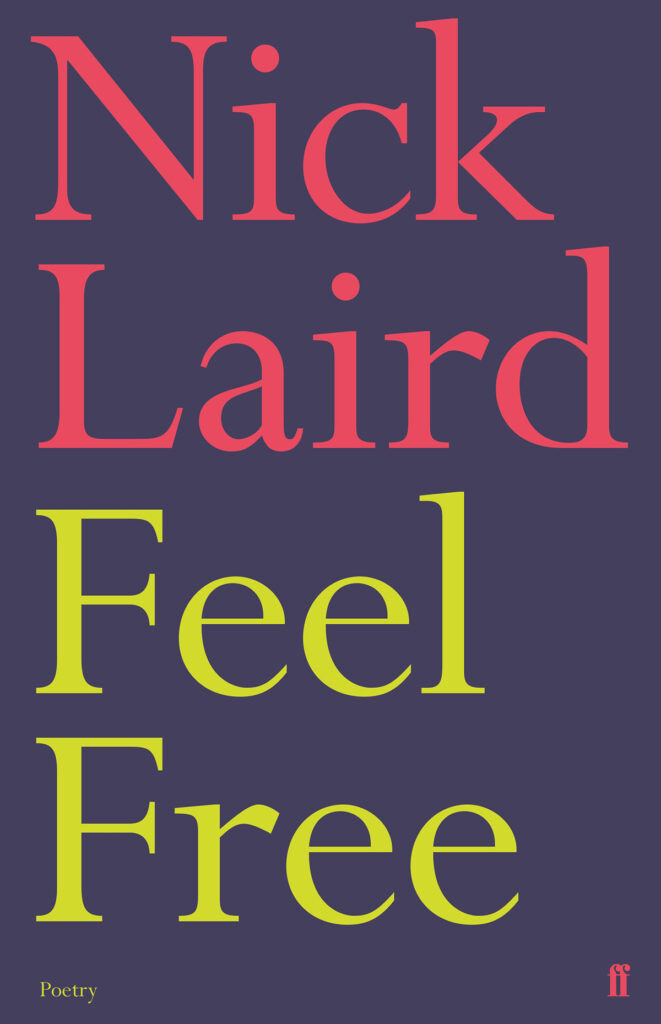
Nick Laird’s Feel Free (Faber & Faber) is shortlisted for the T. S. Eliot Prize 2018. John Field blogs at Poor Rude Lines.
Be among the first to receive updates on the latest T. S. Eliot Prize news by subscribing now!