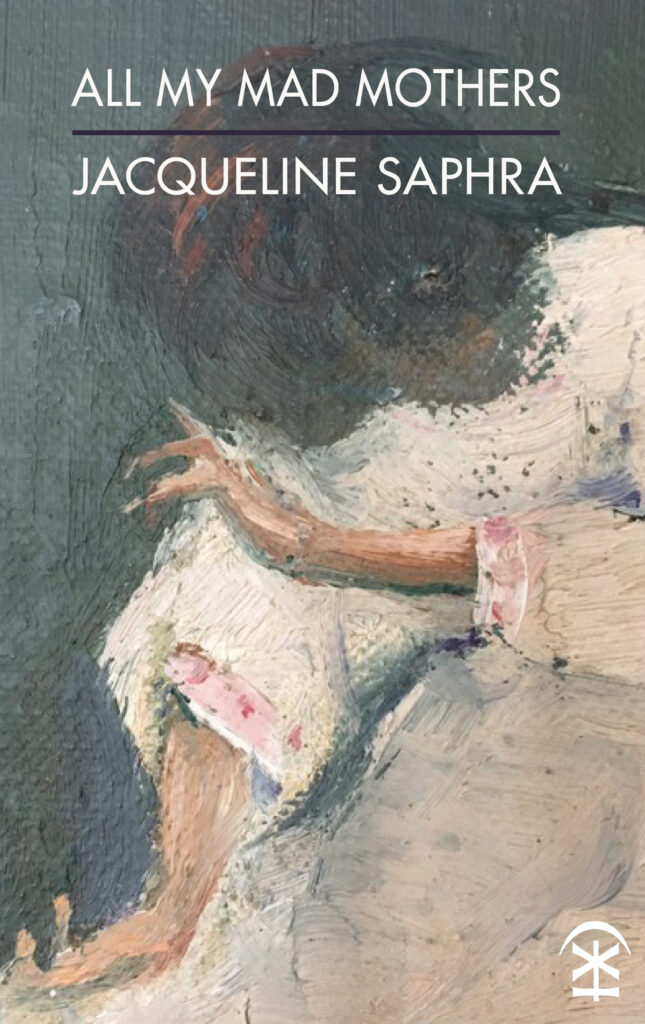

All My Mad Mothers

Nine Arches Press
Saphra_Jacqueline_bw
Jacqueline Saphra’s first pamphlet, Rock’n’Roll Mamma, was published by Flarestack in 2008. Her first full collection, The Kitchen of Lovely Contraptions (flipped eye, 2011) was developed with funding from Arts Council England and nominated for the Aldeburgh First Collection Prize. A book of illustrated prose poems, If I Lay on my Back I Saw Nothing but Naked Women, was published...

Review

Review

Jacqueline Saphra’s All My Mad Mothers is a moving rumination on motherhood, writes John Field. 'Interspersed with prose sketches, the collection is a warm and intimate exploration of love, sex, ageing and family'

Videos

Jacqueline Saphra reads from All My Mad Mothers at the T. S. Eliot Prize Shortlist Readings
Jacqueline Saphra reads ‘My Friend Juliet’s Icelandic Lover’
Jacqueline Saphra talks about her work
Jacqueline Saphra reads ‘My Mother’s Bathroom Armoury’
Jacqueline Saphra reads ‘Charm for Late Love’

Related News Stories

  The T. S. Eliot Foundation is delighted to announce that this year’s winner of the T. S. Eliot Prize 2017 is Ocean Vuong for his remarkable debut collection Night Sky with Exit Wounds, published by Cape Poetry. After months of reading and deliberation, Judges W. N. Herbert (Chair), James...
To mark the 25th anniversary of the T. S. Eliot Prize, the T. S. Eliot Foundation has increased the winner’s prize money to £25,000. Judges W. N. Herbert (Chair), James Lasdun and Helen Mort have chosen the Shortlist from a record 154 poetry collections submitted by publishers. Tara Bergin, The...
Review of All My Mad Mothers

Jacqueline Saphra’s All My Mad Mothers is a moving rumination on motherhood. Interspersed with prose sketches, the collection is warm and intimate as it explores love, sex, ageing and family

Jacqueline Saphra’s All My Mad Mothers opens with ‘In the winter of 1962 my mother’, and we see the mother attempting to escape from a marriage, baby in arms ‘on Hyde Park Corner / travelling round and round in shrinking circles / not sure how to execute the move outwards’. Marriage is a confinement of planetary proportions: the Mini attempts to achieve escape velocity, to resist the gravitational pull of the relationship. The cost of relationships is explored further in ‘Eddie and the Pessaries’ where the mother gave up ‘freedom, ballet, photography, figure skating, pottery, fossil hunting, trapeze, playing the piano and French’. She ‘could’ have been more than ‘just someone’s woman’. It’s brutal: the possessive pronoun, the reductive quality of ‘woman’ – as if she’s just a functionary of her sex. Saphra’s hypothetical ‘could’ leaves her future empty.

In the ekphrastic sonnet ‘Spunk’ (after Jacob Epstein’s Adam), Saphra animates Epstein’s slabs of flesh and semi-erect cock. It is ‘primed to score’, with ‘primed’ making the cock a loaded gun and its spunk as destructive as gunpowder. ‘He forced an opening, she let him in’ exploits the fabric of the poem as the caesura forces its own opening. Saphra then leaves a gulf of space between the octave and sestet, between the act and the aftermath. The poem ends with a bitter couplet: ‘It seems so far for us to fall. / Must this man be the father of us all?’ Thankfully, other men in the collection are shadows of Epstein’s monstrous man. In ‘The Day My Cousin Took me to the Musée Rodin’ the cousin affects Adam’s licentiousness: ‘he placed one sweaty main upon my / firm nichon and one upon my fesse.’ French highlights and fetishises tits and ass although, at least on this occasion, the cad ‘sauntered off into the crowd’.

The collection asserts the unchanging nature of humanity. In ‘Volunteers, 1978’ a young woman works on a kibbutz where ‘brown, perfect boys’ ‘lay down their Uzis / like handbags beside steaming bowls / of chicken soup’. Their submachine guns echo Adam’s ‘primed’ cock but the simile ‘like handbags’ undermines their attempt to play the alpha role. Towards the end of the collection, we read the sonnet ‘Valentine for Turbulent Times’. The first quatrain is suffused with kisses and coffee but, in the second, the wider world encroaches, ‘grinning from / its armoured tank as it exits the hatch / to trip you up with its big dirty boots’ and love, that powerful emotion, is rendered ‘small and useless like the unseasonal / ladybird’.

The collection presents the relationships between women as the interesting ones. In ‘Virginity’, the mother speaks first and has planned this irksome job into ‘that lull / between O Levels and results’ and paves the way for Paris, ‘where anything might happen’. Losing your virginity becomes something to get ‘sorted’, like a leaky tap and Ian, with ‘his nascent paunch / at only seventeen’ is the one serving a purpose.

All My Mad Mothers is frank and iconoclastic. The media offers an infinite slurry of submissive, airbrushed totty and Saphra’s women are an antidote. They have no illusions about men: fathers disappoint and their sexuality narrows the world (in one prose fragment, the father paints naked women so obsessively that his stored canvases make the room smaller). Lovers are little better – but mothers, with all their faults and contradictions, are priceless.

Jacqueline Saphra’s All My Mad Mothers (Nine Arches Press) is shortlisted for the T. S. Eliot Prize 2017. John Field blogs at Poor Rude Lines.

All My Mad Mothers
Nine Arches Press

Newsletter

Be among the first to receive updates on the latest T. S. Eliot Prize news by subscribing now!


The T. S. Eliot Prize on Social Media

Part of tseliot.com

Designed by thinking

Interview of All My Mad Mothers

All My Mad Mothers
Nine Arches Press

Newsletter

Be among the first to receive updates on the latest T. S. Eliot Prize news by subscribing now!


The T. S. Eliot Prize on Social Media

Part of tseliot.com

Designed by thinking