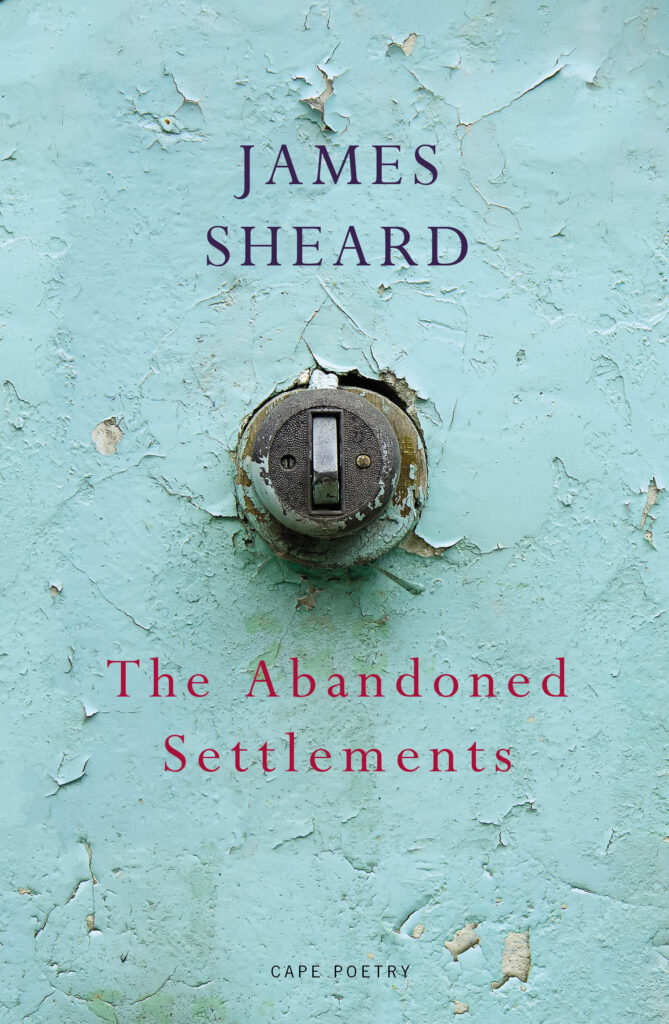
James Sheard’s The Abandoned Settlements 'views loss and change through the prism of place and space, and the result is painfully, exquisitely fragile', writes John Field
Be among the first to receive updates on the latest T. S. Eliot Prize news by subscribing now!
James Sheard’s The Abandoned Settlements ‘views loss and change through the prism of place and space, and the result is painfully, exquisitely fragile’, writes John Field
When moving house, the child’s bedroom ceases to function as castle keep. Those gaudy walls, emblazoned with animals, are no longer totems. Stripped of furniture and the ephemera of childhood, it’s just another set of scarred walls and the mural forest scene is either tawdry, or pathetic. James Sheard’s The Abandoned Settlements views loss and change through the prism of place and space, and the result is painfully, exquisitely fragile.
Sheard’s opening poem, ‘Line Break’, states that: ‘We’re all pilgrims. We’re all / more or less aware of that’. ‘Pilgrims’ makes itinerants of us all and, perhaps, implies a quest for religious enlightenment. Reminding the reader that everyone is just passing through works against the fallacies of stability and permanence architecture offers us. Perhaps the poem’s brevity – a single couplet – also echoes our transitoriness.
Over the page, and we reach the collection’s title poem: ‘Think of it like this. The spine you once caressed / is the bony turf at Wharram, the only thing left / of the walls that held you, the hearth that warmed you.’ Yorkshire’s Wharram Percy was possibly abandoned as rising wool prices in the late Middle Ages reshaped agriculture, and love, bones and buildings find their locus in that place. The poem reads as a litany, as abandoned places are memorialised and achieve a saintly immortality – an immortality heightened by the referencing of towns like Oradour, site of a massacre by the Nazis in 1944. However, thrillingly, Sheard recognizes that love ‘walks towards us / in a stranger’s body. How it sets itself in high memorial / above the utter transformation of our lives. Love, that is: // For love exists, and then is ruined, and then persists.’ Sheard’s poem breaks with its tercet form to ring the changes for that final statement and the internal rhyme ‘exists, ‘persists’ emphasises the haunting, redemptive possibilities of any moment, no matter how bleak it may first appear.
‘White Roses’ explores a different sort of abandonment, as a room has been abandoned recently: ‘Well, I know what it’s like: / you have been walking your room, // sniffing at your white roses / and shivering. There is a sip // of almond liquor in a glass / on your desk, and a note’. ‘Walking your room’ perhaps suggests a sense of confinement and the ‘almond liquor’ and ‘note’ hint at suicide and the titular white rose taken on funereal connotations.
‘Shadow Self’ offers a more uncanny, Gothic sense of haunting, as ‘He’s living it, / your shadow self. / He owns your flat / and fucks your wife.’ Sheard’s third person narrative creates a sense of observation and paranoia, and the poem’s iambic dimeter and repetition create an obsessive relentlessness.
‘Dedication’ knits sensuality and architecture as the poem visits a temple – perhaps in India – decorated with scenes from the Kama Sutra, or another text of physical love: ‘You are scattered about the stone temples – / made of poor-fired clay, or carved / from soft rock’. At one level, the poem’s ‘you’ is dead already, and the scattering is a reminder of mortality but the scattering of clay and soft rock figures makes these figures uncanny too. God breathed life into Adam’s clay and the softness of the rock renders it fleshy – the common bonds of humanity unite the species as Sheard’s lyric poem delivers its own hymn of longing and desire.
The Abandoned Settlements is a beguiling collection. Working with restraint, Sheard’s empty space and short lines are as eloquent as the broken stones of a ruin yet, when he lets fly, the collection pulses with erotic energy.
James Sheard’s The Abandoned Settlements (Cape Poetry) is shortlisted for the T. S. Eliot Prize 2017. John Field blogs at Poor Rude Lines.
Be among the first to receive updates on the latest T. S. Eliot Prize news by subscribing now!