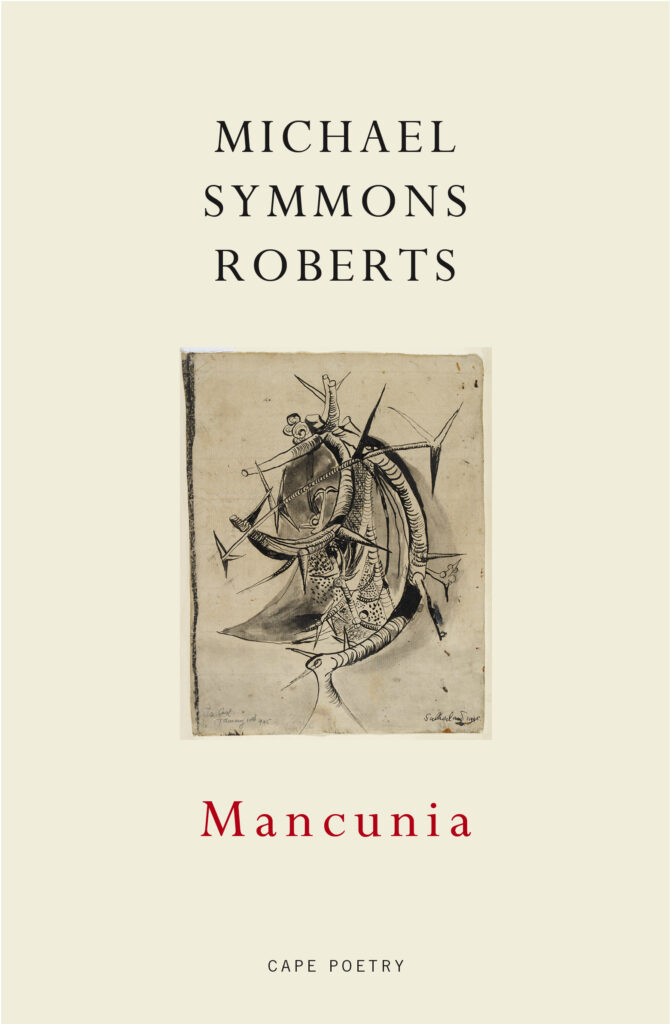

Mancunia

Cape Poetry
MichaelSymmonsRobertscUrszulaSoltys_bw
Michael Symmons Roberts was born in Preston, Lancashire, and spent his childhood in Lancashire. He now lives near Manchester. His eight poetry collections have all been published by Cape Poetry and include Corpus (2004), which was the winner of the 2004 Whitbread Poetry Award, and was shortlisted for the T. S. Eliot Prize, the Forward Prize for Best Collection and...

Review

Review

Michael Symmons Roberts's Mancunia explores the post-industrial identity crisis of urban spaces and of those who live in them, writes John Field. 'Yet, at the same time, Symmons Roberts sees a timeless optimism in the human spirit, that the utopian ambitions of our forbears live again through us'

Videos

Michael Symmons Roberts reads from Mancunia at the T. S. Eliot Prize Shortlist Readings
Michael talks about his work
Michael Symmons Roberts reads ‘What’s Yours is Mine’
Michael Symmons Roberts reads ‘Mancunian Miserere’
Michael Symmons Roberts reads ‘Barfly’

Related News Stories

  The T. S. Eliot Foundation is delighted to announce that this year’s winner of the T. S. Eliot Prize 2017 is Ocean Vuong for his remarkable debut collection Night Sky with Exit Wounds, published by Cape Poetry. After months of reading and deliberation, Judges W. N. Herbert (Chair), James...
To mark the 25th anniversary of the T. S. Eliot Prize, the T. S. Eliot Foundation has increased the winner’s prize money to £25,000. Judges W. N. Herbert (Chair), James Lasdun and Helen Mort have chosen the Shortlist from a record 154 poetry collections submitted by publishers. Tara Bergin, The...
Review of Mancunia

Michael Symmons Roberts’s Mancunia explores the post-industrial identity crisis of urban spaces and of those who live in them, writes John Field. ‘Yet, at the same time, Symmons Roberts sees a timeless optimism in the human spirit and the utopian ambitions of our forbears live again through us’

Michael Symmons Roberts’ Mancunia tours dive bars and patches of wasteland; it swoops from the refugee shanty towns of modern geo-political displacement, down through sedimentary layers and back in time to the Roman fort of Mancunium. Mancunia explores identity and belonging, setting contemporary social concerns against the backdrop of history, acknowledging that there is nothing new under the sun.

‘Acteon’ highlights the unchanging nature of all things, as Acteon, the Classical peeping Tom, is recast: ‘Between back-to-backs along the alleys / he lifts wrung-out sheets / and shirts hung up to dry, / in search of a repeat // glimpse of a goddess out to get / a tan’. An iambic trimeter pulses at the heart of the poem, endowing a scene played out along a row of terraced housing with a Greek gravitas. We are invited to look again at Acteon’s hunting hounds and recognize that the dangers posed by status dogs are nothing new.

‘American Pit Bull’ recasts dog as victim as the speaker encounters one ‘caged in the unclaimed baggage area / of Terminal Two in August heat’ and knows that the dog’s ‘denouement will come / in some dank warehouse with a mob’. Globalization presses in on Manchester as wars overseas and international crime push in on the city’s liminal spaces.  The Pit Bull’s ‘blood-line / served to bind him to his purpose’ and this metaphor for heredity becomes a physical leash, suggesting that we are slaves to our nature. However, the speaker, like Coleridge’s Ancient Mariner, drifts from shore ‘as with each succession mine / has cut me further loose’ and articulates the tension between growing apart from one’s community and being ostracized from it.

In ‘The Value of Nothing’, ‘Two white dogs tear into each other / in a sunlight square, over nothing more // than a marbled twist of gristle’, slaves to their nature. It would be too easy to sneer at these dumb animals, risking life and limb over something so worthless but the poem resists this urge: they fight over ‘a marbled twist’. The gristle is aestheticized, and the reader too sees its desirability. The poem’s focus broadens to the trinkets of courtship: ‘My hunch is that their true fault lay / in thinking they could change their destiny // with amethysts as amulets, deep Russian, / dark as plum-blood, worth a fortune’. Symmons Roberts’s humanity is no more rational than the other animals and the smug divisions between species and ethnicities are questioned.

Tackling the Syrian refugee crisis, ‘In Paradisum’ presents Manchester as heaven for those prepared to travel the hard miles to ‘our city’ and the possessive pronoun warns of territorialism. Citizens ‘slow our cars past them as a mark of respect’ but it looks more like rubbernecking. The poem forces us to take an uncomfortable look at a human nature that struggles to see people as people unless a narrative can be associated with them: ‘the one in the Brazil shirt becomes Paulo, / and the one in the blue smock his cousin Lily.’ The poem closes as the warm, fuzzy dream of Paulo and Lily is banished by ‘some fox in a bin’ and the suspected nocturnal raids of animals presents suburbia as fearful, net curtain twitching Nimbies.

Mancunia is a collection for our times. Post-industrialism has created an identity crisis: both for urban spaces and for those who lived in them. Yet, at the same time, Symmons Roberts sees a timeless optimism in the human spirit, that the utopian ambitions of our forbears live again through us.

Michael Symmons Roberts’s Mancunia (Cape Poetry) is shortlisted for the T. S. Eliot Prize 2017. John Field blogs at Poor Rude Lines.

Mancunia
Cape Poetry

Newsletter

Be among the first to receive updates on the latest T. S. Eliot Prize news by subscribing now!


The T. S. Eliot Prize on Social Media

Part of tseliot.com

Designed by thinking

Interview of Mancunia

Mancunia
Cape Poetry

Newsletter

Be among the first to receive updates on the latest T. S. Eliot Prize news by subscribing now!


The T. S. Eliot Prize on Social Media

Part of tseliot.com

Designed by thinking