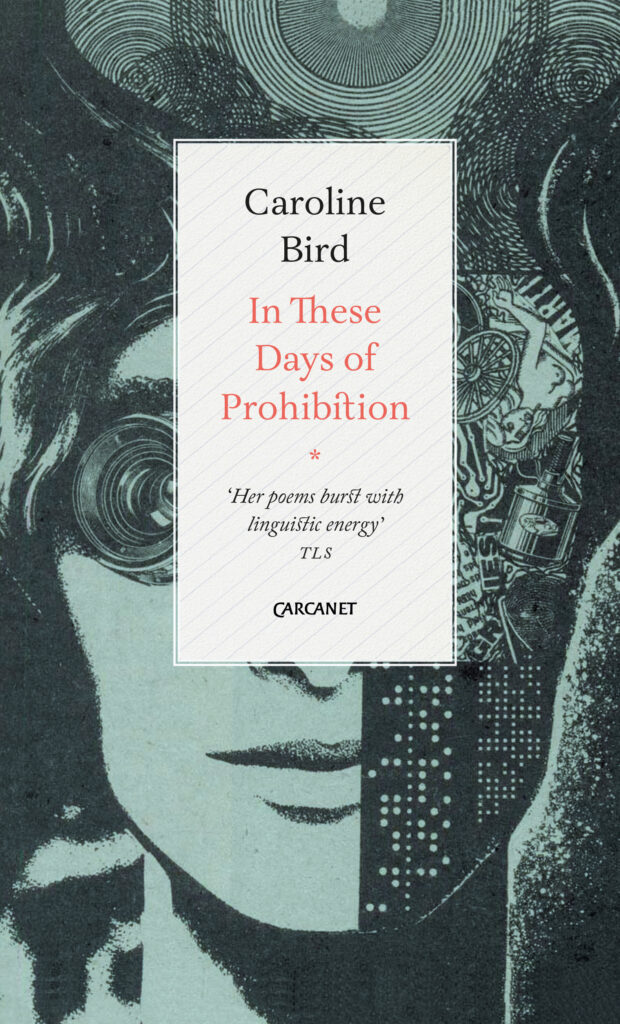

In These Days of Prohibition

Carcanet Press
Bird_Caroline_bw CROP
Caroline Bird was born in 1986 and grew up in Leeds before moving to London in 2001. She won an Eric Gregory Award in 2002 and the Foyle Young Poet of the Year Award in 1999 and 2000. Caroline has had numerous collections of poetry published by Carcanet, including Looking Through Letterboxes (published in 2002 when she was only 15),...

Review

Review

The poems in Caroline Bird's In These Days of Prohibition are profoundly disquieting, exploring obsession, hedonism and anxiety, writes John Field

Videos

Caroline Bird reads from In These Days of Prohibition at the T. S. Eliot Prize Shortlist Readings
Caroline Bird reads ’48 Veneer Avenue’
Caroline Bird reads ‘Patient Intake Questionnaire’
Caroline Bird reads ‘Megan Married Herself’
Caroline Bird talks about her work

Related News Stories

  The T. S. Eliot Foundation is delighted to announce that this year’s winner of the T. S. Eliot Prize 2017 is Ocean Vuong for his remarkable debut collection Night Sky with Exit Wounds, published by Cape Poetry. After months of reading and deliberation, Judges W. N. Herbert (Chair), James...
To mark the 25th anniversary of the T. S. Eliot Prize, the T. S. Eliot Foundation has increased the winner’s prize money to £25,000. Judges W. N. Herbert (Chair), James Lasdun and Helen Mort have chosen the Shortlist from a record 154 poetry collections submitted by publishers. Tara Bergin, The...
Review of In These Days of Prohibition

The poems in Caroline Bird’s In These Days of Prohibition are profoundly disquieting, exploring obsession, hedonism and anxiety, writes John Field

The collection, its epigraph taken from John Ashbery’s ‘The Problem of Anxiety’, plays with absence from the outset: ‘Suppose this poem were about you – would you / put in the things I’ve carefully left out?’ Caroline Bird’s ‘A Surreal Joke’ opens with the end-stopped statement: ‘One year is blank on my curriculum vitae’, reminding us how difficult life can be in a society predicated on uninterrupted work – keeping one’s nose clean. Bird’s speaker says ‘I was in the desert, convalescing, repairing my septum. I’d tried to die / expensively dragging it out over six months, locked in my university / bathroom with a rolled-up scrap of canto.’ Bird’s technical control is a joy; the poem accelerates as the death is dragged out expensively, moving from end-stops and accented caesuras to excited enjambment. The expensive death suggests cocaine – so it’s fitting that Bird drags this out – line after line.

‘Patient Intake Questionnaire’ and ‘Star Vehicle’ pose question after unanswered question. ‘Patient Intake Questionnaire’ plays with the form of psychological diagnostic self-examination. Its imperatives demand responses and so, despite foregrounding the collection with Ashbery’s comment about material added by the reader, we are forced to engage with the questionnaire’s absurdity: ‘Do you peel bananas fearfully in case there is no banana inside?’ ‘Star Vehicle’ is more disturbing. This time, the poem is framed as requests, not demands. They start innocuously, and professionally: ‘Can I shoot you entirely in standard-definition digital video?’, but the poem darkens: ‘Can I shoot you suffocating inside a harp case? […] Can I shoot you shooting up? Can I shoot you shooting yourself?’ The list is exhausting. Some items, although excessive, suggest real relationships between artists and muses: ‘Can I shoot you every day for sixty-four years?’ is redolent of the relationship between the photographer Nobuyoshi Araki and his wife Yoko Aoki – whom he photographed obsessively until her death.

The collection satirises popular culture. In ‘Far From Civilisation’, ‘Gemma’s ankles were swollen / from the flight. She was ratty. / “I look like an elephant,” she said / through microscopic cheeks’. The line break forces the reader to consider, for a moment, that there might actually be something wrong with Gemma. Bird makes us wait for line two before delivering a satirical punch and exposing Gemma’s vacuous hyperbolous vanity. Perhaps Gemma, Jewel, Elle and Pixie are on a modelling shoot, but they could just as easily be on a ‘gap yah’ and the poem’s title oozes irony: our intrepid travellers may feel far from civilization but the reader is invited to draw other conclusions. ‘Stephanie’ cocks a similar snook: ‘She was eighteen, used “party” as a verb’. Tellingly, the Oxford English Dictionary’s first example of this meaning of the word is from the 1986 movie Bill & Ted’s Excellent Adventure. Bill and Ted were icons of youthful vacuity, yet it takes Stephanie, a Sally Bowles figure, to spy ‘the part worth saving in me’ suggesting that, despite it all, high culture and popular culture need one another.

The collection’s final part moves towards the light. In ‘Public Resource’, ‘There is a place called The Open / where brave people put things’, and, in ’The Amnesty’, ‘I surrender my weapons: / Catapult, Tears, Raincloud Hat, / Lip Zip, Brittle Coat, Taut Teeth / in guarded rows.’

In These Days of Prohibition takes a hard look at contemporary society but is, ultimately, uplifting. If Brett Easton Ellis wrote poems, I’d like to think they’d be poems like these.

Caroline Birds’s In These Days of Prohibition (Carcanet) is shortlisted for the T. S. Eliot Prize 2017. John Field blogs at Poor Rude Lines.

In These Days of Prohibition
Carcanet Press

Newsletter

Be among the first to receive updates on the latest T. S. Eliot Prize news by subscribing now!


The T. S. Eliot Prize on Social Media

Part of tseliot.com

Designed by thinking

Interview of In These Days of Prohibition

In These Days of Prohibition
Carcanet Press

Newsletter

Be among the first to receive updates on the latest T. S. Eliot Prize news by subscribing now!


The T. S. Eliot Prize on Social Media

Part of tseliot.com

Designed by thinking