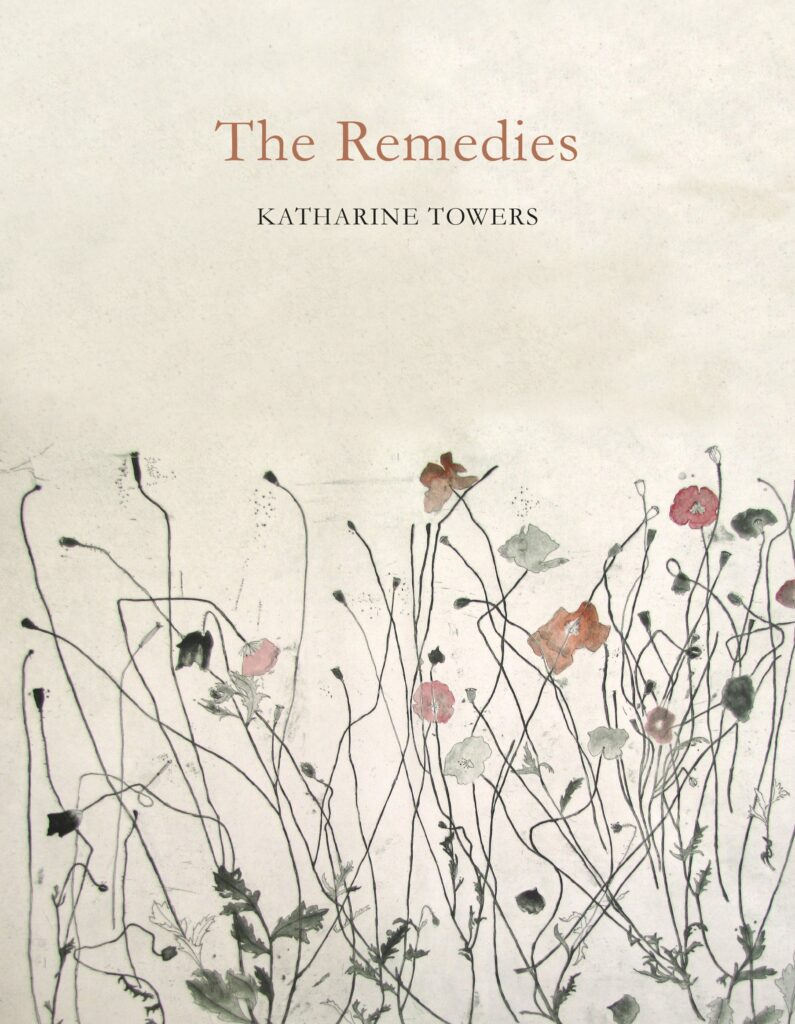

'The Remedies possesses the purity, the intensity of an essential oil and, in the darkness, Katharine Towers offers us light', writes John Field
Be among the first to receive updates on the latest T. S. Eliot Prize news by subscribing now!
The Remedies ‘possesses the purity, the intensity of an essential oil and, in the darkness, Katharine Towers offers us light’, writes John Field
These poems are as simple as simples (medicines made from a single herb or plant), as simple as the attack and decay of a musical note struck beautifully. Here, Katharine Towers showcases an exquisite lightness of touch and, using the simplest, purest of materials, her poems sing from the page.
Take ‘Daisies’, which opens: “We don’t wish to shout / or be brilliant or climb up walls / or hang from walls”. The daisies are voiced with a simple demotic and the perfect rhyme of walls / walls lends the poem further simplicity and innocence, as does the childlike character of the daisies. At this point, at the word ‘but’, we reach the poem’s single stanza break – and suddenly that guileless tercet begins to feel like a miniaturised octave and those innocent daisies, the flower of many a childhood, achieve a sagacity, “shyly shaking our heads / because we understand, yes truly we do”. Humble and unassuming the daisy might be, but this poem’s sonnet-like volta finds the classic beauty in the commonplace.
The collection’s second section, Flower Remedies, gives voice to plants used by Dr Edward Bach in his homeopathic remedies for states of mind. Towers suggests the homeopathic principles underlying Bach’s remedies by voicing each plant as the state of mind it supposedly works upon. This ‘physician heal thyself’ dimension also adds irony to the poems. ‘Willow’, we read, is a remedy for self-pity and the tree says “Don’t think that I weep. / I’m practising drowning.” The willow’s weighty statements, the finality of those end-stopped full stops conveys the character of the willow with the same confidence and deftness with which the daisies were invoked. In ‘Common Centaury’, a remedy for those who are too selfless, Towers writes in a rough iambic dimeter: “All summer long / I acquiesce – / a drudgery / of red and pink” and the brevity of these lines suggests that the plant can hardly bear to leave a mark on the page.
In its gentle way, the collection considers beauty, time, love and loss and the note sounded by one poem is as likely to bounce off the next one as it is to resonate and the editing of the collection brings these oppositions to the fore. ‘So Beautiful it Must be True’ opens with an epigraph from the Minimalist composer, Arvo Pärt: “It’s enough if a single note is played perfectly”. The note, one of the smallest divisions of the ephemeral is incarnated as it “flew up and landed in your heart […] singing to itself and wanting only / to be left alone”. A note, internalised, becomes the essence of beauty but, on the facing page, in ‘Tinnitus’, the internal noise becomes “round-the-clock / back-chat of an irritated nerve”.
The lyrics in the final section put this simplicity to work on more personal subjects with touching effect and often with exceptional brevity. In ‘Midnight’ (for AE), Towers presents a couplet of couplets: “This darkness lit by one bird’s / threadbare song. // Let’s stand and listen, love. / No-one knows we’re gone”.
The Remedies possesses the purity, the intensity of an essential oil and, in the darkness, Katharine Towers offers us light.
Katharine Towers’s The Remedies (Picador Poetry) is shortlisted for the T. S. Eliot Prize 2016. John Field blogs at Poor Rude Lines.
Be among the first to receive updates on the latest T. S. Eliot Prize news by subscribing now!