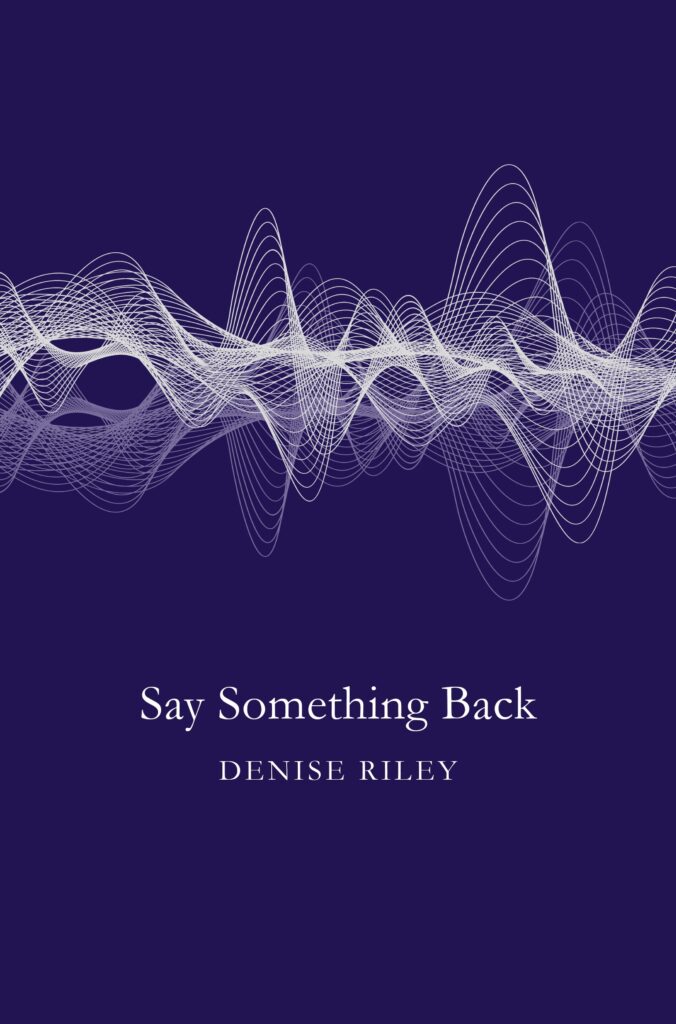

'Denise Riley's Say Something Back is a powerful collection and uses the poetry of the past to ventriloquize a history of mourning, adding sedimentary layers to its articulation of grief', writes John Field
Be among the first to receive updates on the latest T. S. Eliot Prize news by subscribing now!
Denise Riley’s Say Something Back ‘is a powerful collection and uses the poetry of the past to ventriloquize a history of mourning, adding sedimentary layers to its articulation of grief’, writes John Field
Though you are sitting in the warmth of home, curtains closed to the winter darkness, you can feel the hardness of the frost fingering the corners of the room. Denise Riley‘s Say Something Back has this quality – the void of the white page feels less like the canvas of possibility and more like the oppressive silence of oblivion as the collection explores grief and loss.
Riley opens with ‘Maybe; maybe not’, the title of which feels like a shoulder-shrugging skit on Hamlet’s existential crisis. Its irreverence continues as the opening line invokes Paul’s First Letter to the Corinthians – the wedding favourite – the Bible’s great paean to love. ‘When I was a child I spoke as a thrush, I / thought as a clod, I understood as a stone’. In Paul’s version, the child thinks like a child but perhaps Riley‘s thrush calls Keats’s ‘Ode to a Nightingale’ to mind – the nightingale (thrush) ‘wast not born for death’. Riley then references William Blake’s ‘The Clod and the Pebble’, where the clod aligns with Paul’s selfless vision of love while the pebble would bind another to its delight. Again, Riley offers us a maybe / maybe not as the poem effortlessly takes in a broad sweep of literary history in its brisk allusion. The speaker aligns with the clod’s selflessness but can ‘never / get it clear, down in the soily waters’ and within seven lines, the reader is left abandoned on the void of the white page with an image of confusion, blindness and drowning.
Having sounded this knell, the collection gets going in earnest with ‘A Part Song’, a sequence meditating upon love and loss. Part iv, another terse elegy employing the structure of ‘Maybe; maybe not’, opens ‘Each child gets cannibalised by its years’. Growing to maturity might be seen as a benign process but here it is presented as one of self-consuming violence. In this context, it suggests suicide – an act which not only removes a loved one, but demands a re-appraisal of every previous moment and memory: ‘But all at once / Those natural overlaps got cut, then shuffled / Tight in a block, their layers patted square’. The sequence stares, unflinching, into the abyss and refuses – mocks – conventional optimistic comfort, citing and rejecting lines from Mary Elizabeth Frye’s ‘Do not stand at my grave and weep’: ‘I can’t get sold on reincarnating you / As those bloody “gentle showers of rain” / Or in “fields of ripening grain” – oooh / Anodyne’.
The collection closes with ‘A gramophone on the subject’ – another exploration of loss, this time in the Great War. In ‘7 ‘He lies somewhere in France’. Somewhere’ the speaker asks ‘What can it mean, that someone walks / out of your house then they won’t come back ever’. The collection’s bookends universalise parental grief and the oozing mud of oblivion presented in the earlier poems is darkened with blood and violence here by association.
Say Something Back is a powerful collection and uses the poetry of the past to ventriloquize a history of mourning, adding sedimentary layers to its articulation of grief.
Denise Riley’s Say Something Back (Picador Poetry) is shortlisted for the T. S. Eliot Prize 2016. John Field blogs at Poor Rude Lines.
Be among the first to receive updates on the latest T. S. Eliot Prize news by subscribing now!